
Topic 3.6B
Sinusoidal Function Transformations
In 3.6A every sinusoid began its cycle at — at a maximum, at a minimum, or on the midline. Real data does not cooperate like that: high tide might arrive at 3 a.m., not at midnight. This note adds the last transformation, a horizontal shift, and uses it to write an equation for any sinusoid.
8 MIN READ5 IDEAS33 PROBLEMS14 flashcards
Read this first
30 sec
- 01
Read the phase shift from , never from + (something). Factor out first.
Phase Shift
Remember from 1.12: the graph of is the graph of moved units to the RIGHT, and the graph of is moved units to the LEFT. For a sinusoid, a horizontal translation has a special name: a phase shift.
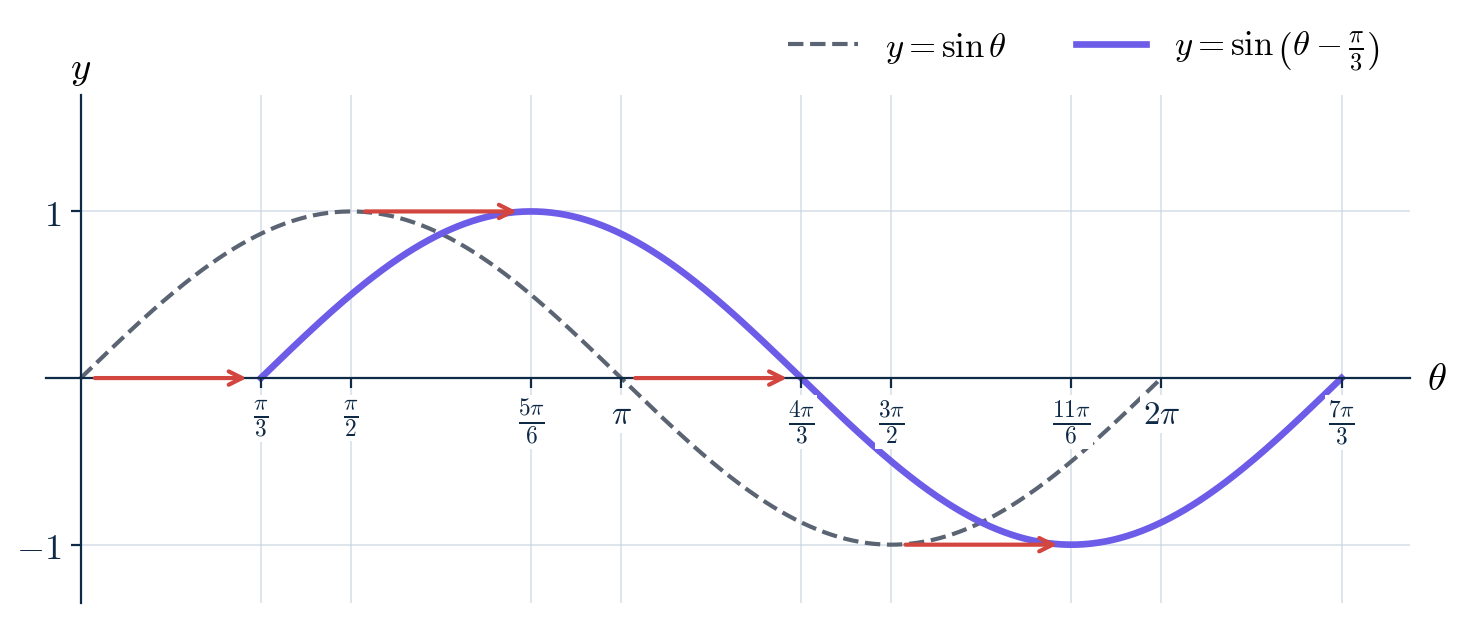
Every point of moves to the right.
In , the input has to be larger to produce the same output as before, so every feature — the zeros, the maximum, the minimum — arrives later. You have already met one phase shift: in 3.5, is the sine graph shifted to the left.
CONCEPT
The complete form
Every sinusoidal function can be written in one of these forms, where a, , , and are constants:
| Constant | Transformation | Effect on the graph |
|---|---|---|
| a | vertical dilation | amplitude |a| (reflected if a < 0) |
| b | horizontal dilation | period 2π/|b| |
| c | horizontal translation (phase shift) | left c units if c > 0; right |c| units if c < 0 |
| d | vertical translation | midline y = d |
COMMON MISTAKE
" moves the graph to the LEFT, because of the minus sign."
Horizontal shifts work opposite to the sign you see. The cycle begins when the expression inside the parentheses equals 0: gives , which is to the right.
Quick test for any equation: set the inside of the parentheses equal to 0 and solve. That is where the shifted cycle begins.
Factor Out b First
When , the phase shift is hidden. The shift is the amount added to itself, so must be factored out of the parentheses before you can read it.
Worked example
Example 1. For , find the amplitude, midline, period, and phase shift. Then sketch one period.
- 01
Factor 3 out of the input: . So the same function can be written as:
- 02
Read the constants: amplitude 2.5, midline , period , and a phase shift of to the RIGHT.
- 03
A sine graph with begins a cycle on its midline, going up. After the shift, that happens at instead of .
- 04
Step by a quarter period, , starting at : , , , , . Follow the pattern midline → max → midline → min → midline.
θ π/4 5π/12 7π/12 3π/4 11π/12 y −1 1.5 −1 −3.5 −1 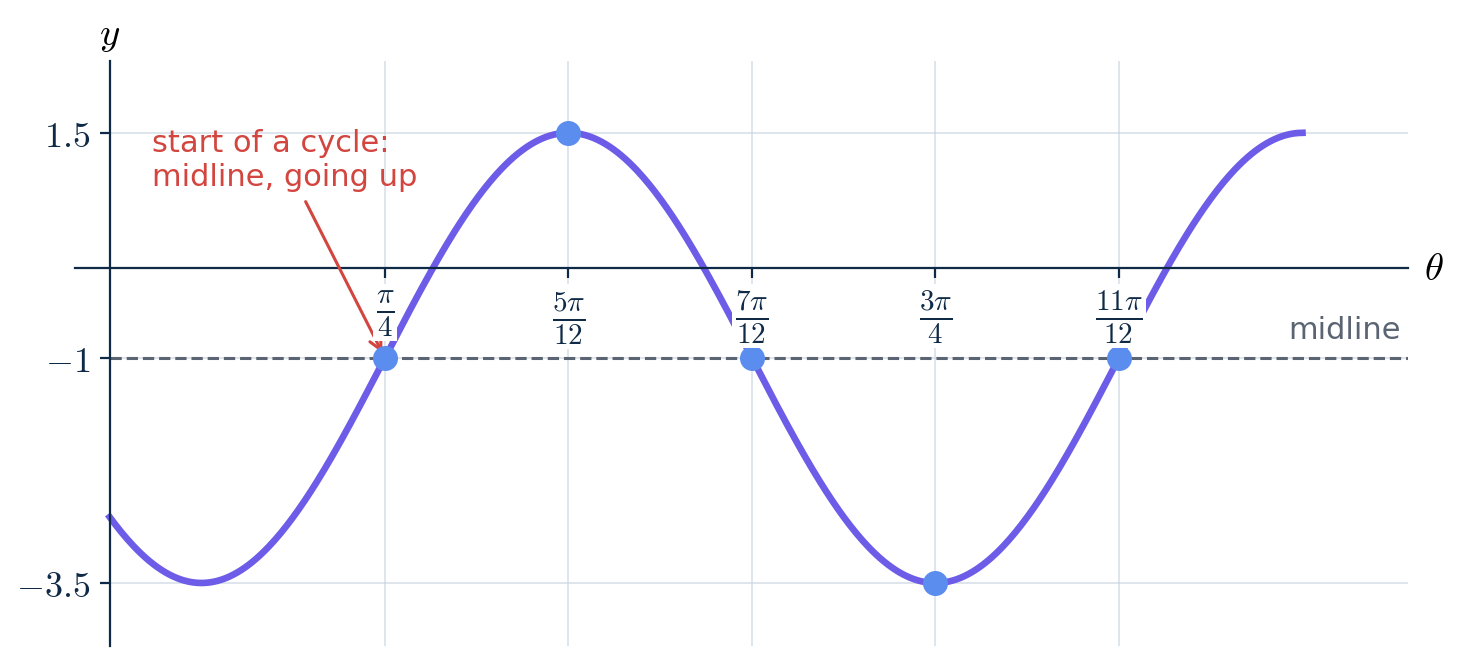
One period of begins at .
COMMON MISTAKE
"The phase shift of − 1 is to the right."
is the shift of the whole input , not of . Factoring gives , so only has to move . Check: at , the input is ✓, so the cycle starts there.
If you used , you would place the start of the cycle exactly where the graph actually reaches its minimum, −3.5.
KEY RULE
Read the phase shift from , never from + (something). Factor out first.
Quick check
What is the phase shift of ?
Writing an Equation from a Graph
Remember Example 2 from 3.5: a sinusoidal function has a minimum at and its next maximum at . We found the midline , amplitude 6, and period 10, so . Now we can finish the job — and discover that there is more than one right answer.
Worked example
Example 2. Write an equation for .
- 01
Choose a key point to be the start of your cycle. Each choice leads to a different — but correct — equation.
- 02
Start at the minimum . A cosine that starts at a minimum has (3.6A); shift it right 2: .
- 03
Start at the maximum . A cosine with , shifted right 7: .
- 04
Start on the midline going up, which happens halfway between the minimum and the maximum, at . A sine with , shifted right 4.5: .
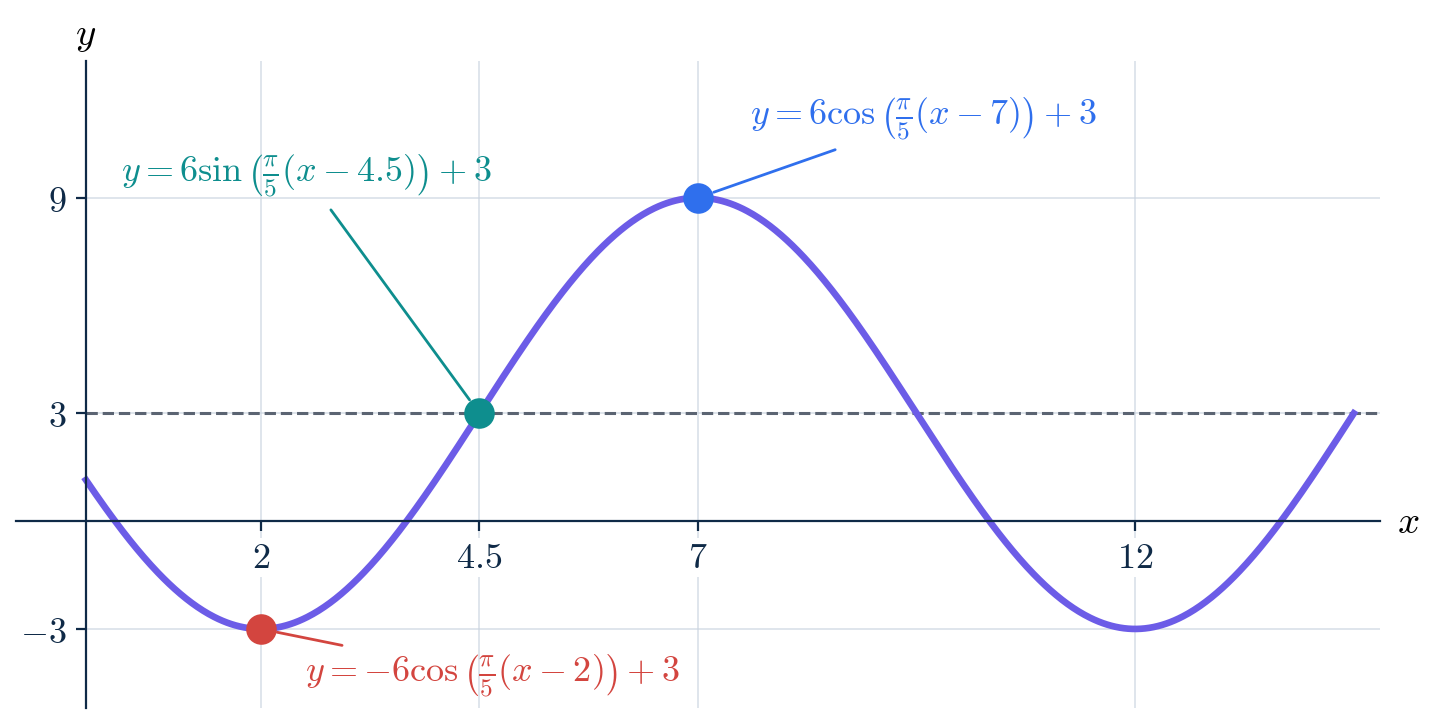
Three different starting points, three correct equations for the same graph.
All three equations produce exactly the same graph. On a free-response question, any correct equation earns credit, so choose whichever key point is easiest to read.
COMMON MISTAKE
"The maximum is at , so ."
A shift to the right by 7 is written . With the graph moves LEFT instead, and , not 9.
Always test your equation at the point you started from: it must give the correct output.
Quick check
A sinusoid has a minimum of at and its next maximum of at . What is its period?
Modeling Periodic Data
REAL-LIFE EXAMPLE
Tides at a fishing pier
The water depth at a pier rises and falls with the tides. One morning the depth reaches a high of 4.6 meters at 3:00 a.m. and falls to its next low of 1.0 meter at 9:12 a.m.
Let be the number of hours after midnight, so 3:00 a.m. is and 9:12 a.m. is .
Worked example
Example 3. Write a sinusoidal model for the depth. Use it to estimate the depth at noon, and decide whether the water is rising or falling then.
- 01
Midline: . Amplitude: .
- 02
High tide to the next low tide is half a period: hours. So the period is 12.4 hours, and .
- 03
Start the cycle at high tide, : a cosine with , shifted right 3. .
- 04
Noon is : meters. If you round to 0.507 first, you get instead. Both round to about 2.53 m, but they already differ in the third decimal place — so keep exact (or store it in your calculator) until the final step.
- 05
Low tide was at , and the next high tide comes half a period later, at . Noon lies between them, so the water is rising.
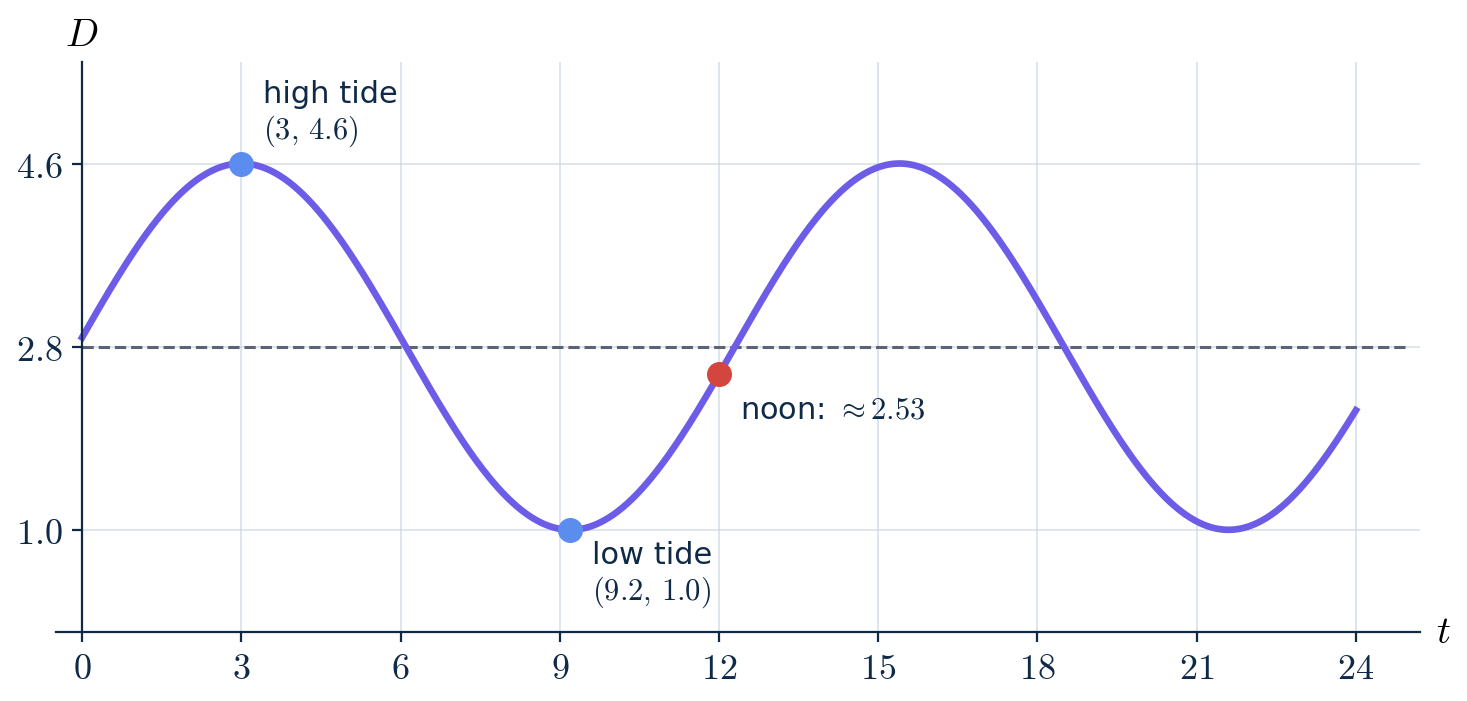
over one day.
Common slips
" moves the graph to the left, because of the minus sign."
Horizontal shifts work opposite to the sign you see. The cycle begins when the expression inside the parentheses equals 0: gives , which is to the right.
Quick test for any equation: set the inside of the parentheses equal to 0 and solve. That is where the shifted cycle begins.
"The phase shift of − 1 is to the right."
is the shift of the whole input , not of . Factoring gives , so only has to move . Check: at , the input is ✓, so the cycle starts there.
If you used , you would place the start of the cycle exactly where the graph actually reaches its minimum, −3.5.
"The maximum is at , so ."
A shift to the right by 7 is written . With the graph moves left instead, and , not 9.
Always test your equation at the point you started from: it must give the correct output.
Lock it in
Try the flashcards
14 cards · Sinusoids, Sine or cosine graph?
Recap card
6 lines to re-read the night before.
- 01
A phase shift is a horizontal translation. In , the graph shifts left units (right if is negative).
- 02
The cycle begins where the inside of the parentheses equals 0.
- 03
Factor out before reading the shift: is a shift of , not .
- 04
A sinusoid has many correct equations: start the cycle at a maximum, a minimum, or a midline crossing.
- 05
Check any equation at the point you started from, and keep exact until the last step to avoid rounding errors.
- 06
Coming up in 3.7: fitting sinusoidal models to real data.