
Topic 3.3
Sine and Cosine Function Values
In 3.2B we learned that the terminal ray of meets the unit circle at the point . For most angles, those coordinates are messy decimals that need a calculator. But for a handful of special angles — multiples of and — we can find the exact values using nothing more than the Pythagorean theorem and symmetry. These angles appear again and again in the rest of the course, so this note builds them from scratch rather than asking you to memorize a chart.
11 MIN READ5 IDEAS33 PROBLEMS5 flashcards
Read this first
30 sec
- 01
Quadrant → reference angle (to the x-axis) → Quadrant I value → attach the sign.
The Angle π/4
Halfway between the positive x-axis and the positive y-axis, the terminal ray of splits the first quadrant exactly in half. That ray lies on the line , so the point where it meets the unit circle has equal coordinates.
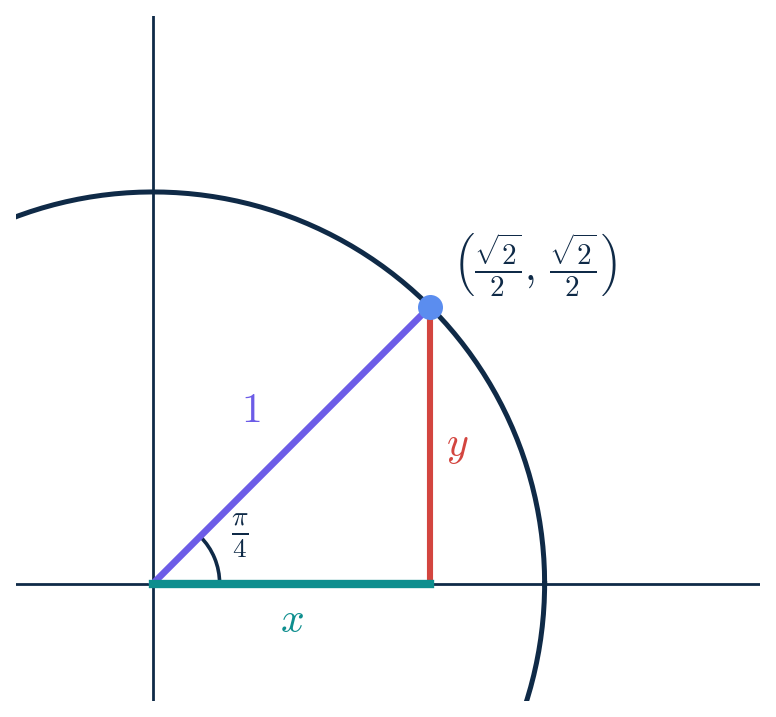
At the two legs are equal: .
Worked example
Example 1. Find the exact values of and .
- 01
lies on the line , so its coordinates are equal: .
- 02
is on the unit circle, so becomes , or , so .
- 03
Taking the square root gives TWO answers: or . is in Quadrant I, where , so reject the negative root: .
- 04
So P = (, ), which means and .
You may also see this value written as . The two forms are equal: multiply the top and bottom of by to get .
COMMON MISTAKE
", so . Done."
An even power always has two square roots. is also true for — and that negative root is not garbage. It is the x-coordinate of the point at and at .
Always write both roots, then use the quadrant to decide which one belongs to the angle you want. That habit is exactly what lets us fill in the other quadrants in Section 3.
The Angles π/6 and π/3
For we need one clever idea: reflect across the x-axis to get a point P′ at . The angle between the two rays is .
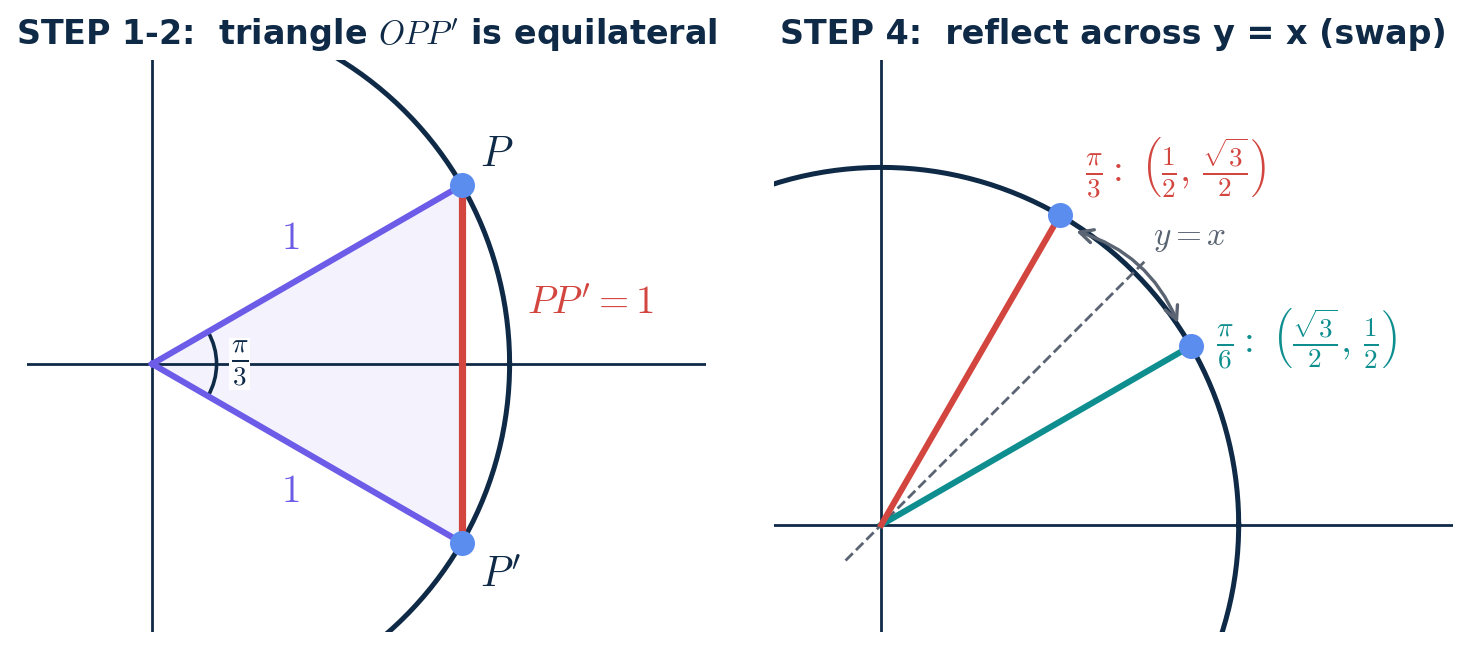
Left: triangle OPP′ is equilateral, so PP′ = 1. Right: swapping the coordinates gives the point for .
Worked example
Example 2. Find the exact values of , , , and .
- 01
Triangle OPP′ has two sides of length 1 (both are radii) and the angle between them is , which is . A triangle with two equal sides and angle between them is equilateral, so all three sides are 1: PP′ = 1.
- 02
PP′ is split in half by the x-axis, so sits halfway up: . That gives .
- 03
Use the unit circle: , so and or . is in Quadrant I, so . That gives .
- 04
The ray for is the mirror image of the ray for across the line , because is away from the y-axis just as is away from the x-axis. Reflecting across swaps the coordinates: and .
The first-quadrant values
Putting Sections 1 and 2 together with the quadrantal angles from 3.2B gives every value we need in Quadrant I:
| θ | 0 | π/6 | π/4 | π/3 | π/2 |
|---|---|---|---|---|---|
| cos θ | 1 | √3/2 | √2/2 | 1/2 | 0 |
| sin θ | 0 | 1/2 | √2/2 | √3/2 | 1 |
Read the table as a story: as the terminal ray rises from the x-axis toward the y-axis, the point moves left and up. So can only decrease from 1 to 0, and can only increase from 0 to 1.
COMMON MISTAKE
"."
Mixing up and is the most common error in this topic. Instead of memorizing which is which, picture the angle. is a small angle, so the terminal ray is close to the x-axis. The point is far to the right and not very high — so is the big value and is the small value .
For the ray is steep, close to the y-axis, so the roles flip: is big and is small.
Quick check
What is exactly?
Every Quadrant by Symmetry
Remember from 3.2B: reflecting a point across an axis or through the origin changes only the signs of its coordinates, never their sizes. So every special angle in Quadrants II, III, and IV borrows its values from a Quadrant I angle.
CONCEPT
Reference angle
The reference angle of is the acute angle between the terminal ray of and the nearest part of the x-axis.
The sine and cosine of have the same size as the sine and cosine of its reference angle. Only the signs can differ, and the quadrant decides them.
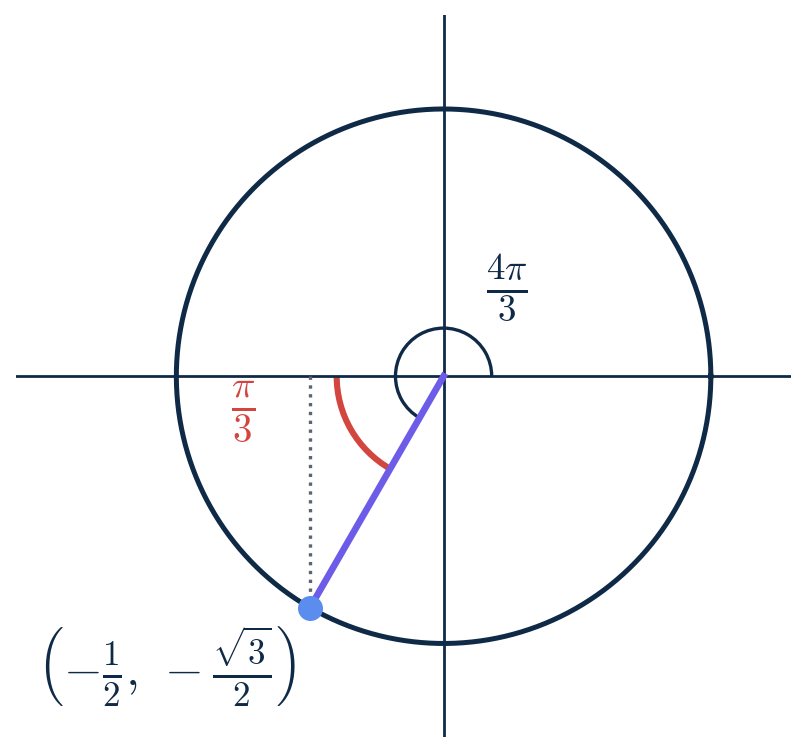
The terminal ray of is past the negative x-axis, so its reference angle is .
Worked example
Example 3. Find the exact value of .
- 01
Locate the angle: , so the terminal ray is in Quadrant III.
- 02
Find the reference angle: the ray is past the negative x-axis () by .
- 03
Use the Quadrant I value: .
- 04
Attach the sign: in Quadrant III, , so sine is negative. .
Worked example
Example 4. Find the exact values of and .
- 01
: first remove full turns (3.2A). , so .
- 02
is in Quadrant II with reference angle . , and cosine is negative in Quadrant II, so .
- 03
: add full turns until the angle is between 0 and . .
- 04
is in Quadrant IV with reference angle . , and sine is negative in Quadrant IV, so .
COMMON MISTAKE
"The reference angle of is , because the ray is away from the y-axis."
Reference angles are always measured to the x-axis, never the y-axis. The ray of is away from the negative x-axis, so its reference angle is , and .
Measuring to the y-axis swaps sine and cosine and gives the wrong value. If in doubt, check with the picture: is a steep ray, so its y-coordinate should be the big value, .
KEY RULE
Quadrant → reference angle (to the x-axis) → Quadrant I value → attach the sign.
The complete unit circle
Applying the same four steps to every multiple of and fills in the whole circle. You do not need to memorize this picture: if you know the first-quadrant table and the signs in each quadrant, you can rebuild any point in a few seconds.
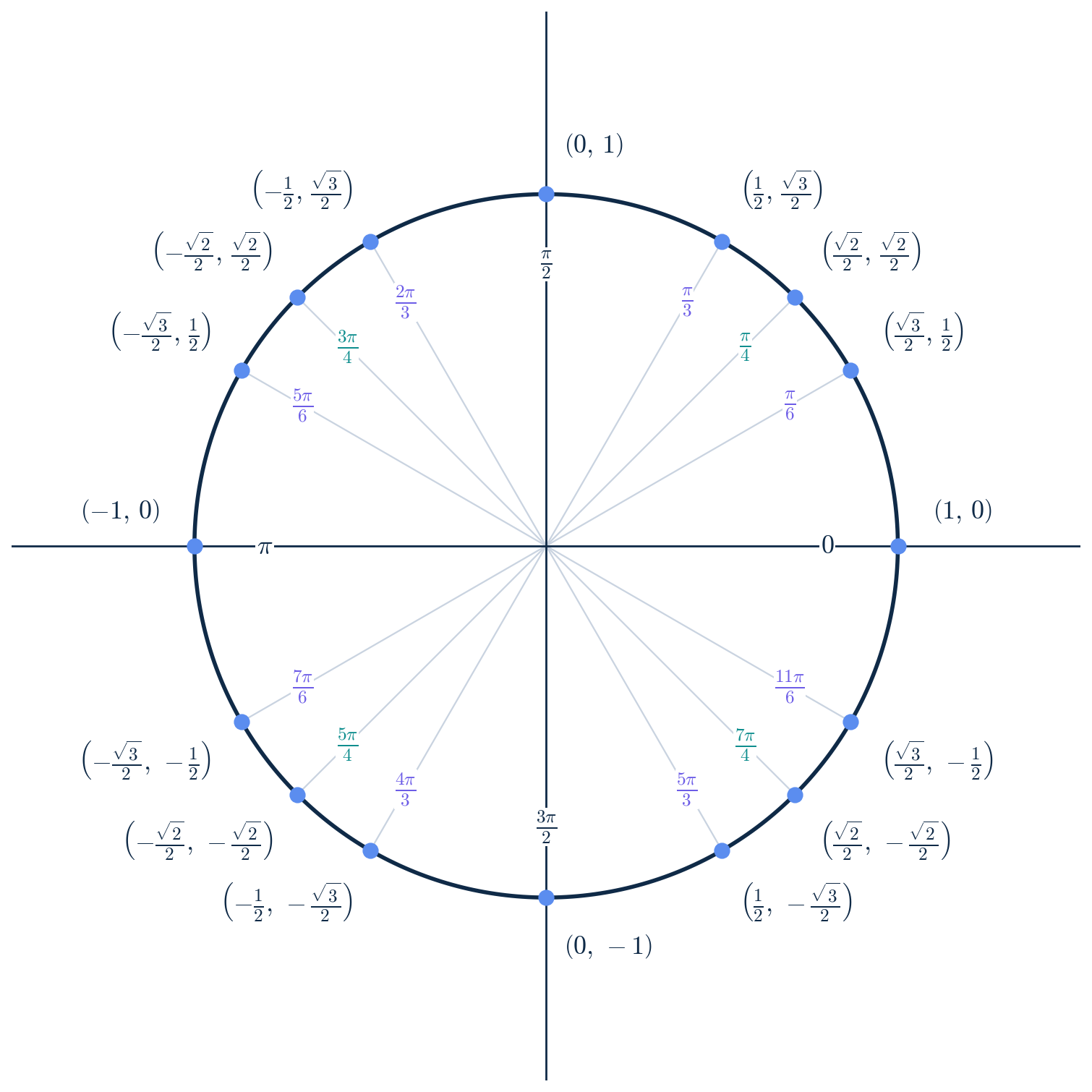
All multiples of (purple) and (teal). Each point is .
Quick check
What is exactly?
Points on Any Circle
On a circle of radius , 3.2B told us and . Multiply both equations by , and we get the coordinates of the point directly:
Worked example
Example 5. The terminal ray of meets a circle of radius 20 centered at the origin. Find the coordinates of the point of intersection.
- 01
is in Quadrant III with reference angle , so and .
- 02
Scale by the radius: and .
- 03
The point is (, ), which is about . Check: it is in Quadrant III, 20 units from the origin. ✓
Worked example
Example 6. The terminal ray of an angle , where , meets a circle centered at the origin at the point (−7, ). Find the radius and the angle .
- 01
The radius is the distance from the origin: .
- 02
Divide by : and .
- 03
Those values have the sizes of the row, so the reference angle is . Cosine is negative and sine is positive, so is in Quadrant II: .
COMMON MISTAKE
" and , so the point is (, )."
is the point on the UNIT circle. That point is only 1 unit from the origin, not 20. On a circle of radius , every coordinate must be multiplied by .
Quick check: the distance from the origin to your answer should equal .
REAL-LIFE EXAMPLE
Back to the bike pedal
In 3.1, the pedal was on a 17 cm crank whose center was 28 cm above the ground. Put the crank center at the origin and measure counterclockwise from the horizontal, pointing toward the front of the bike.
The pedal is at relative to the crank center, so its height above the ground is .
At (straight up), the height is cm — exactly the top value from the 3.1 table. At , the height is cm.
This is the bridge to 3.4: the height of a rotating point is a sine function of the angle.
Common slips
", so . Done."
An even power always has two square roots. is also true for — and that negative root is not garbage. It is the x-coordinate of the point at and at .
Always write both roots, then use the quadrant to decide which one belongs to the angle you want. That habit is exactly what lets us fill in the other quadrants in Section 3.
"."
Mixing up and is the most common error in this topic. Instead of memorizing which is which, picture the angle. is a small angle, so the terminal ray is close to the x-axis. The point is far to the right and not very high — so is the big value and is the small value .
For the ray is steep, close to the y-axis, so the roles flip: is big and is small.
"The reference angle of is , because the ray is away from the y-axis."
Reference angles are always measured to the x-axis, never the y-axis. The ray of is away from the negative x-axis, so its reference angle is , and .
Measuring to the y-axis swaps sine and cosine and gives the wrong value. If in doubt, check with the picture: is a steep ray, so its y-coordinate should be the big value, .
" and , so the point is (, )."
is the point on the unit circle. That point is only 1 unit from the origin, not 20. On a circle of radius , every coordinate must be multiplied by .
Quick check: the distance from the origin to your answer should equal .
Lock it in
Try the flashcards
5 cards · Unit circle
Recap card
6 lines to re-read the night before.
- 01
Special angles have exact values: and of , , and come from , , and .
- 02
comes from on the unit circle; comes from an equilateral triangle; comes from swapping the coordinates of .
- 03
When solving , write both roots and use the quadrant to choose.
- 04
Small angle → is the big value; steep angle → is the big value.
- 05
Reference angle: the acute angle to the nearest x-axis. Values keep their size; the quadrant sets the sign.
- 06
On a circle of radius , the point is .