
Topic 3.2B
Sine, Cosine, and Tangent
In 3.2A we placed angles in standard position and measured them in radians. Now we attach numbers to an angle. The terminal ray of every angle crosses a circle centered at the origin at exactly one point, and the coordinates of that point give three important values: the sine, cosine, and tangent of the angle.
9 MIN READ5 IDEAS32 PROBLEMS5 flashcards
Read this first
30 sec
- 01
follows . follows . is positive when and share a sign (Quadrants I and iii).
- 02
Related angles have the same-sized sine and cosine — only the signs change, based on the quadrant.
Three Ratios from One Point
CONCEPT
Sine, cosine, and tangent
Place an angle in standard position and draw a circle of radius centered at the origin. The terminal ray meets the circle at a point .
is the vertical displacement of from the x-axis divided by the distance from the origin to .
is the horizontal displacement of from the y-axis divided by the distance from the origin to .
is the slope of the terminal ray: the vertical displacement divided by the horizontal displacement.
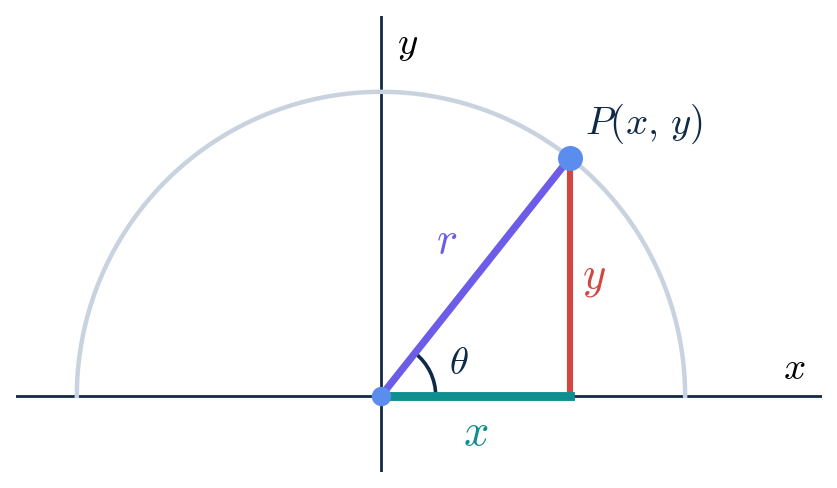
and are signed displacements. is a distance, so it is always positive.
In Quadrant I, , , and are the sides of a right triangle, so these are the same ratios you may know as SOH-CAH-TOA. The circle version is more powerful: it works in every quadrant, because and are allowed to be negative.
Why doesn't the size of the circle matter? Just like radian measure in 3.2A: a bigger circle stretches , , and by the same factor, so every ratio stays the same.
Worked example
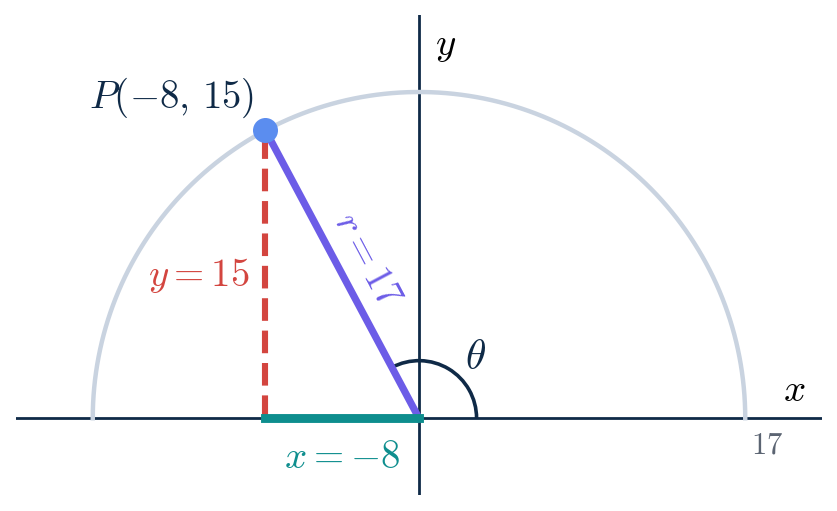
Example 1. The terminal ray of an angle in standard position passes through the point . Find , , and .
- 01
Find , the distance from the origin to , with the Pythagorean theorem: .
- 02
.
- 03
. The negative sign stays: is 8 units to the LEFT of the y-axis.
- 04
. Check: the terminal ray rises as it goes left, so its slope should be negative. ✓
Try a bigger circle: the same ray also passes through , which is 34 units from the origin. Then and — exactly the same values.
COMMON MISTAKE
", because lengths can't be negative."
is a distance, so it is always positive. But and are displacements — they carry a direction. is to the left of the y-axis, so its horizontal displacement is −8, and .
Dropping the sign would describe a point in Quadrant I, which belongs to a completely different angle.
Quick check
The terminal ray of meets the circle of radius at . What is ?
The Unit Circle
The simplest circle to use is the unit circle: the circle of radius 1 centered at the origin. With , the division disappears.
CONCEPT
Sine and cosine on the unit circle
If the terminal ray of meets the unit circle at , then and . In other words, the point itself is
Cosine comes first, just as comes first in . Since is y ÷ x, it can also be written using sine and cosine:
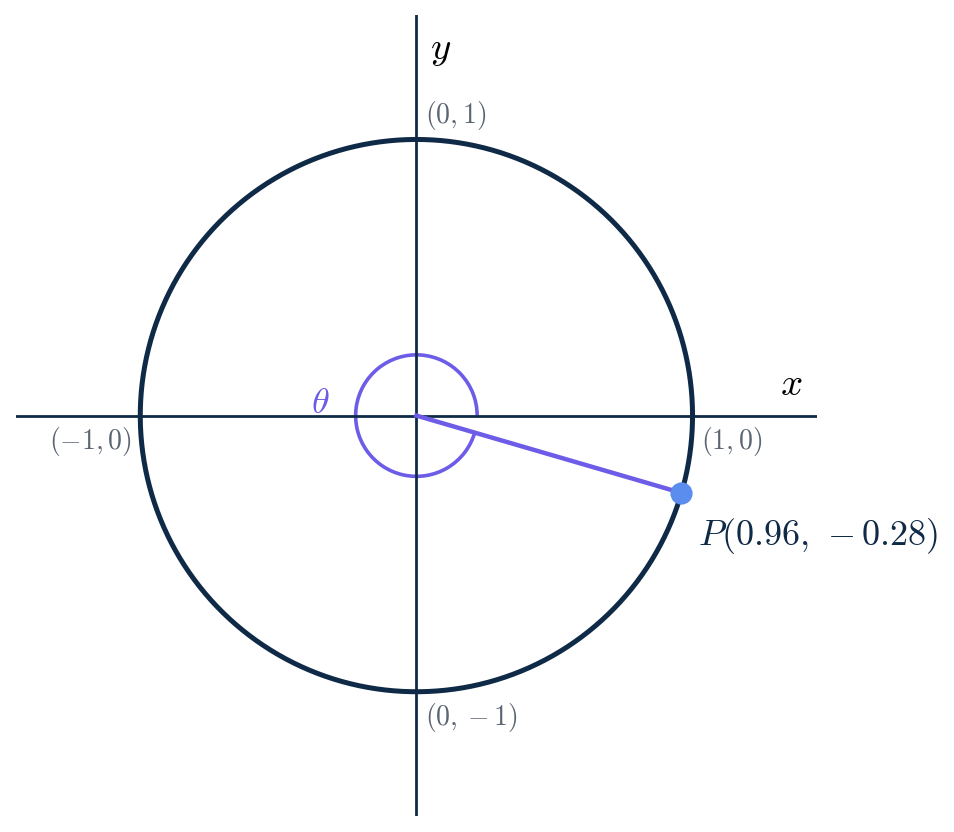
On the unit circle, the coordinates of are the cosine and the sine of .
Worked example
Example 2. The terminal ray of meets the unit circle at . Find , , and , and name the quadrant of .
- 01
On the unit circle, read the coordinates directly: and .
- 02
.
- 03
and , so the terminal ray lies in Quadrant IV.
Every point on the unit circle is exactly 1 unit from the origin, so neither coordinate can be bigger than 1 or smaller than −1. That means and for every angle . Tangent has no such limit: a steep terminal ray can have a very large slope.
The quadrantal angles
When the terminal ray lies on an axis, is one of the four points where the unit circle crosses the axes:
| θ | 0 | π/2 | π | 3π/2 |
|---|---|---|---|---|
| P | (1, 0) | (0, 1) | (−1, 0) | (0, −1) |
| cos θ | 1 | 0 | −1 | 0 |
| sin θ | 0 | 1 | 0 | −1 |
| tan θ | 0 | undefined | 0 | undefined |
COMMON MISTAKE
"."
At , , so — division by zero. The terminal ray is vertical, and a vertical line has no slope, so is undefined.
Compare : , so . A horizontal ray has slope 0. Zero on top gives 0; zero on the bottom gives undefined.
Signs in Each Quadrant
On the unit circle, is and is , so their signs come straight from the quadrant. And is positive exactly when and have the same sign.
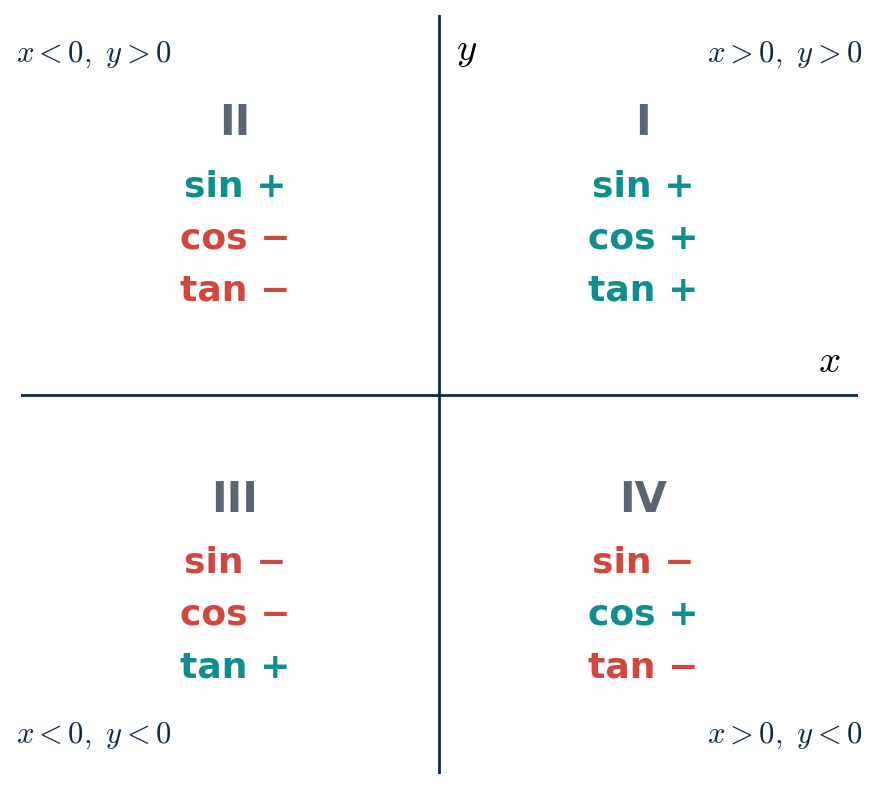
Signs of sine, cosine, and tangent in each quadrant.
KEY RULE
follows . follows . is positive when and share a sign (Quadrants I and III).
Worked example
Example 3. An angle satisfies and . In which quadrant is the terminal ray of ?
- 01
means , so is in Quadrant III or Quadrant IV.
- 02
means and have the same sign. Since , must also be negative.
- 03
and , so the terminal ray lies in Quadrant III.
Quick check
In which quadrant is and ?
Reflecting a Point on the Unit Circle
The symmetry of the circle turns one point into four. Suppose the terminal ray of meets the unit circle at P(, ) in Quadrant I. Reflecting across the axes produces three more points on the unit circle, each belonging to a related angle.
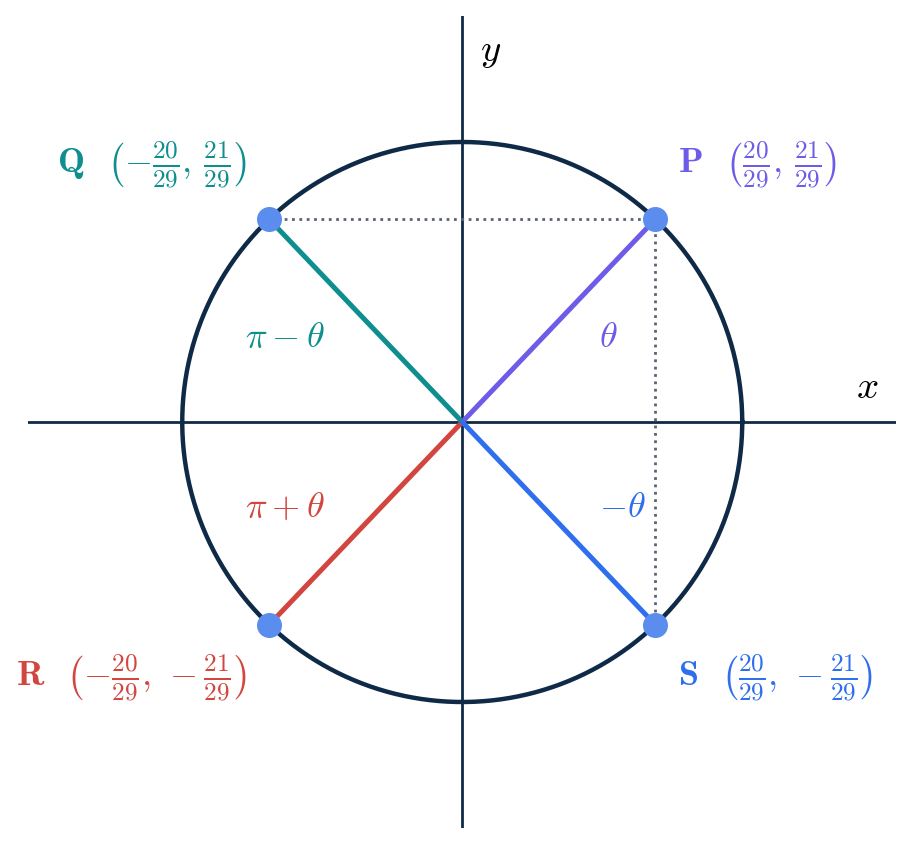
Reflections change the signs of the coordinates, never their sizes.
| Point | How it is made | Angle | cos | sin |
|---|---|---|---|---|
| P | original point | θ | 20/29 | 21/29 |
| Q | reflect P across the y-axis | π − θ | −20/29 | 21/29 |
| R | reflect P through the origin | π + θ | −20/29 | −21/29 |
| S | reflect P across the x-axis | −θ | 20/29 | −21/29 |
Why those angles? Reflecting across the y-axis makes the ray sit radians short of the negative x-axis, which is . Reflecting through the origin points the ray in exactly the opposite direction — half a turn more — which is . Reflecting across the x-axis reverses the direction of rotation, which is .
COMMON MISTAKE
"Q is the reflection across the y-axis, so change the sign of ."
Reflecting across the y-axis moves a point from the right side of the y-axis to the left side — so it is that changes sign, not . Q = (−20/29, ).
Quick check: the reflected point must land in the quadrant you expect. should be in Quadrant II, where and . ✓
KEY RULE
Related angles have the same-sized sine and cosine — only the signs change, based on the quadrant.
Common slips
", because lengths can't be negative."
is a distance, so it is always positive. But and are displacements — they carry a direction. is to the left of the y-axis, so its horizontal displacement is −8, and .
Dropping the sign would describe a point in Quadrant I, which belongs to a completely different angle.
"."
At , , so — division by zero. The terminal ray is vertical, and a vertical line has no slope, so is undefined.
Compare : , so . A horizontal ray has slope 0. Zero on top gives 0; zero on the bottom gives undefined.
"Q is the reflection across the y-axis, so change the sign of ."
Reflecting across the y-axis moves a point from the right side of the y-axis to the left side — so it is that changes sign, not . Q = (−20/29, ).
Quick check: the reflected point must land in the quadrant you expect. should be in Quadrant ii, where and . ✓
Lock it in
Try the flashcards
5 cards · Unit circle
Recap card
6 lines to re-read the night before.
- 01
If the terminal ray of meets a circle of radius at , then , , and .
- 02
and are signed displacements; is a distance and is always positive. The ratios do not depend on the size of the circle.
- 03
On the unit circle, and .
- 04
and . is undefined when the terminal ray is vertical.
- 05
follows the sign of , follows the sign of , and is positive in Quadrants I and iii.
- 06
Reflecting a point across an axis or through the origin gives the angles , , and , with the same-sized sine and cosine.