
Topic 3.2A
Sine, Cosine, and Tangent
In 3.1, the crank arm of a bike pedal spun around a center point, and the pedal's height followed a periodic pattern. To describe motion like that with a function, we first need a precise way to say how far something has turned. That is the job of this note: angles in the coordinate plane, and a new unit for measuring them called the radian. In 3.2B we will use these angles to define sine, cosine, and tangent.
8 MIN READ5 IDEAS31 PROBLEMS5 flashcards
Read this first
30 sec
- 01
. One full turn = radians. Half a turn = radians.
- 02
To locate an angle: add or subtract until it is between 0 and , then compare it with , , and .
Angles in Standard Position
CONCEPT
Standard position
An angle in the coordinate plane is in standard position when its vertex is at the origin and one of its rays lies along the positive x-axis.
That fixed ray is the initial ray. The ray that rotates away from it is the terminal ray.
Positive angles rotate counterclockwise from the initial ray. Negative angles rotate clockwise.
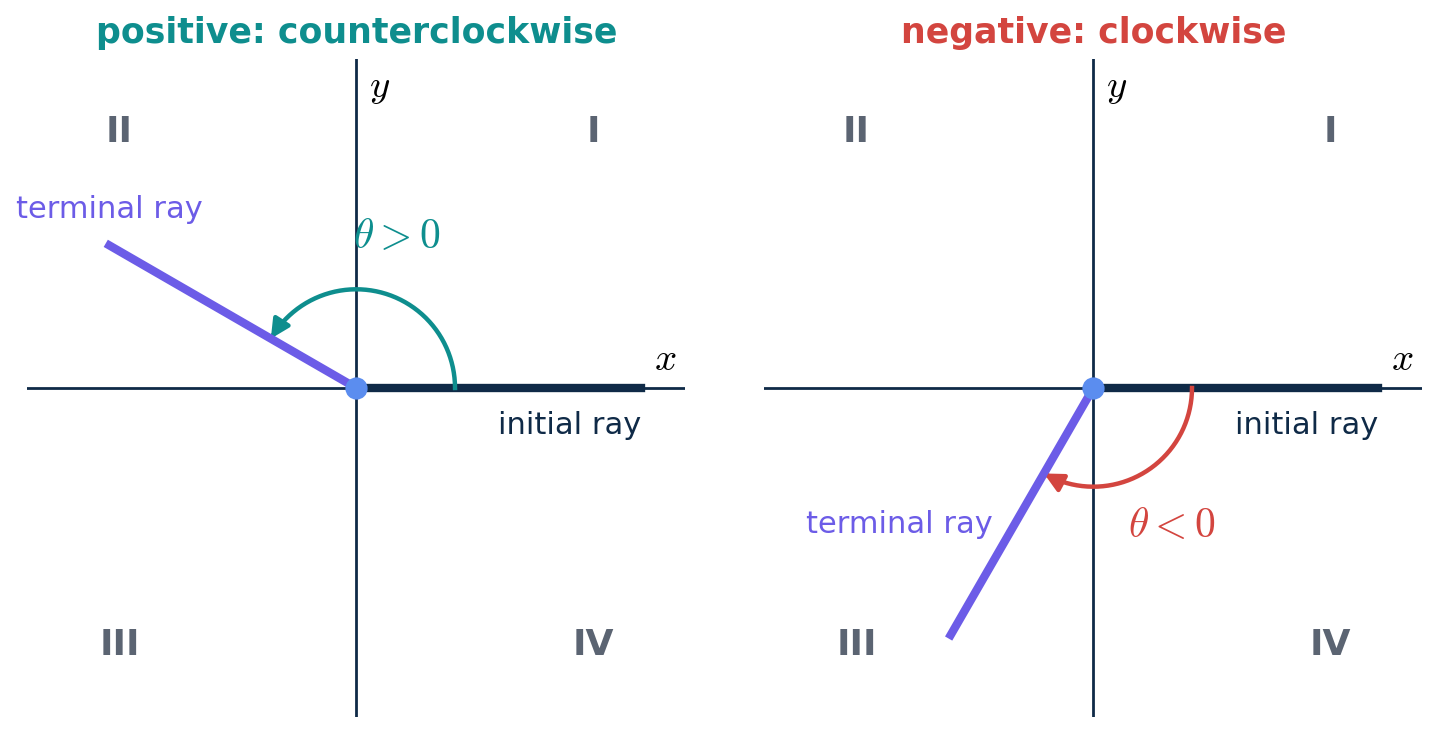
Both angles start on the positive x-axis. The sign tells you which way the terminal ray turned.
The axes split the plane into four quadrants, numbered I, II, III, and IV counterclockwise starting from the upper right. We will often describe an angle by naming the quadrant where its terminal ray lands.
Measuring Angles in Radians
You probably learned to measure angles in degrees, where one full turn is . The number 360 is a historical choice — nothing about a circle forces it. AP Precalculus and calculus use a unit that comes from the circle itself: the radian.
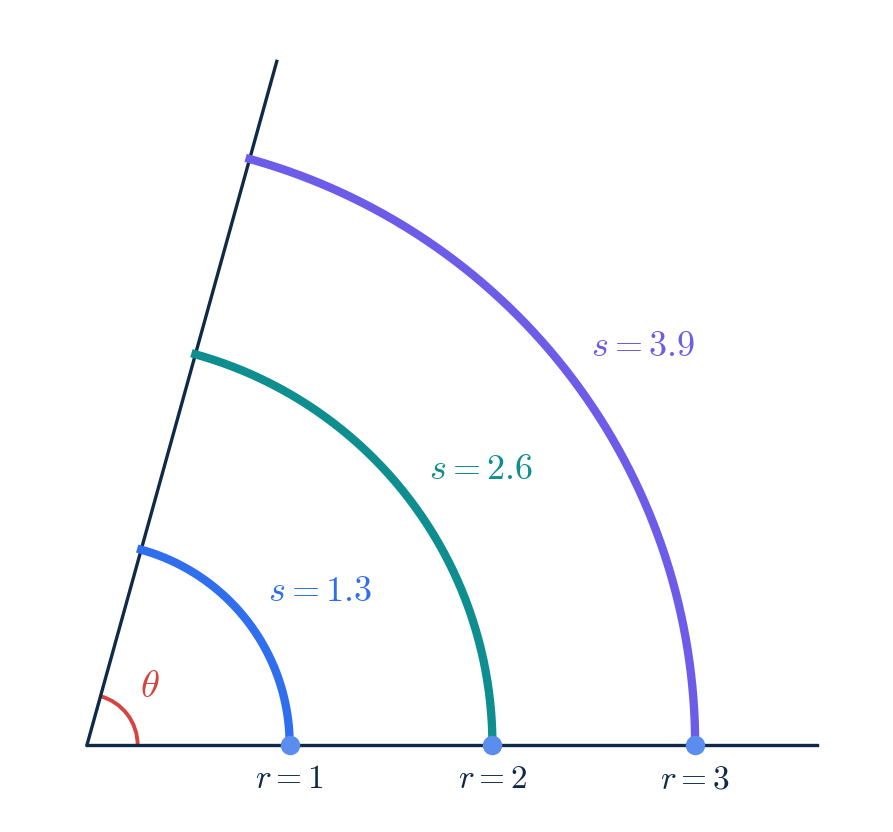
The same angle cuts off arcs of 1.3, 2.6, and 3.9 on circles of radius 1, 2, and 3. The arc grows with the radius, but s ÷ r stays 1.3.
CONCEPT
Radian measure
Draw a circle of radius centered at the vertex of the angle. If the angle cuts off an arc of length on that circle, the radian measure of the angle is
Here is the arc length and is the radius, measured in the same units. When the circle gets bigger, the arc gets longer by exactly the same factor, so the ratio s ÷ r does not depend on which circle you draw. It measures the angle and nothing else.
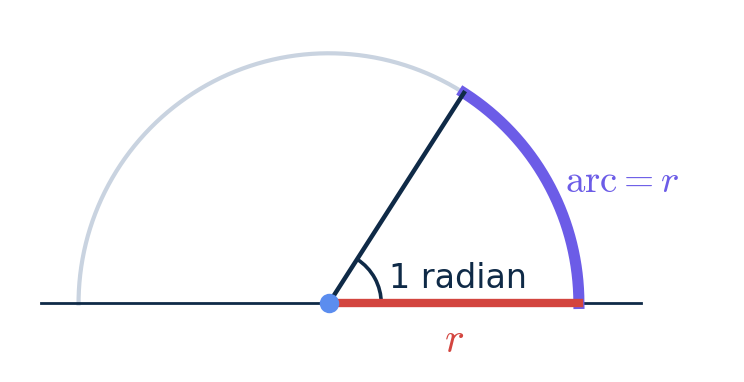
One radian is the angle whose arc is exactly as long as the radius. It is a little less than .
Worked example
Example 1. (a) A circle has radius 6 cm, and an angle at its center cuts off an arc of 9 cm. Find the measure of the angle in radians. (b) An angle of 2 radians is drawn at the center of a circle of radius 3.5 in. How long is the arc it cuts off?
- 01
radians. The centimeters cancel, so a radian measure is just a number.
- 02
(b) Solve for by multiplying both sides by : inches.
REAL-LIFE EXAMPLE
How far has the wheel turned?
A bike wheel has radius 0.35 m. When the bike rolls forward 0.7 m, a point on the tire travels 0.7 m along the circle.
The wheel has turned radians — the arc traveled is two radii long.
This is why radians are natural: they connect turning directly to distance traveled.
How many radians are in a full turn?
For one full turn, the arc is the whole circumference, . So the angle is radians, which is about 6.28. Half a turn is radians, and a quarter turn is radians.
KEY RULE
. One full turn = radians. Half a turn = radians.
COMMON MISTAKE
"A bigger circle makes a bigger angle."
Look again at the three arcs in the first figure of this section. The outer arc is three times as long as the inner one, but the angle is identical — the two rays never moved. Radian measure divides by the radius precisely to cancel out the size of the circle.
If you compare only arc lengths, you are measuring the circle, not the angle.
Quick check
An arc of length on a circle of radius subtends what angle, in radians?
Converting Between Degrees and Radians
Degrees still appear in everyday life, so it helps to move between the two units. A full turn is both and radians, so radians. That single fact gives both conversions:
| Degrees | 30° | 60° | 90° | 180° | 270° | 360° |
|---|---|---|---|---|---|---|
| Radians | π/6 | π/3 | π/2 | π | 3π/2 | 2π |
It also follows that 1 radian = , which matches the picture of one radian above.
Worked example
Example 2. Convert to radians, and convert radians to degrees.
- 01
radians (divide the top and bottom by 30).
- 02
. The factors of cancel.
- 03
Check that the sizes make sense: is a little less than , and is a little less than . Likewise, is a little more than , and is a little more than . ✓
COMMON MISTAKE
"."
is a number, about 3.14159. What is true is that radians and describe the same amount of turning — in the same way that 1 foot and 12 inches describe the same length. Writing is like writing .
This matters on a calculator. Starting in 3.2B you will evaluate sine and cosine, and your calculator must be in radian mode. An input of 180 means 180 radians — almost 29 full turns — not half a turn.
Quick check
Convert to radians.
Angles That Share a Terminal Ray
Remember from 3.1: shifting a periodic function by one full period changes nothing. Angles behave the same way. Rotate a terminal ray one extra full turn — radians — in either direction, and it ends up exactly where it started.
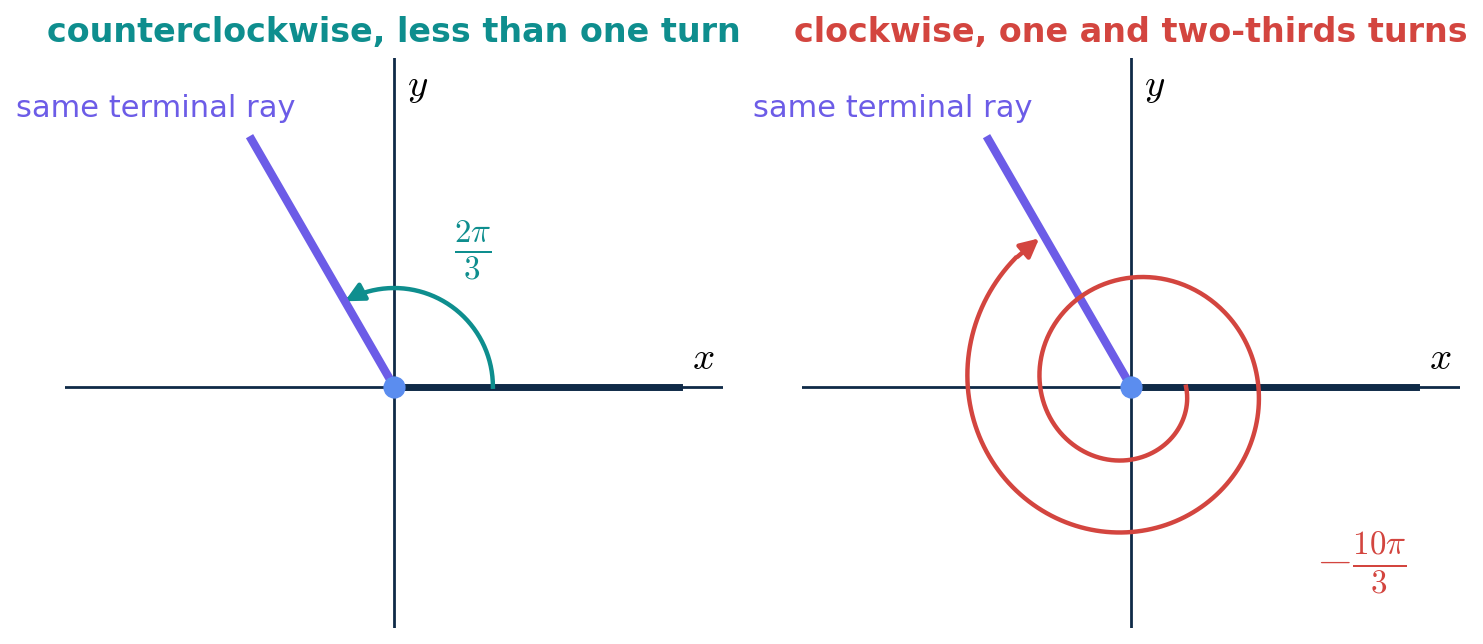
and differ by — two full turns — so they end on the same terminal ray.
Angles that share a terminal ray are called coterminal. For example, is coterminal with , , and . Each of these differs from by a whole number of full turns.
Worked example
Example 3. In which quadrant does the terminal ray of each angle lie? radians
- 01
is more than one full turn, . Subtract a full turn: . Since , the terminal ray lies in Quadrant IV.
- 02
is negative, so add full turns until the angle is between 0 and : . Since , the terminal ray lies in Quadrant II.
- 03
(c) An angle written without is still in radians. Compare 5 with the quadrant boundaries: and . Since , the terminal ray lies in Quadrant IV.
COMMON MISTAKE
"A negative angle always ends up below the x-axis."
The sign tells you only the direction of rotation, not where the ray lands. A clockwise turn of is almost a full turn, and it lands in the same place as — in Quadrant I, above the x-axis. (Check: .)
To find the quadrant of any angle, first move it into the interval from 0 to by adding or subtracting .
KEY RULE
To locate an angle: add or subtract until it is between 0 and , then compare it with , , and .
Common slips
"A bigger circle makes a bigger angle."
Look again at the three arcs in the first figure of this section. The outer arc is three times as long as the inner one, but the angle is identical — the two rays never moved. Radian measure divides by the radius precisely to cancel out the size of the circle.
If you compare only arc lengths, you are measuring the circle, not the angle.
"."
is a number, about 3.14159. What is true is that radians and describe the same amount of turning — in the same way that 1 foot and 12 inches describe the same length. Writing is like writing .
This matters on a calculator. Starting in 3.2B you will evaluate sine and cosine, and your calculator must be in radian mode. An input of 180 means 180 radians — almost 29 full turns — not half a turn.
"A negative angle always ends up below the x-axis."
The sign tells you only the direction of rotation, not where the ray lands. A clockwise turn of is almost a full turn, and it lands in the same place as — in Quadrant I, above the x-axis. (Check: .)
To find the quadrant of any angle, first move it into the interval from 0 to by adding or subtracting .
Lock it in
Try the flashcards
5 cards · Unit circle
Recap card
6 lines to re-read the night before.
- 01
Standard position: vertex at the origin, initial ray on the positive x-axis. Counterclockwise is positive; clockwise is negative.
- 02
Radian measure compares arc length to radius, so it does not depend on the size of the circle.
- 03
One full turn is radians, radians = , and 1 radian ≈ .
- 04
Degrees to radians: multiply by . Radians to degrees: multiply by .
- 05
and share a terminal ray — the same "shift by a full cycle" idea from 3.1.
- 06
To find a quadrant, first shift the angle into the interval from 0 to .