
Topic 3.1
Periodic Phenomena
In Units 1 and 2, the functions we studied kept growing, kept shrinking, or turned around a few times before heading off toward infinity. Unit 3 is about a completely different kind of behavior: patterns that repeat forever. The height of a bike pedal, the tides, the hours of daylight across a year — each one comes back to where it started, again and again. This note builds the vocabulary we will use for the rest of the unit.
13 MIN READ6 IDEAS33 PROBLEMS5 flashcards
Read this first
30 sec
- 01
Period = the length of one full cycle: same output and same behavior.
- 02
Far-away input? Slide it by whole periods until it lands inside the known cycle.
- 03
Over any interval exactly one period long, the average rate of change is 0.
What Makes a Relationship Periodic?
CONCEPT
Periodic relationship
A relationship is periodic when its output values repeat the same pattern over successive, equal-length intervals of input values.
One complete repetition of the pattern is called a cycle.
Periodic behavior is also described as cyclical.
The key word is same. All three graphs below go up and down over and over, but only one of them is periodic.
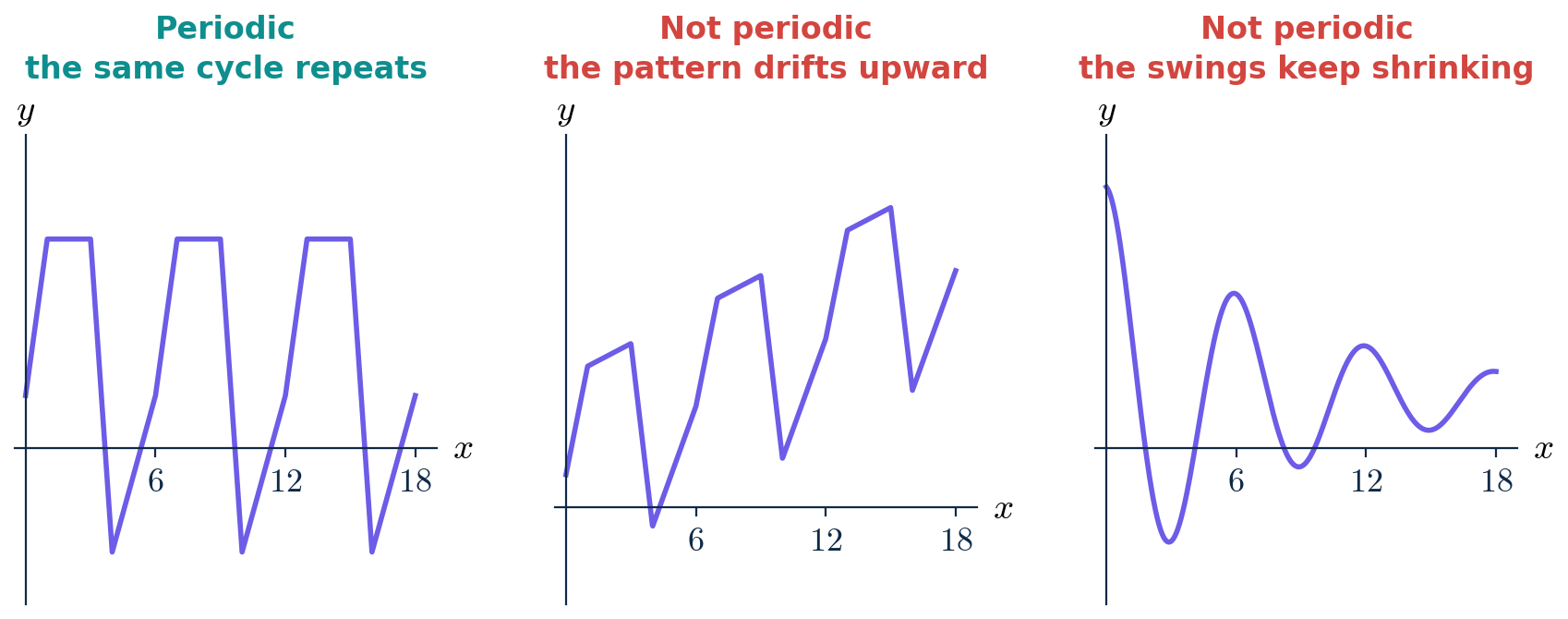
Only the first graph repeats exactly. The other two repeat a shape, but their output values change from cycle to cycle.
COMMON MISTAKE
"It goes up and down over and over, so it must be periodic."
Wiggling is not enough. In the middle graph, every cycle sits a little higher than the one before, so the outputs never return to the same values. In the right graph, each swing is smaller than the last, so again the outputs do not repeat.
Here is a test that always works: a periodic graph can be slid one cycle to the right and land exactly on top of itself — every height, every turn, every corner.
REAL-LIFE EXAMPLE
Where periodic behavior shows up
A bike pedal rises and falls with every turn of the crank.
Ocean tides rise and fall on a regular schedule every day.
A resting heart produces the same electrical pattern with each beat.
The number of daylight hours in a city follows the same pattern every year.
In each case, if you understand one cycle, you understand every cycle.
The Period
CONCEPT
Definition of the period
The period of a periodic function is the length of one cycle, measured along the input axis.
In symbols, the period is the smallest positive number such that
Read it out loud: "If I move units to the right, I get back the output I started with — no matter where I start." The word smallest matters. A pattern that repeats every 6 units also repeats every 12 units and every 18 units, but its period is 6.
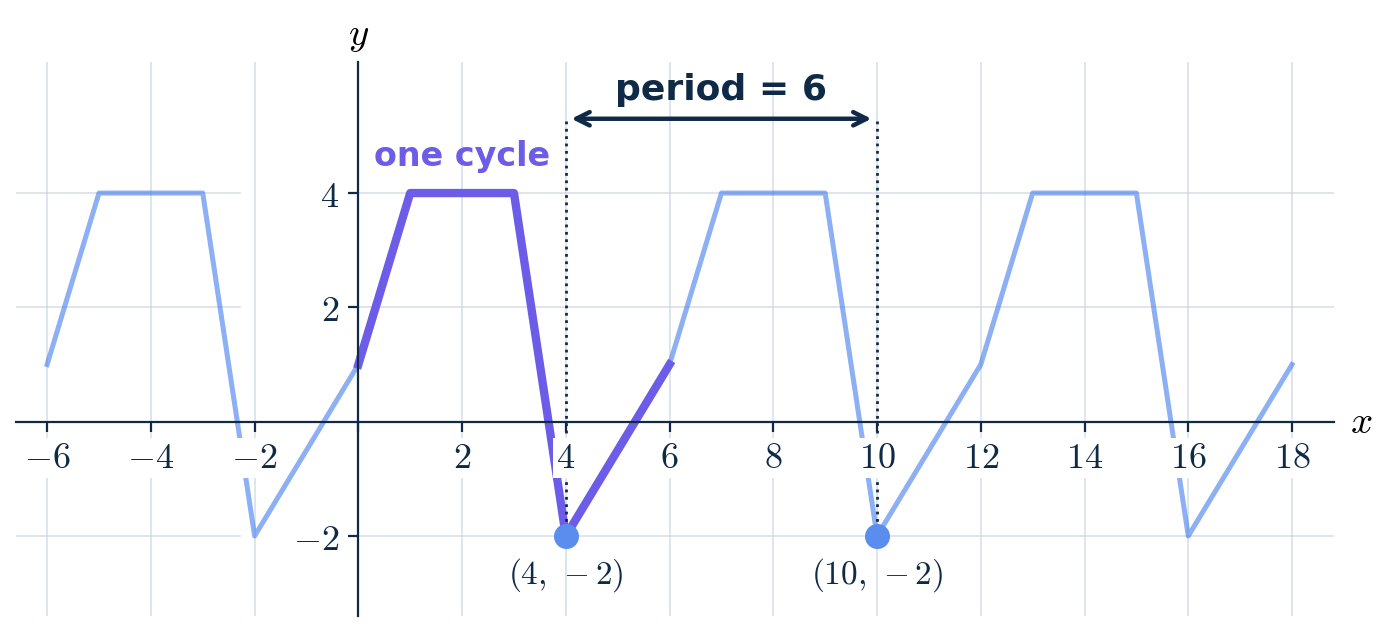
The function repeats every 6 units. The dark segment on is one cycle.
Worked example
Example 1. Use the graph of above to find its period.
- 01
Pick a feature that is easy to spot and appears only once per cycle. The sharp low corner at is a good choice.
- 02
Move right until the same feature appears again. The next low corner is at .
- 03
The period is the horizontal distance between them: .
- 04
Check with a second feature. The flat top begins at and again at , and . ✓ The period of is 6.
COMMON MISTAKE
"The graph is at when and again when , so the period is 3.5."
Two points at the same height are not necessarily at the same place in the cycle. At the graph is rising through , but at it is falling through . The next time the graph rises through is at , so the period is .
The same trap catches students who measure from one x-intercept to the next. The zeros of are at about and — only apart — because one is on a falling piece and the other is on a rising piece.
To measure a period, match the height AND the direction (rising or falling). Even better, match a one-of-a-kind feature such as a corner or a peak.
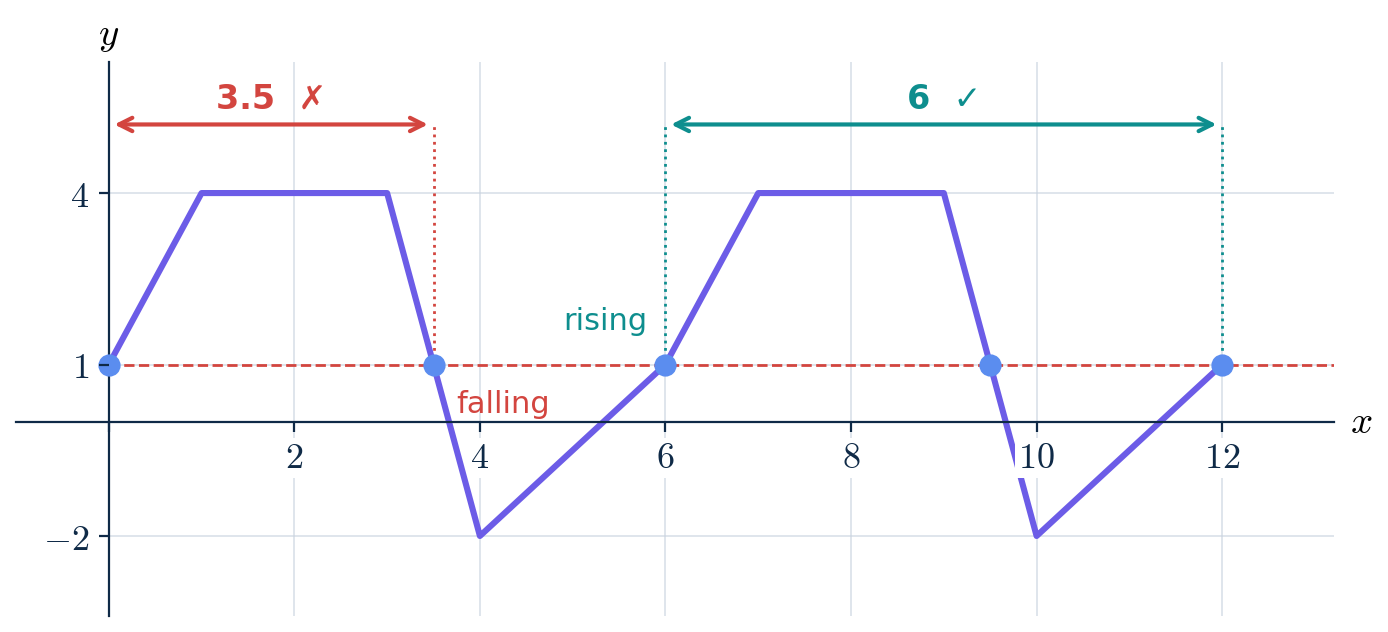
Same height is not enough. The graph rises through at , 6, 12, … — exactly every 6 units.
KEY RULE
Period = the length of ONE full cycle: same output AND same behavior.
Quick check
The graph of a periodic function rises through at , falls through at , and next rises through at . What is the period?
Building a Graph from a Description
On the AP exam you will often read a description of a periodic situation and be asked to sketch it or to label key points. The strategy is always the same: pin down one cycle first, then repeat it.
Worked example
Example 2. Mina rides her bike at a steady pace. Each pedal is attached to a crank arm 17 cm long, and the center of the crank is 28 cm above the ground. The pedal makes one full turn every 1.2 seconds. At time , the right pedal is at its lowest point. Let be the height of the right pedal above the ground, in centimeters, seconds after she starts timing. Sketch the graph of .
- 01
Find the lowest and highest heights. Lowest: cm (crank pointing straight down). Highest: cm (crank pointing straight up).
- 02
Split one turn into quarter-turns. One turn takes 1.2 s, so each quarter-turn takes s. Follow the pedal: bottom → front → top → back → bottom. At the front and back positions the crank is horizontal, so the pedal is level with the center: 28 cm.
t (seconds) 0 0.3 0.6 0.9 1.2 Pedal position bottom front top back bottom h(t) (cm) 11 28 45 28 11 - 03
Plot these five points and connect them with a smooth curve. The pedal moves smoothly, so the graph has no sharp corners.
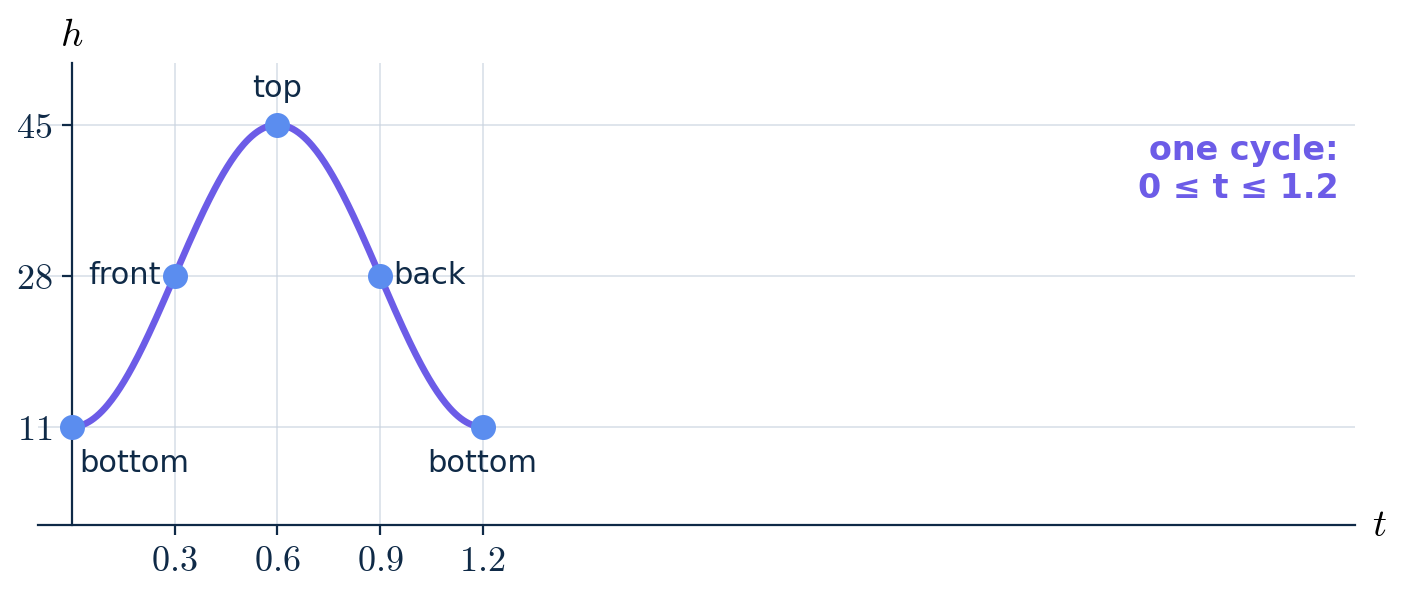
One cycle of , built from the five key points.
- 04
Repeat the cycle every 1.2 seconds. The pedal is at the bottom again at , 2.4, 3.6, … and at the top at , 1.8, 3.0, …
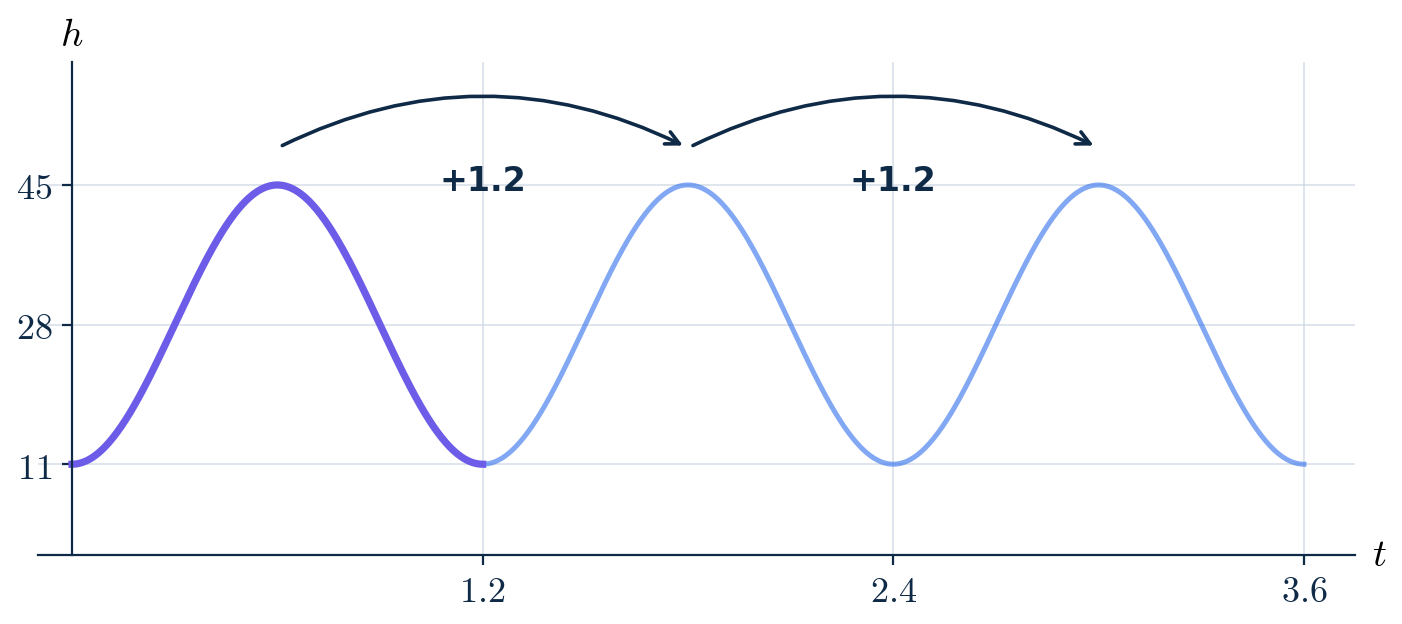
Copying the cycle every 1.2 seconds gives the whole graph.
Notice that the key-point table did all the work. Once one cycle is correct, the rest of the graph is just copying — which is exactly what "periodic" means.
Using the Period to Find Output Values
Because the graph lands on itself after every units, any input can be slid back into the one cycle we know.
CONCEPT
Shifting by whole periods
If has period , then moving left or right by any whole number of periods does not change the output:
To evaluate at a far-away input, add or subtract multiples of until the input lands inside a cycle you can see.
Worked example
Example 3. Use the graph of (period 6) from Section 2 to find and .
- 01
The known cycle runs from to . For , subtract 6 as many times as needed: .
- 02
So — the right end of the flat top.
- 03
For a negative input, add multiples of 6 instead: .
- 04
So — the low corner.
Worked example
Example 4. The function is periodic with period 8. Selected values of are shown in the table. Find , , and .
| x | 0 | 2 | 3 | 5 |
|---|---|---|---|---|
| g(x) | 3 | 5 | −2 | 0 |
- 01
: , so .
- 02
: the input is negative, so add 8s. , so .
- 03
: work from the inside out. First, , so . Then .
The same idea works with a variable. Every input of the form , where is an integer, is a whole number of periods away from 5. So for every integer .
COMMON MISTAKE
"For , subtract 8 from 14 to get 6."
Dropping the negative sign sends you to the wrong input — and is not even in the table. The input −14 is 14 units to the LEFT of 0. To move back into the cycle from 0 to 8, you must move RIGHT, which means adding 8s: (still negative), then . ✓
Check by going the other way: . The inputs 2 and −14 really are exactly two periods apart, so .
KEY RULE
Far-away input? Slide it by whole periods until it lands inside the known cycle.
Quick check
A function has period and . What is ?
Every Cycle Has the Same Features
Remember from Unit 1: a function is concave up where its rate of change is increasing and concave down where its rate of change is decreasing. For a periodic function, whatever happens in one cycle happens in every cycle — and that includes all of these features.
CONCEPT
Features repeat every period
If has period , then every one of these repeats when you shift by :
the intervals where is increasing or decreasing;
the intervals where is concave up or concave down;
relative maximums, relative minimums, and points of inflection;
the pattern of the rate of change.
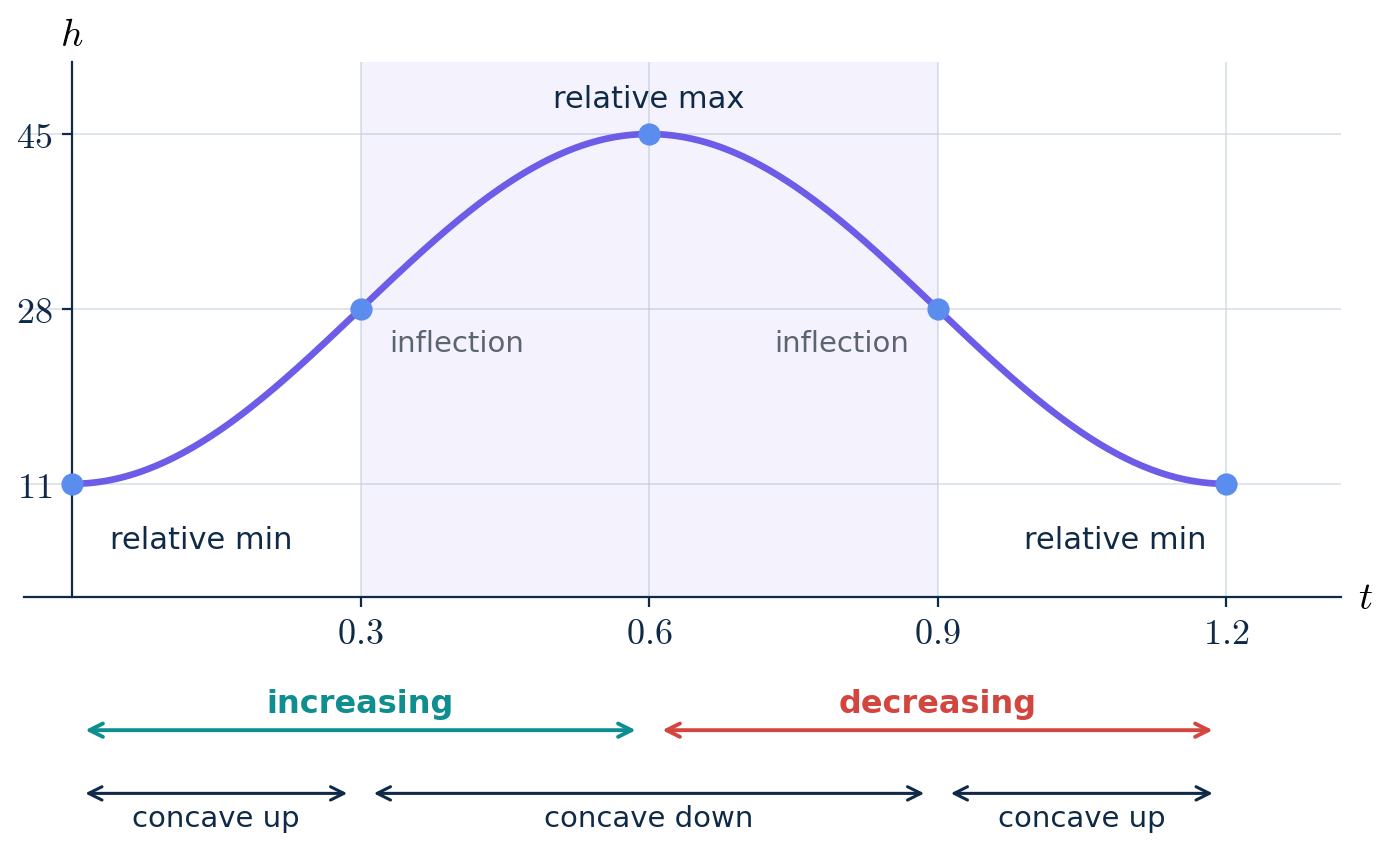
One cycle of the pedal height . Every later cycle has the same features, shifted by 1.2 seconds.
Worked example
Example 5. For the pedal height from Example 2, describe the behavior of at seconds. Then decide whether has a relative maximum at seconds.
- 01
Slide 7.9 back into the first cycle by subtracting whole periods: .
- 02
At , is decreasing (0.7 is between 0.6 and 1.2) and concave down (0.7 is between 0.3 and 0.9). Decreasing and concave down means the rate of change is negative and becoming more negative: just after passing the top, the pedal is dropping faster and faster.
- 03
For : . The pedal is at the top at , so has a relative maximum at , and cm.
COMMON MISTAKE
"At the pedal is concave down, so it must be going up."
Concavity and direction are two separate questions. Concave down only says the rate of change is decreasing. On the pedal is concave down while rising — it is slowing down as it approaches the top. On it is concave down while falling — it is speeding up on the way down.
Always answer "increasing or decreasing?" and "concave up or down?" separately, each from its own interval.
Average rate of change over one full period
Here is a consequence that surprises many students. Pick any starting input a. After exactly one period, the function is back at the same output, so . That makes the average rate of change over any interval of length equal to zero:
For example, the average rate of change of from to is , even though goes up and down in between. For the pedal, the average rate of change over is also 0 cm per second, because the pedal finishes every full turn at the same height where it started.
KEY RULE
Over any interval exactly one period long, the average rate of change is 0.
Common slips
"It goes up and down over and over, so it must be periodic."
Wiggling is not enough. In the middle graph, every cycle sits a little higher than the one before, so the outputs never return to the same values. In the right graph, each swing is smaller than the last, so again the outputs do not repeat.
Here is a test that always works: a periodic graph can be slid one cycle to the right and land exactly on top of itself — every height, every turn, every corner.
"The graph is at when and again when , so the period is 3.5."
Two points at the same height are not necessarily at the same place in the cycle. At the graph is rising through , but at it is falling through . The next time the graph rises through is at , so the period is .
The same trap catches students who measure from one x-intercept to the next. The zeros of are at about and — only apart — because one is on a falling piece and the other is on a rising piece.
To measure a period, match the height and the direction (rising or falling). Even better, match a one-of-a-kind feature such as a corner or a peak.
"For , subtract 8 from 14 to get 6."
Dropping the negative sign sends you to the wrong input — and is not even in the table. The input −14 is 14 units to the left of 0. To move back into the cycle from 0 to 8, you must move right, which means adding 8s: (still negative), then . ✓
Check by going the other way: . The inputs 2 and −14 really are exactly two periods apart, so .
"At the pedal is concave down, so it must be going up."
Concavity and direction are two separate questions. Concave down only says the rate of change is decreasing. On the pedal is concave down while rising — it is slowing down as it approaches the top. On it is concave down while falling — it is speeding up on the way down.
Always answer "increasing or decreasing?" and "concave up or down?" separately, each from its own interval.
Lock it in
Try the flashcards
5 cards · Periodic and context
Recap card
6 lines to re-read the night before.
- 01
A relationship is periodic when its outputs repeat the same pattern over equal-length input intervals. One repetition is a cycle.
- 02
The period is the smallest positive with for every .
- 03
Measure a period between matching features — same height and same direction — not between any two points at the same height.
- 04
To graph from a description, find the key points of one cycle, then copy the cycle every period.
- 05
for any integer : slide far-away inputs back into the known cycle. For negative inputs, add periods.
- 06
Increasing/decreasing intervals, concavity, extrema, and the rate-of-change pattern all repeat every period.