
Topic 2.9
Logarithmic Expressions
Ever since 2.1 one question has been waiting: when does Nova reach 10,000 subscribers? We built tables and saw that it happens between month 9 and month 10. Now let's set up the equation:
10 MIN READ8 IDEAS33 PROBLEMS15 flashcards
Read this first
30 sec
- 01
A logarithm is an exponent: ⇔ .
The unknown is an EXPONENT: 1.5 raised to what power gives 39.0625? Addition has subtraction to undo it, multiplication has division, and squaring has square roots. For “what exponent?” we need a new operation, the logarithm.
Remember from 2.8: an inverse runs a function backwards, from output to input. The logarithm runs an exponential function backwards, from the result back to the exponent. (2.10 looks at that inverse relationship as graphs.)
A Logarithm Is an Exponent
CONCEPT
Definition
(read “log base of c”; in print the is written small and low) is the exponent you put on to get .
In symbols: means exactly the same thing as . The base must be positive and not 1, just like the base of an exponential function (2.3).
Read as the question “2 to what power is 32?” The answer is 5, so .
Every exponential fact can be rewritten as a logarithm fact, and back. Three parts are involved: the BASE , the EXPONENT a, and the RESULT . The base stays the base in both forms. The logarithm always equals the exponent:
| exponential form | logarithmic form | in words |
|---|---|---|
| 2 to the 5th is 32 | ||
| 10 to the −2 is 0.01 | ||
| = 1/2 | the square root of 9 is 3 | |
| anything to the 0 is 1 | ||
| = b | anything to the 1st is itself |
Worked example
Example 1 (converting). (a) Write and in log form. (b) Write in exponential form.
- 01
: the base is 7, the exponent is 2, the result is 49. The log equals the exponent: .
- 02
: base 5, exponent −1, result 0.2. So .
- 03
: base 16, and the is the exponent, so . Check: , and ✓.
KEY RULE
A logarithm is an exponent: ⇔ .
Quick check
Rewrite in exponential form.
Evaluating Logarithms by Hand
To evaluate , don't reach for a formula. Ask the question “b to what power is ?”, and write as a power of .
Worked example
Example 2. Evaluate , , , and .
- 01
: 3 to what power is 81? , so .
- 02
: , so .
- 03
: , so . A result between 0 and 1 needs a NEGATIVE exponent.
- 04
: , so . Roots give FRACTIONAL exponents (2.4).
When is not a whole power of , write both as powers of a smaller common base.
Worked example
Example 3. Evaluate and .
- 01
: and . Set up and rewrite with base 2:
- 02
Check: ✓.
- 03
, the same way:
COMMON MISTAKE
“.”
A logarithm is not a division. asks for the exponent: , so . Check any answer by raising the base to it: , not 8.
“, because 8 is .”
Again, check by raising: . The right answer is .
Worked example
Try it yourself. Evaluate without a calculator: (a) (b) (c) (d) (e)
Answers: (a) −3, because . (b) , because . (c) −3, because . (d) −2. (e) , because .
Logarithms Between Whole Numbers
Most logarithms aren't whole numbers. You can still pin them down by finding the powers on either side.
Worked example
Example 4. Between which two whole numbers is ? And ? And ?
- 01
and . Since , is between 4 and 5. (A calculator gives about 4.3219.)
- 02
and , so is between 2 and 3. (About 2.5441.)
- 03
Nova: and , and . So is between 9 and 10, about 9.04. That matches the table from 2.1: Nova passes 10,000 early in month 10.
The logarithm measures position on a scale where each step MULTIPLIES instead of adds. On an ordinary number line, 1, 2, 4 and 8 crowd together; on a base-2 log scale they are equally spaced:
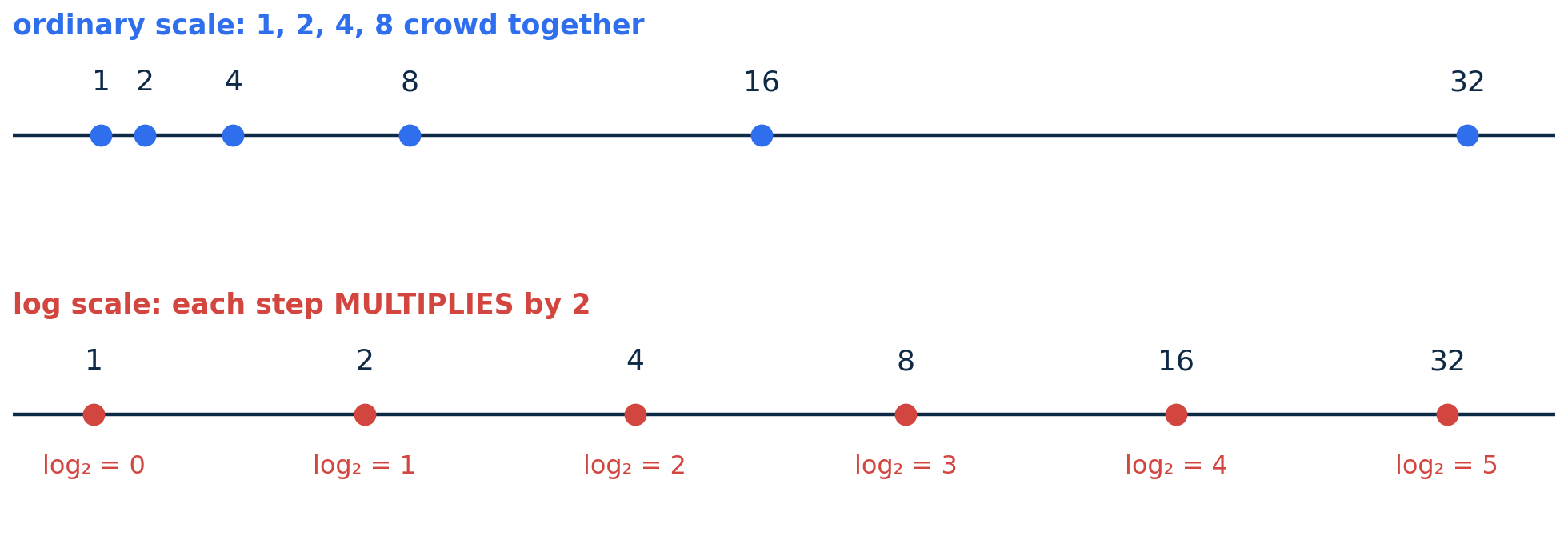
On the log scale, the position of each number is its base-2 logarithm.
The Two Logarithms on Your Calculator
CONCEPT
Common Log and Natural Log
The common logarithm has base 10 and is written without a base: means . (, .)
The natural logarithm has base (2.3) and has its own name: means .
Your calculator has a LOG key and an LN key. For other bases, like , you'll learn a trick in 2.12.
Worked example
Example 5. Evaluate , , ln , and .
- 01
, because is to the 5th. (ln just reads off the exponent of .)
- 02
, and ln .
- 03
isn't a simple power of : use the LN key. , so .
COMMON MISTAKE
“ and are the same thing.”
They have different bases. , because . , because needs a bigger exponent to reach 10. Always check which key the problem means.
Quick check
Evaluate to four decimal places.
What Logarithms Can't Do
Remember from 2.3: for every . A positive base raised to ANY power is positive. So no exponent turns into 0 or into a negative number.
CONCEPT
The Input of a Logarithm
is defined only for . and are undefined.
For , the logarithm is negative (a negative exponent makes a fraction): is between −1 and 0. For (with ), it is positive. For , it is 0.
COMMON MISTAKE
“.”
, not −100. A NEGATIVE logarithm means a small positive input, not a negative input. No power of 10 is negative, so is undefined.
Logarithmic Scales in Real Life
Some quantities range over huge sizes: the ground motion of earthquakes can differ by factors of millions. Scientists report them with a logarithm, so the numbers stay small and each step up means “multiplied by 10”.
REAL-LIFE EXAMPLE
Earthquake Magnitude
The magnitude of an earthquake is based on the logarithm (base 10) of how strongly the ground shakes. Going up 1 in magnitude means the ground motion is 10 times bigger.
A magnitude 7.0 quake versus a 5.0 quake: 2 steps, so times the ground motion, not “2 more”. A 6.5 versus a 6.0: half a step, times.
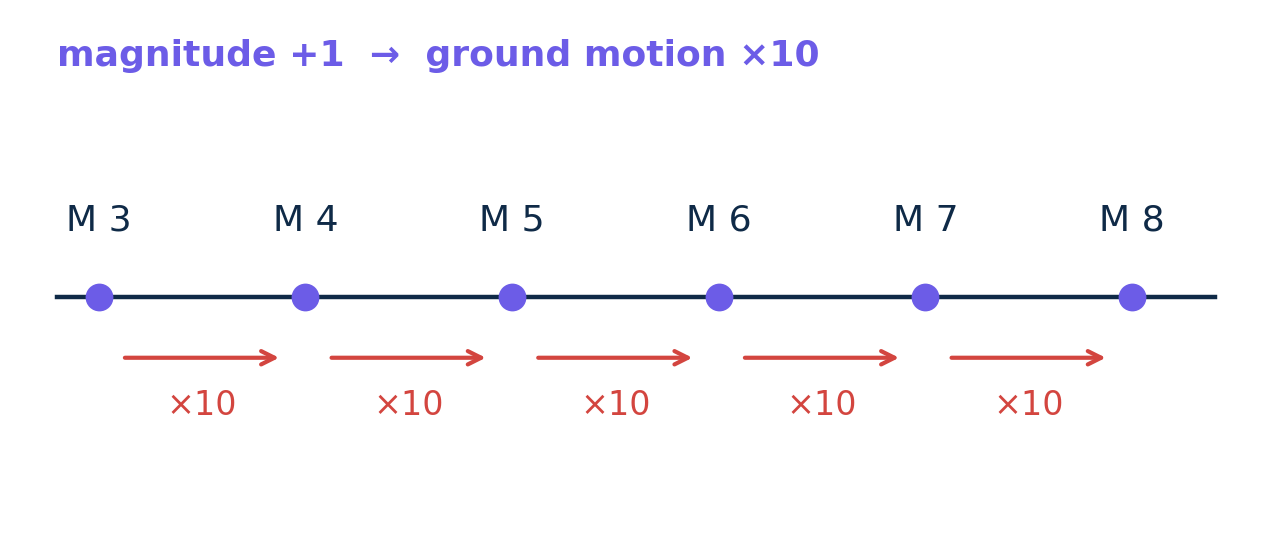
Equal steps on the magnitude scale are equal FACTORS of ground motion.
Practice
Worked example
P1. Rewrite in logarithmic form, and in exponential form. Find a.
Answer: . And : , so .
Worked example
P2. Which is larger, or ? Explain without a calculator.
Answer: puts between 4 and 5; puts between 3 and 4. So is larger (about 4.907 vs 3.096). A smaller base needs a larger exponent.
Worked example
P3. How many times stronger is the ground motion of a magnitude 7.2 earthquake than a 5.2?
Answer: 2 steps: times.
Worked example
P4. Evaluate and , and find the two whole numbers that lies between.
Answer: . , so . Since , is between 3 and 4.
Common slips
“.”
A logarithm is not a division. asks for the exponent: , so . Check any answer by raising the base to it: , not 8.
“, because 8 is .”
Again, check by raising: . The right answer is .
“ and are the same thing.”
They have different bases. , because . , because needs a bigger exponent to reach 10. Always check which key the problem means.
“.”
, not −100. A negative logarithm means a small positive input, not a negative input. No power of 10 is negative, so is undefined.
Lock it in
Try the flashcards
15 cards · Logarithms, Log or exponential graph?
Recap card
6 lines to re-read the night before.
- 01
A logarithm is an exponent: ⇔ (, ). and .
- 02
To evaluate by hand, write as a power of (use a common base like 2 if needed; roots are fractional exponents). Check by raising the base to your answer.
- 03
Logs between whole numbers: find the powers of on either side.
- 04
means base 10; means base , and .
- 05
exists only for . Inputs between 0 and 1 give negative logs.
- 06
Log scales turn equal steps into equal factors (earthquakes: +1 magnitude = ×10). Next, in 2.10: the graph of .