
Topic 2.10
Inverses of Exponential Functions
In 2.9 you met the logarithm as an operation: “what exponent?” Now we treat it as a function, (the logarithm with base b), and compare it with its partner . Every feature of the exponential graph from 2.3 has a matching feature on the logarithm graph, because the two are inverses.
8 MIN READ7 IDEAS33 PROBLEMS15 flashcards
Remember from 2.8: inverse functions undo each other, swap inputs with outputs, swap domain with range, and have graphs that are reflections across . To find an inverse formula, solve for , then swap the names.
Logarithms Undo Exponentials
CONCEPT
Inverse Pair
For , , the functions and are inverses of each other.
Composing them in either order returns the input. The only condition: needs a positive input, so the second identity holds for .
Why? asks “b to what power gives ?” The answer is obviously . And raises to exactly the exponent that produces , so the result is .
| expression | value | reason |
|---|---|---|
| 3 | log undoes the power of 5 | |
| 7 | 10 to the exponent that makes 7 | |
| 4 | ln has base e | |
| −2 | ln undoes the power of e |
Swapping the rows of an exponential table gives a logarithm table:
| x | −2 | −1 | 0 | 1 | 2 | 3 |
|---|---|---|---|---|---|---|
| 1/4 | 1/2 | 1 | 2 | 4 | 8 |
| x | 1/4 | 1/2 | 1 | 2 | 4 | 8 |
|---|---|---|---|---|---|---|
| −2 | −1 | 0 | 1 | 2 | 3 |
The Graphs: Reflections Across y = x
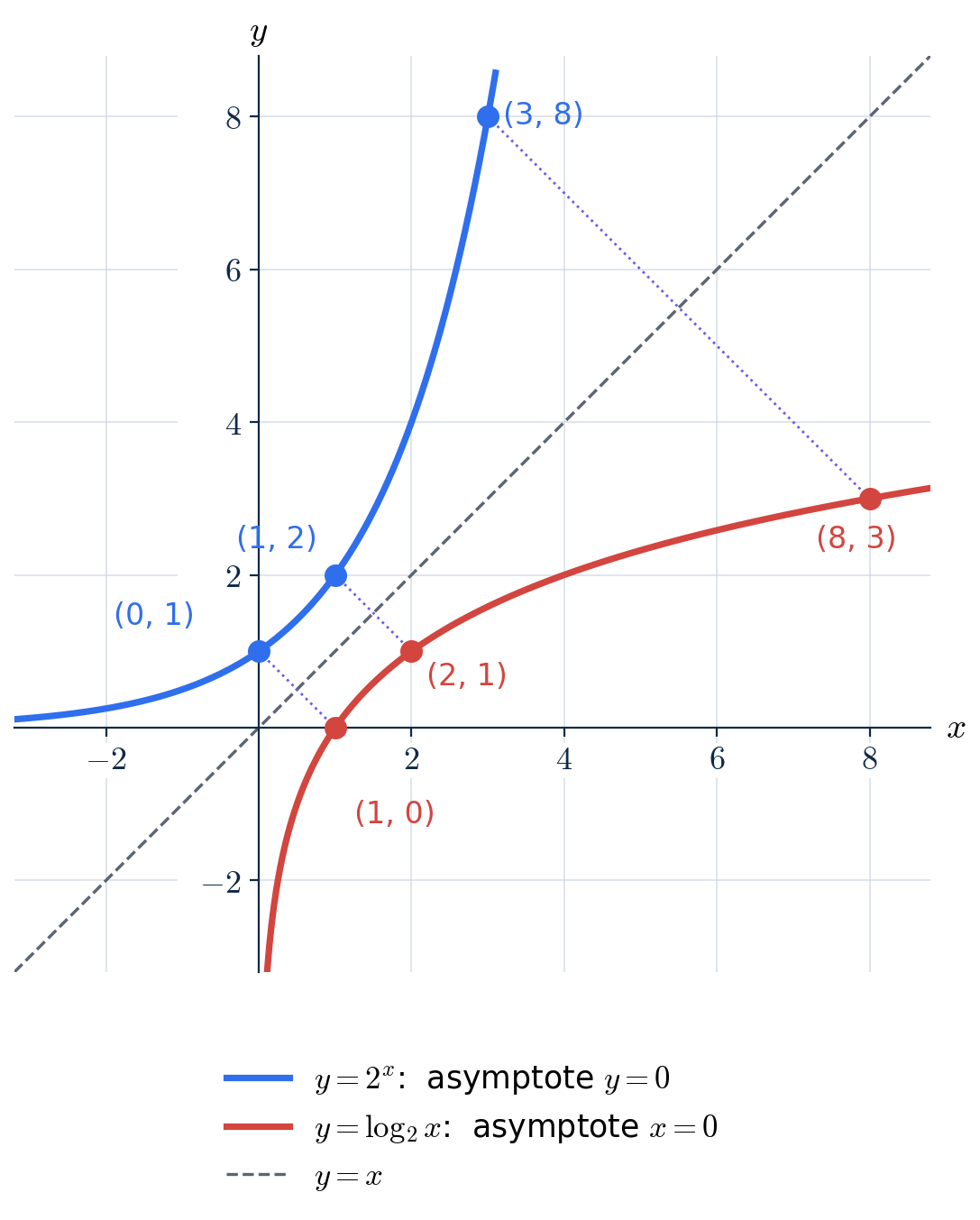
Every point on becomes on .
Because the graphs are reflections, every feature swaps its and roles:
| feature | y = (b > 1) | y = (b > 1) |
|---|---|---|
| domain | all real x | x > 0 |
| range | y > 0 | all real y |
| asymptote | horizontal: y = 0 | vertical: x = 0 |
| key points | (0, 1) and (1, b) | (1, 0) and (b, 1) |
| shape | increasing, concave up | increasing, concave down |
Reading the notation → . The small means approaches 0 from the RIGHT, through positive values like 0.1, 0.001, 0.000001. That's the only way to approach 0 inside the domain of log. As → , → −∞: and , falling without bound. That is the vertical asymptote .
If , both functions are decreasing. For example, and . The logarithm graph is then concave up, the reflection of a decreasing, concave up exponential.
COMMON MISTAKE
“Both graphs have the asymptote .”
Reflecting across turns a horizontal line into a vertical line. approaches the x-axis () as → −∞; approaches the y-axis () as → . Draw the asymptote first, and ask which variable can't reach 0.
Finding Inverse Formulas
The method is the same as in 2.8: solve for , then swap. The new step is converting between exponential form and log form (2.9).
Worked example
Example 1. Find the inverse of , and its domain.
- 01
Write and isolate the exponential part: add 5, then divide by 3.
- 02
Rewrite in log form:
- 03
Swap names: . The log needs , so the domain of is , which is exactly the range of (, so − 5 > −5).
- 04
Check: , and ✓.
Worked example
Example 2. Find the inverse of .
- 01
Write and isolate the log: subtract 1.
- 02
Rewrite in exponential form:
- 03
Swap names: . Check: , and ✓.
Quick check
Find the inverse of .
Multiply the Input, Add to the Output
Remember from 2.3: adding to the input of an exponential multiplies its output (). The inverse reverses that: multiplying the input of a logarithm adds to its output.
Doubling the input of always adds exactly 1. That's why a logarithm grows so slowly: reaches 10 only at , and 20 only after doubling ten more times.
COMMON MISTAKE
“.”
Multiplying the INPUT by 2 adds 1 to the output; it doesn't double it. , but .
Quick check
A table has with . Exponential, logarithmic, or neither?
Nova's Inverse
REAL-LIFE EXAMPLE
From Subscribers Back to Months
Solve for to get the inverse of . It answers “in which month does Nova have subscribers?”
Check with the table: , because . And , the number from 2.9. Doubling the audience from 256 to 512 takes months, the doubling time estimated in 2.5A.
Worked example
Try it yourself. (a) What is the inverse of ? Find . (b) is on the graph of . Which point is on the graph of its inverse?
Answers: (a) (x) = , and . (b) .
Practice
Worked example
P1. Find the inverse of and check it at .
Answer: gives , so . , and ✓.
Worked example
P2. Find the inverse of , and check it at .
Answer: , so . . , and ✓.
Worked example
P3. Find the inverse of , and find .
Answer: , so . = 21, and ✓.
Worked example
P4. . Write , give the domain and range of , and find .
Answer: . has domain and range all real numbers. , because .
Common slips
“Both graphs have the asymptote .”
Reflecting across turns a horizontal line into a vertical line. approaches the x-axis () as → −∞; approaches the y-axis () as → . Draw the asymptote first, and ask which variable can't reach 0.
“.”
Multiplying the input by 2 adds 1 to the output; it doesn't double it. , but .
Lock it in
Try the flashcards
15 cards · Logarithms, Log or exponential graph?
Recap card
5 lines to re-read the night before.
- 01
and are inverses: , and for .
- 02
Their graphs reflect across . Domain and range swap; the horizontal asymptote becomes the vertical asymptote ; becomes .
- 03
To invert an exponential: isolate , then rewrite in log form. To invert a log: isolate the log, then rewrite in exponential form.
- 04
Exponential: add to the input → multiply the output. Logarithm: multiply the input → add to the output.
- 05
Next, in 2.11: logarithmic functions in general, with transformations, end behavior, and data.