
Topic 2.11
Logarithmic Functions
2.10 showed (the logarithm with base b) as the reflection of . This note studies logarithmic functions as a family on their own: how their graphs behave at the ends, what happens when you stretch, shift, and reflect them, and how to recognize one from a table.
8 MIN READ6 IDEAS33 PROBLEMS15 flashcards
Read this first
30 sec
- 01
Logarithmic: when the inputs are multiplied by a constant, the outputs add a constant.
Remember from 2.3: exponential functions are always increasing or always decreasing, and always concave up or always concave down. Logarithmic functions inherit exactly the same kind of behavior, turned on its side.
Features of a Logarithmic Function
CONCEPT
Features ()
Domain: . Range: all real numbers. Vertical asymptote: . x-intercept: , because .
If : always increasing and concave down. If : always decreasing and concave up. So there are no maximums, minimums, or points of inflection.
End behavior: as → ( shrinking toward 0 through positive values) the outputs go to −∞ if ; as → ∞ they go to ∞, but extremely slowly.
With a negative coefficient everything flips upside down:
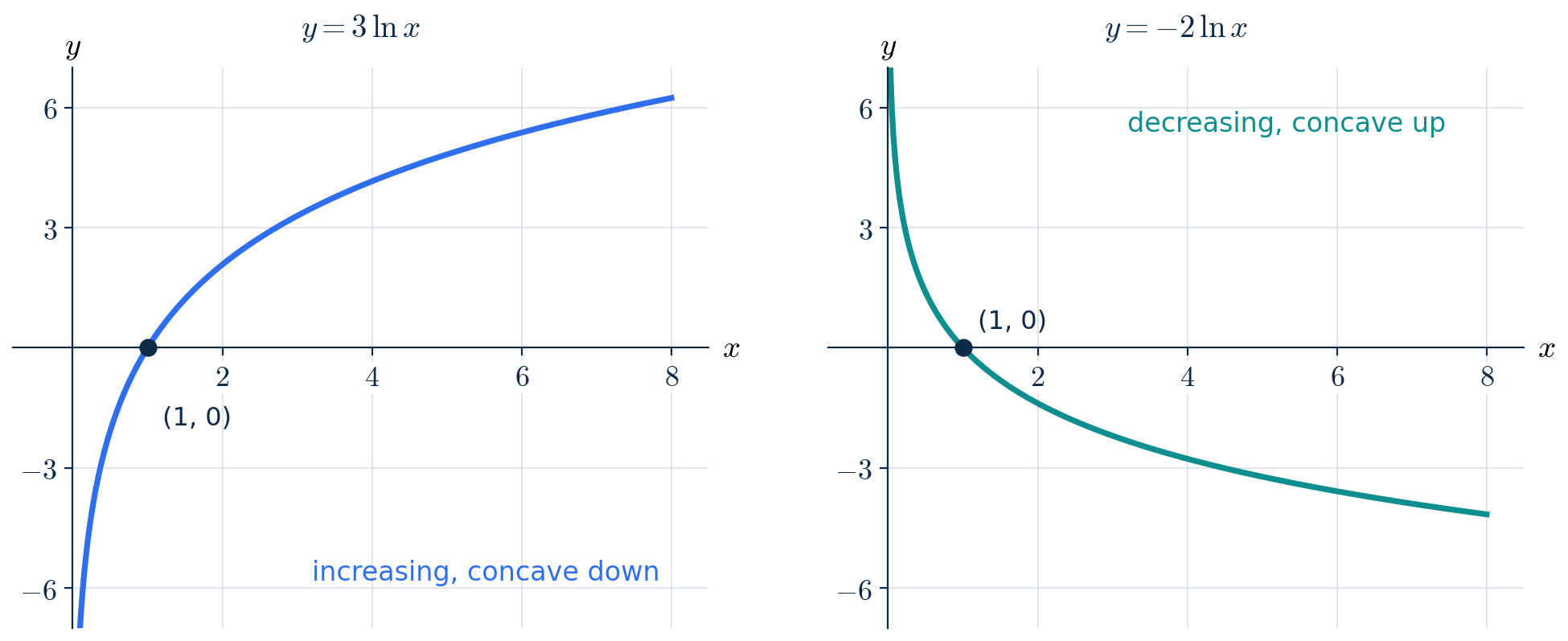
A positive coefficient gives an increasing, concave down curve; a negative one flips it to decreasing, concave up. Both pass through .
Why concave down? The gains shrink. , but . Equal steps in give smaller and smaller increases, so the rate of change is decreasing, which is what concave down means.
Transformations
CONCEPT
What Each Constant Does
shifts the graph horizontally. It moves the asymptote to , and the domain becomes . Find it by setting the inside equal to 0.
shifts the graph vertically. It does NOT move the asymptote, because the asymptote is a vertical line.
a stretches the graph vertically (and flips it over the x-axis if ).
Worked example
Example 1. . Find the domain, the asymptote, the x-intercept, and some points.
- 01
The input of a logarithm must be positive: , so the domain is .
- 02
The asymptote is where the inside equals 0: .
- 03
Points: choose so that is a power of 2. gives ; gives 2; gives 3; gives 4.
- 04
x-intercept: set . , so and .
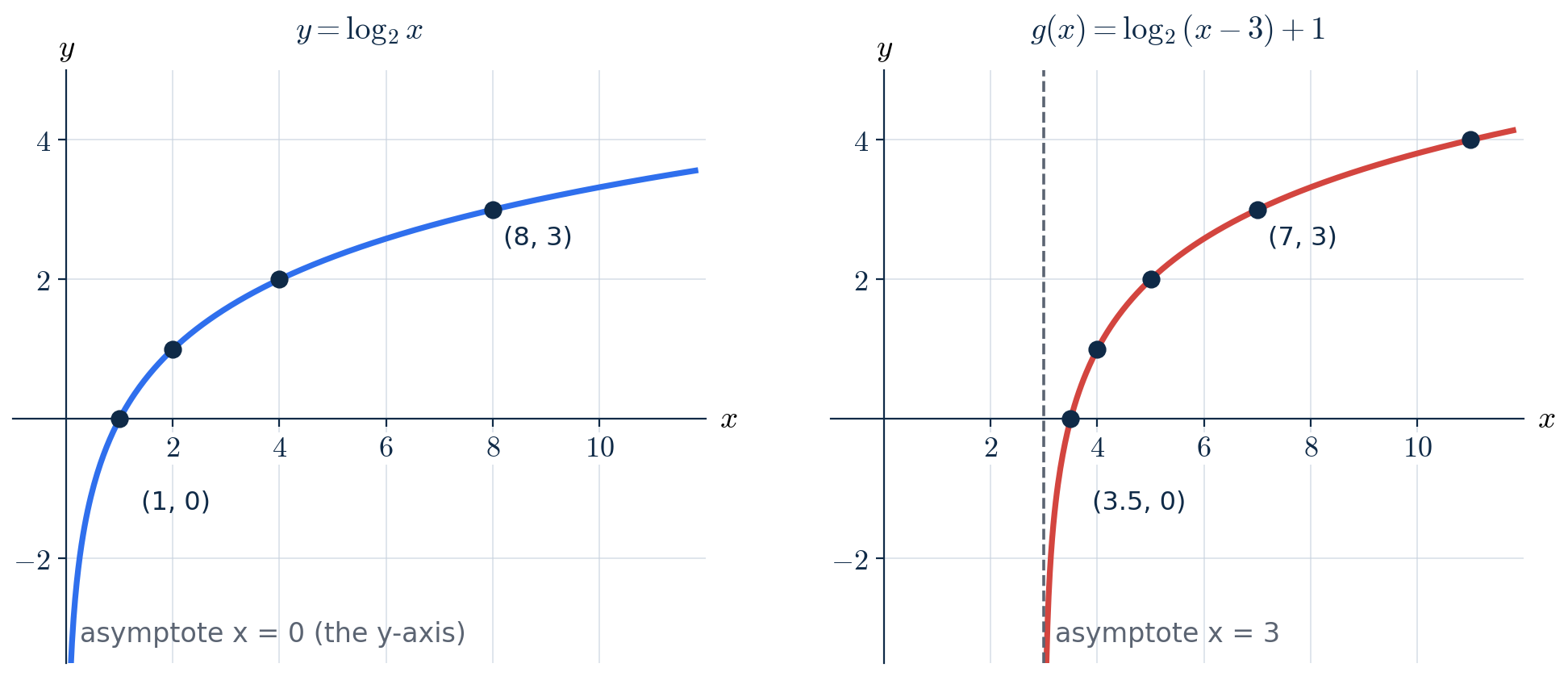
Moving right 3 and up 1. The asymptote moves with the horizontal shift only.
Worked example
Example 2. . Find three points, the x-intercept, and the shape.
- 01
Choose x-values that are powers of , so is a whole number: , , .
- 02
x-intercept: , so and .
- 03
, so is increasing and concave down, with asymptote (no horizontal shift).
COMMON MISTAKE
“ has its asymptote at .”
A logarithm's asymptote is vertical. The +1 lifts the whole curve, but lifting a vertical line doesn't move it. The asymptote is , from setting the inside equal to 0.
“ is the same as .”
A logarithm doesn't distribute over subtraction. At : , but . (2.12 shows the rules logs DO follow.)
Quick check
For , state the domain and the vertical asymptote.
Reflections and Direction
A minus sign can go in two places, and each one flips a different way.
CONCEPT
Two Kinds of Reflection
Outside: flips the graph over the x-axis. Increasing becomes decreasing; the domain stays .
Inside: , or , flips the graph over a vertical line. The domain now points LEFT: for we need , so .
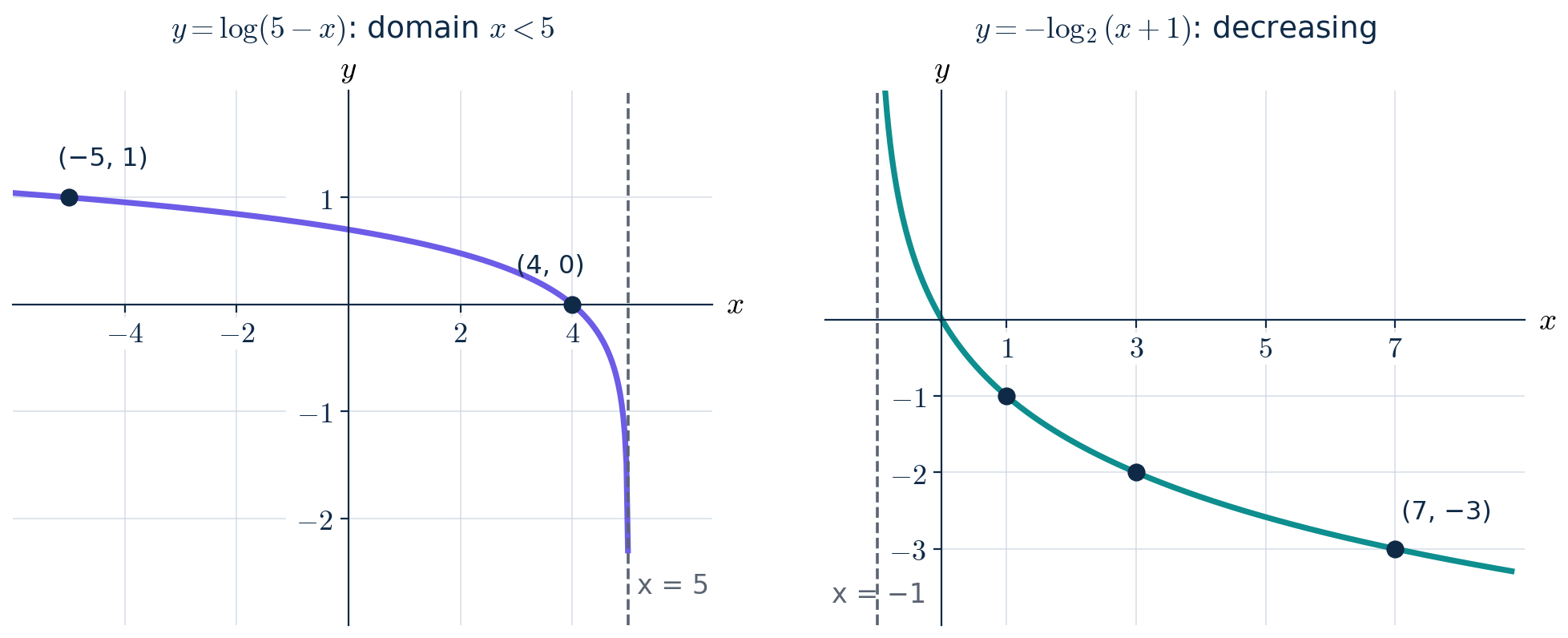
Left: exists only for and drops toward the asymptote . Right: decreases, passing , , .
Check the left graph with points: and . As → 5 from the left, → , so the outputs fall to −∞.
Quick check
What is the domain of ?
Recognizing Logarithmic Data
Remember from 2.2: linear data adds equal amounts over equal input steps, and exponential data multiplies. Logarithmic data is the inverse pattern.
KEY RULE
Logarithmic: when the inputs are MULTIPLIED by a constant, the outputs ADD a constant.
| x | 1 | 3 | 9 | 27 | 81 |
|---|---|---|---|---|---|
| y | 2 | 5 | 8 | 11 | 14 |
Worked example
Example 3. Write a logarithmic model for the table above.
- 01
Inputs: each is 3 times the one before (×3). Outputs: each is 3 more . So the model is , with base 3 because the inputs are multiplied by 3.
- 02
At , , so : .
- 03
Each ×3 step raises by 1 and by 3, so .
Decreasing data works the same way: , 4, 8, 16, 32 with , 8, 6, 4, 2 (each doubling subtracts 2) fits .
REAL-LIFE EXAMPLE
Earthquake Magnitude as a Function
From 2.9: magnitude grows by 1 each time the ground motion A is multiplied by 10. With A measured relative to a standard small quake, : , 100, 1000, 10000 gives , 2, 3, 4.
Multiplying the input by 10 adds 1 to the output: the logarithmic pattern in action.
Worked example
Try it yourself. . Give the domain, the vertical asymptote, and the x-intercept.
Answers: , so the domain is and the asymptote is . gives , so the x-intercept is .
Practice
Worked example
P1. . Find , , . Is increasing or decreasing? Concave up or down?
Answer: , , : each ×10 in the input adds 3. , so increasing and concave down.
Worked example
P2. . Find the domain, the asymptote, and , , .
Answer: Domain , asymptote . , , .
Worked example
P3. . Find the domain, , and the x-intercept.
Answer: , so . . x-intercept: , so and .
Common slips
“ has its asymptote at .”
A logarithm's asymptote is vertical. The +1 lifts the whole curve, but lifting a vertical line doesn't move it. The asymptote is , from setting the inside equal to 0.
“ is the same as .”
A logarithm doesn't distribute over subtraction. At : , but . (2.12 shows the rules logs do follow.)
Lock it in
Try the flashcards
15 cards · Logarithms, Log or exponential graph?
Recap card
5 lines to re-read the night before.
- 01
: domain , range all reals, vertical asymptote , x-intercept . Always increasing or decreasing; always concave one way.
- 02
: domain , asymptote (set the inside = 0). shifts the graph but not the asymptote.
- 03
A minus sign outside flips over the x-axis; a minus sign inside (like ) flips the domain to the left.
- 04
Logarithmic data: multiplying the inputs by a constant adds a constant to the outputs.
- 05
Next, in 2.12: the product, quotient, and power rules for logarithms, and changing bases.