FiveWay Premium

Unlock every question

1,292 more practice questions, 134 Killer problems, timed mock exams in the 2027 format, and sets built from the skills you miss.

Current accessGuestYou are browsing without an account. Sign in to keep your record.

Free

Always, no account needed to read

  • A 7-question diagnostic and the first 8 practice questions in every topic
  • A worked solution and a note on each wrong choice for those questions
  • Every concept note, in every chapter
  • Your record and My page

Premium

Everything in Free, plus

  • The other 1,292 questions — every chapter, to the end
  • 134 Killer problems, pitched above the exam ceiling
  • Timed mock exams in the 2027 format — 42 questions, 105 minutes
  • Sets built from the skills you keep missing, refilled weekly
  • Analytics — accuracy per skill, time per question, your weak chapters
Unlock early access

Early access is free while we test. No card, no timer. Compare plans

Sign in to FiveWay

Sign in to keep your answers and see which skills to fix.

  • Free to start
  • No password
  • Progress saved on every device

We store your answers and the skills they belong to. Your first name and last initial appear only on the leaderboard and in Community.

Topic 2.12

Logarithmic Function Manipulation

In 2.9 we found that Nova reaches 10,000 subscribers at t=log⁡1.539.0625t = \log_{1.5} 39.0625, somewhere between 9 and 10, but no calculator has alog⁡1.5a \log_{1.5} key. This note gives the rules that let you rearrange logarithms. One of them, the change of base formula, finally lets you compute that number.

11 MIN READ8 IDEAS34 PROBLEMS14 flashcards

Remember from 2.4: the exponent rules bm⋅bn=bm+nb^{m} \cdot b^{n} = b^{m+n}, bm/bn=bm−nb^{m} / b^{n} = b^{m-n}, and (bm)p=bmp(b^{m})^{p} = b^{mp}. A logarithm IS an exponent (2.9), so every exponent rule turns into a logarithm rule. If you ever forget a log rule, rebuild it from the exponent rule, as we do below.

A note on notation: log⁡b\log_{b} means “logarithm with base b” (the bb is written small and low in print). log without a base means base 10, and ln means base ee.

01

The Three Rules

CONCEPT

Properties of Logarithms (MM, N>0N > 0)

Product rule: the log of a product is the SUM of the logs.

Quotient rule: the log of a quotient is the DIFFERENCE of the logs.

Power rule: an exponent inside the log comes out in front as a MULTIPLIER.

log⁡b(MN)=log⁡bM+log⁡bNlog⁡b(MN)=log⁡bM−log⁡bNlog⁡b(Mp)=plog⁡bM\log_b(MN) = \log_b M + \log_b N \qquad \log_b\left(\tfrac{M}{N}\right) = \log_b M - \log_b N \qquad \log_b(M^{p}) = p\log_b M

Each rule comes straight from an exponent rule. Name the two logarithms first: let m=log⁡bMm = \log_{b} M and n=log⁡bNn = \log_{b} N. By the definition of a logarithm, that means M=bmM = b^{m} and N=bnN = b^{n}.

  1. 01

    Product: multiplying powers ADDS exponents, so the log (the exponent) of MNMN is m+nm + n.

M=bm,  N=bn  ⇒  MN=bm+n  ⇒  log⁡b(MN)=m+n=log⁡bM+log⁡bNM = b^{m},\; N = b^{n} \;\Rightarrow\; MN = b^{m+n} \;\Rightarrow\; \log_b(MN) = m + n = \log_b M + \log_b N
  1. 02

    Quotient: dividing powers SUBTRACTS exponents.

MN=bmbn=bm−n  ⇒  log⁡bMN=m−n=log⁡bM−log⁡bN\frac{M}{N} = \frac{b^{m}}{b^{n}} = b^{m-n} \;\Rightarrow\; \log_b \frac{M}{N} = m - n = \log_b M - \log_b N
  1. 03

    Power: raising a power to a power MULTIPLIES exponents.

Mp=(bm)p=bmp  ⇒  log⁡b(Mp)=mp=plog⁡bMM^{p} = (b^{m})^{p} = b^{mp} \;\Rightarrow\; \log_b(M^{p}) = mp = p\log_b M

Now check each rule with numbers you can do by hand:

ruleleft sideright side
productlog⁡2(8⋅4)=log⁡232=5\log_{2}(8 \cdot 4) = \log_{2} 32 = 5log⁡28+log⁡24=3+2=5\log_{2} 8 + \log_{2} 4 = 3 + 2 = 5
quotientlog⁡3(81/9)=log⁡39=2\log_{3}(81/9) = \log_{3} 9 = 2log⁡381−log⁡39=4−2=2\log_{3} 81 - \log_{3} 9 = 4 - 2 = 2
powerlog⁡2(82)=log⁡264=6\log_{2}(8^{2}) = \log_{2} 64 = 62⋅log⁡28=2⋅3=62 \cdot \log_{2} 8 = 2 \cdot 3 = 6
02

Using the Rules With Known Values

The rules let you build new logarithms from ones you already know. Suppose you are told log⁡2≈0.3010\log 2 \approx 0.3010 and log⁡3≈0.4771\log 3 \approx 0.4771.

Worked example

Use log⁡2≈0.3010\log 2 \approx 0.3010 and log⁡3≈0.4771\log 3 \approx 0.4771 to find log⁡6\log 6, log⁡18\log 18, log⁡(1/9)\log(1/9), and log⁡1.5\log 1.5.

  1. 01

    6=2⋅36 = 2 \cdot 3, so by the product rule log⁡6=log⁡2+log⁡3≈0.3010+0.4771=0.7781\log 6 = \log 2 + \log 3 \approx 0.3010 + 0.4771 = 0.7781.

  2. 02

    18=2⋅3218 = 2 \cdot 3^{2}, so log⁡18=log⁡2+2log⁡3≈0.3010+0.9542=1.2552\log 18 = \log 2 + 2 \log 3 \approx 0.3010 + 0.9542 = 1.2552.

  3. 03

    1/9=3−21/9 = 3^{-2}, so by the power rule log⁡(1/9)=−2log⁡3≈−0.9542\log(1/9) = -2 \log 3 \approx -0.9542.

  4. 04

    1.5=3/21.5 = 3/2, so by the quotient rule log⁡1.5=log⁡3−log⁡2≈0.1761\log 1.5 = \log 3 - \log 2 \approx 0.1761. (That's the number you'll see as Nova's slope in 2.15.)

    A calculator gives log⁡6≈0.7782\log 6 \approx 0.7782 and log⁡18≈1.2553\log 18 \approx 1.2553. The last digit differs because log⁡2\log 2 and log⁡3\log 3 were already rounded; rounding errors add up. Keep full calculator values until the final answer.

03

Expanding a Logarithm

Expanding means breaking one logarithm of a complicated expression into many simple logarithms. Work from the outside in: first split the division, then the multiplication, then bring down the exponents. Rewrite roots as fractional powers first (x=x1/2\sqrt{x} = x^{1/2}).

Worked example

Example 1. Expand log⁡(100x3/y)\log(100x^{3}/y).

  1. 01

    Quotient rule: log⁡(100x3)−log⁡y\log(100x^{3}) - \log y.

  2. 02

    Product rule: log⁡100+log⁡x3−log⁡y\log 100 + \log x^{3} - \log y.

  3. 03

    Power rule and log⁡100=2\log 100 = 2 (because 102=10010^{2} = 100):

    log⁡(100 x3y)=log⁡100+log⁡x3−log⁡y=2+3log⁡x−log⁡y\log\left(\frac{100\,x^{3}}{y}\right) = \log 100 + \log x^{3} - \log y = 2 + 3\log x - \log y

Worked example

Example 2. Expand ln⁡(x/e2)\ln(\sqrt{x} / e^{2}).

  1. 01

    Rewrite the root: x=x1/2\sqrt{x} = x^{1/2}. Then the quotient rule: ln⁡x1/2−ln⁡e2\ln x^{1/2} - \ln e^{2}.

  2. 02

    Power rule on both, and ln⁡e=1\ln e = 1:

    ln⁡xe2=ln⁡x1/2−ln⁡e2=12ln⁡x−2\ln\frac{\sqrt{x}}{e^{2}} = \ln x^{1/2} - \ln e^{2} = \tfrac{1}{2}\ln x - 2

Worked example

Example 3. Expand log⁡2(8x2/y)\log_{2}(8x^{2} / \sqrt{y}).

  1. 01

    Split into three pieces: log⁡28+log⁡2x2−log⁡2y1/2\log_{2} 8 + \log_{2} x^{2} - \log_{2} y^{1/2}.

  2. 02

    log⁡28=3\log_{2} 8 = 3, and bring down both exponents:

    log⁡28x2y=log⁡28+log⁡2x2−log⁡2y1/2=3+2log⁡2x−12log⁡2y\log_2 \frac{8x^{2}}{\sqrt{y}} = \log_2 8 + \log_2 x^{2} - \log_2 y^{1/2} = 3 + 2\log_2 x - \tfrac{1}{2}\log_2 y

Quick check

Expand log⁡2(8x3)\log_2(8x^3).

04

Condensing Into One Logarithm

Condensing runs the rules backwards. Order matters: FIRST move every coefficient back inside as an exponent (power rule), THEN combine: plus signs become multiplication, minus signs become division.

Worked example

Example 4. Condense 2ln⁡x+ln⁡5−ln⁡32 \ln x + \ln 5 - \ln 3.

  1. 01

    Power rule first: 2ln⁡x=ln⁡x22 \ln x = \ln x^{2}.

  2. 02

    Then combine: the + terms go on top, the − term goes on the bottom:

    2ln⁡x+ln⁡5−ln⁡3=ln⁡x2+ln⁡5−ln⁡3=ln⁡(5x23)2\ln x + \ln 5 - \ln 3 = \ln x^{2} + \ln 5 - \ln 3 = \ln\left(\frac{5x^{2}}{3}\right)
  3. 03

    Check at x=1x = 1: the left side is 0+ln⁡5−ln⁡3≈0.51080 + \ln 5 - \ln 3 \approx 0.5108, and the right side is ln⁡(5/3)≈0.5108\ln(5/3) \approx 0.5108 ✓.

Worked example

Example 5. Condense 12log⁡x−3log⁡y+log⁡5\tfrac{1}{2} \log x - 3 \log y + \log 5.

  1. 01

    Power rule on each coefficient: 12log⁡x=log⁡x1/2=log⁡x\tfrac{1}{2} \log x = \log x^{1/2} = \log \sqrt{x}, and 3log⁡y=log⁡y33 \log y = \log y^{3}.

  2. 02

    Combine: x\sqrt{x} and 5 are added (top), y3y^{3} is subtracted (bottom):

    12log⁡x−3log⁡y+log⁡5=log⁡x1/2−log⁡y3+log⁡5=log⁡5xy3\tfrac{1}{2}\log x - 3\log y + \log 5 = \log x^{1/2} - \log y^{3} + \log 5 = \log \frac{5\sqrt{x}}{y^{3}}

    Condensing can also simplify numbers: ln⁡12−2ln⁡2=ln⁡12−ln⁡4=ln⁡(12/4)=ln⁡3\ln 12 - 2 \ln 2 = \ln 12 - \ln 4 = \ln(12/4) = \ln 3.

    The rules only work in these exact shapes. These look similar but are all FALSE. Each row shows a value where the two sides differ:

    false statementleft sideright side
    log⁡(M+N)=log⁡M\log(M + N) = \log M + log⁡N\log Nlog⁡(2+8)=1\log(2 + 8) = 1log⁡2\log 2 + log⁡8≈1.2041\log 8 \approx 1.2041
    log⁡(M/N)\log(M / N) = log⁡M\log M / log⁡N\log Nlog⁡(100/10)=1\log(100/10) = 1log⁡100\log 100 / log⁡10\log 10 = 2
    (log⁡M)2=2log⁡M(\log M)^{2} = 2 \log M(log⁡1000)2=9(\log 1000)^{2} = 92log⁡10002 \log 1000 = 6
    log⁡(3M)=3log⁡M\log(3M) = 3 \log Mlog⁡30≈1.4771\log 30 \approx 1.47713log⁡103 \log 10 = 3

COMMON MISTAKE

“ln⁡(e+e)=ln⁡e+ln⁡e=2\ln(e + e) = \ln e + \ln e = 2.”

There is no rule for the log of a SUM. ln⁡(e+e)=ln⁡(2e)=ln⁡2+1≈1.6931\ln(e + e) = \ln(2e) = \ln 2 + 1 \approx 1.6931. The product rule turns a product inside the log into a sum outside, never the other way around.

“(log⁡x)2=2log⁡x(\log x)^{2} = 2 \log x by the power rule.”

The power rule needs the exponent INSIDE the log: log⁡(x2)=2log⁡x\log(x^{2}) = 2 \log x. In (log⁡x)2(\log x)^{2} the whole log is squared, which is a different number (9 versus 6 at x=1000x = 1000).

“2ln⁡x+ln⁡5=ln⁡(2x⋅5)2 \ln x + \ln 5 = \ln(2x \cdot 5).”

The 2 is an exponent in disguise, not a factor. Move it inside first: ln⁡(x2⋅5)=ln⁡(5x2)\ln(x^{2} \cdot 5) = \ln(5x^{2}).

Worked example

Try it yourself. (a) Expand log⁡2(8x5)\log_{2}(8x^{5}). (b) Condense 3ln⁡2+ln⁡x−ln⁡43 \ln 2 + \ln x - \ln 4.

Answers: (a) 3+5log⁡2x3 + 5 \log_{2} x. (b) ln⁡8+ln⁡x−ln⁡4=ln⁡(8x/4)=ln⁡(2x)\ln 8 + \ln x - \ln 4 = \ln(8x/4) = \ln(2x).

Quick check

Write 2log⁡5x−log⁡5y2\log_5 x - \log_5 y as a single logarithm.

05

Change of Base

CONCEPT

Change of Base Formula

Any logarithm can be computed with the log or ln key: divide the log of the input by the log of the base.

It works with ln or with log, as long as you use the same one on top and bottom.

log⁡bc=log⁡clog⁡b=ln⁡cln⁡b\log_b c = \frac{\log c}{\log b} = \frac{\ln c}{\ln b}

Why it works: name the unknown logarithm a, rewrite in exponential form, and take ln of both sides:

a=log⁡bc  ⇒  ba=c  ⇒  ln⁡(ba)=ln⁡c  ⇒  aln⁡b=ln⁡c  ⇒  a=ln⁡cln⁡ba = \log_b c \;\Rightarrow\; b^{a} = c \;\Rightarrow\; \ln(b^{a}) = \ln c \;\Rightarrow\; a\ln b = \ln c \;\Rightarrow\; a = \frac{\ln c}{\ln b}

Worked example

Example 6. Compute log⁡220\log_{2} 20 and log⁡650\log_{6} 50.

  1. 01

    log⁡220\log_{2} 20:

    log⁡220=ln⁡20ln⁡2≈2.99570.6931≈4.3219\log_2 20 = \frac{\ln 20}{\ln 2} \approx \frac{2.9957}{0.6931} \approx 4.3219
  2. 02

    Check: 24=162^{4} = 16 and 25=322^{5} = 32, so an answer between 4 and 5 makes sense (2.9).

  3. 03

    log⁡650=ln⁡50/ln⁡6≈2.1833\log_{6} 50 = \ln 50 / \ln 6 \approx 2.1833. Check: 62.1833≈50.06^{2.1833} \approx 50.0 ✓.

REAL-LIFE EXAMPLE

Nova, Solved

Finally: the month when Nova reaches 10,000 subscribers.

log⁡1.539.0625=ln⁡39.0625ln⁡1.5≈9.0394\log_{1.5} 39.0625 = \frac{\ln 39.0625}{\ln 1.5} \approx 9.0394

Using log instead of ln gives the same 9.0394. So Nova crosses 10,000 about 9.04 months after launch.

COMMON MISTAKE

“log⁡1.539.0625=log⁡39.0625−log⁡1.5\log_{1.5} 39.0625 = \log 39.0625 - \log 1.5.”

Change of base is a DIVISION of two logs, not a subtraction. Subtraction belongs to the log of a quotient, log⁡(M/N)\log(M/N), which is a different expression.

06

What the Rules Say About Graphs

Each rule is also a statement about transformations of the graph.

CONCEPT

Graphical Meaning

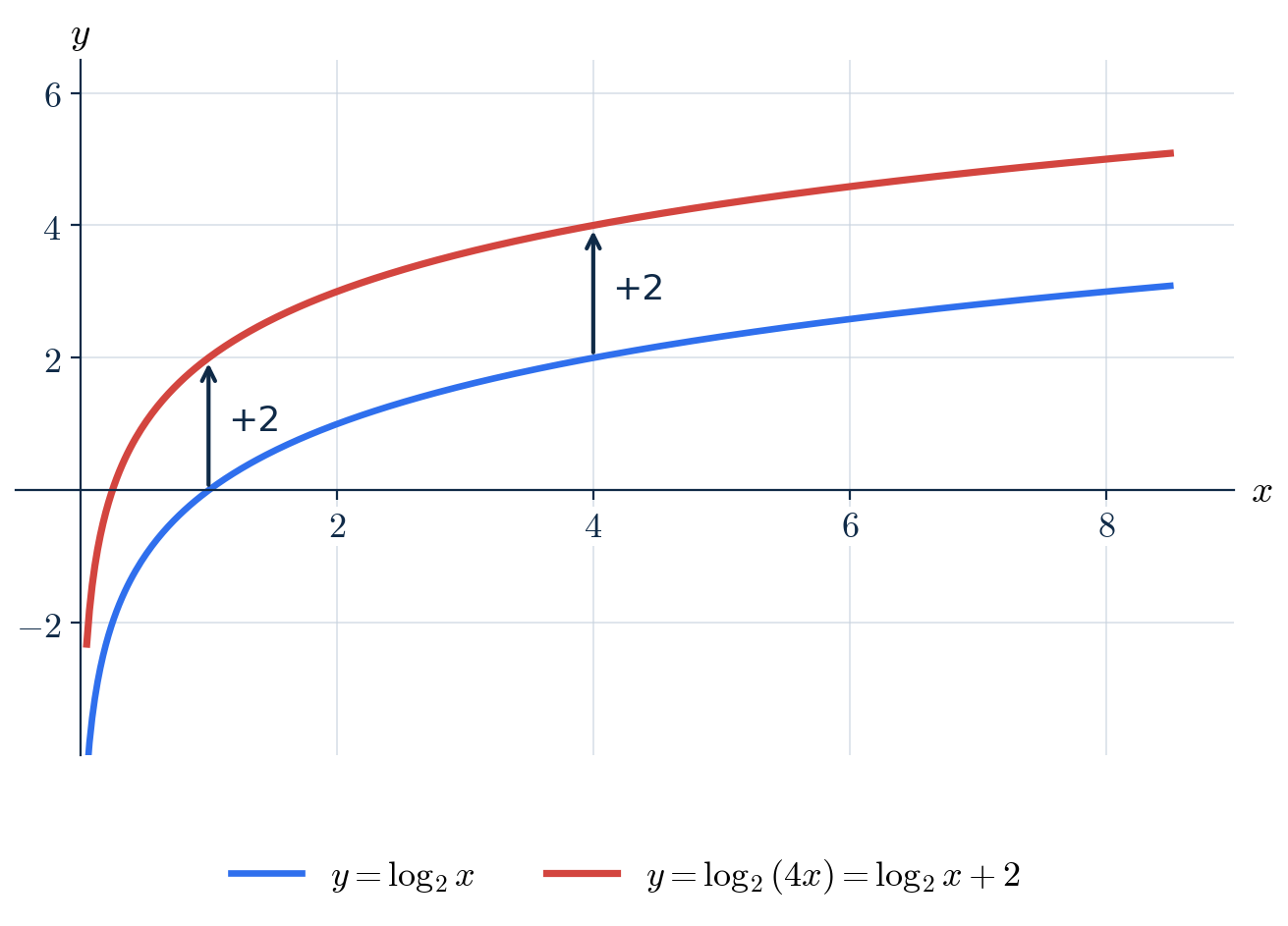
Product rule: log⁡b(kx)=log⁡bk\log_{b}(kx) = \log_{b} k + log⁡bx\log_{b} x. Multiplying the input by kk (a horizontal stretch or compression) is the same as a vertical SHIFT by log⁡bk\log_{b} k.

Power rule: log⁡b(xk)=klog⁡bx\log_{b}(x^{k}) = k \log_{b} x for x>0x > 0. Raising the input to a power is a vertical STRETCH by kk.

Change of base: log⁡bx=1ln⁡b⋅ln⁡x\log_{b} x = \dfrac{1}{\ln b} \cdot \ln x. Every logarithmic function is a vertical stretch of ln⁡x\ln x. For example log⁡2x≈1.4427ln⁡x\log_{2} x \approx 1.4427 \ln x and log⁡3x≈0.9102ln⁡x\log_{3} x \approx 0.9102 \ln x.

Figure

Multiplying the input by 4 lifts the whole graph of log⁡2x\log_{2} x by log⁡24=2\log_{2} 4 = 2.

Two more quick examples: log⁡2(8x)=3+log⁡2x\log_{2}(8x) = 3 + \log_{2} x is the graph of log⁡2x\log_{2} x moved up 3, and log⁡(x3)=3log⁡x\log(x^{3}) = 3 \log x is the graph of log⁡x\log x stretched vertically by 3 (at x=5x = 5 both sides equal log⁡125\log 125).

Remember from 2.4: for exponentials, a horizontal SHIFT was the same as a vertical STRETCH. Logarithms swap the roles: a horizontal STRETCH is the same as a vertical SHIFT.

07

Practice

Worked example

P1. Evaluate log⁡64+log⁡69\log_{6} 4 + \log_{6} 9 without a calculator.

Answer: Product rule: log⁡636=2\log_{6} 36 = 2.

Worked example

P2. Evaluate log⁡354−log⁡32\log_{3} 54 - \log_{3} 2 without a calculator.

Answer: Quotient rule: log⁡327=3\log_{3} 27 = 3.

Worked example

P3. Use change of base to find log⁡7100\log_{7} 100 and log⁡540\log_{5} 40, to 4 decimal places.

Answer: ln⁡100/ln⁡7≈2.3666\ln 100 / \ln 7 \approx 2.3666 and ln⁡40/ln⁡5≈2.2920\ln 40 / \ln 5 \approx 2.2920.

Worked example

P4. Evaluate log⁡1/48\log_{1/4} 8 by writing both numbers as powers of 2.

Answer: (1/4)a=8(1/4)^{a} = 8 means 2−2a=232^{-2a} = 2^{3}, so a=−3/2a = -3/2.

Worked example

P5. Expand log⁡3(9/x4)\log_{3}(9/x^{4}).

Answer: log⁡39−log⁡3x4=2−4log⁡3x\log_{3} 9 - \log_{3} x^{4} = 2 - 4 \log_{3} x.

Worked example

P6. Condense 2log⁡x+log⁡3−log⁡122 \log x + \log 3 - \log 12.

Answer: log⁡x2+log⁡3−log⁡12=log⁡(3x2/12)=log⁡(x2/4)\log x^{2} + \log 3 - \log 12 = \log(3x^{2}/12) = \log(x^{2}/4).

Common slips

  • “ln⁡(e+e)=ln⁡e+ln⁡e=2\ln(e + e) = \ln e + \ln e = 2.”

    There is no rule for the log of a sum. ln⁡(e+e)=ln⁡(2e)=ln⁡2+1≈1.6931\ln(e + e) = \ln(2e) = \ln 2 + 1 \approx 1.6931. The product rule turns a product inside the log into a sum outside, never the other way around.

    “(log⁡x)2=2log⁡x(\log x)^{2} = 2 \log x by the power rule.”

    The power rule needs the exponent inside the log: log⁡(x2)=2log⁡x\log(x^{2}) = 2 \log x. In (log⁡x)2(\log x)^{2} the whole log is squared, which is a different number (9 versus 6 at x=1000x = 1000).

    “2ln⁡x+ln⁡5=ln⁡(2x⋅5)2 \ln x + \ln 5 = \ln(2x \cdot 5).”

    The 2 is an exponent in disguise, not a factor. Move it inside first: ln⁡(x2⋅5)=ln⁡(5x2)\ln(x^{2} \cdot 5) = \ln(5x^{2}).

  • “log⁡1.539.0625=log⁡39.0625−log⁡1.5\log_{1.5} 39.0625 = \log 39.0625 - \log 1.5.”

    Change of base is a division of two logs, not a subtraction. Subtraction belongs to the log of a quotient, log⁡(M/N)\log(M/N), which is a different expression.

Lock it in

Try the flashcards

14 cards · Logarithms, Log rules and equations

Start

Recap card

5 lines to re-read the night before.

  1. 01

    Product: log⁡(MN)=log⁡M+log⁡N\log(MN) = \log M + \log N. Quotient: log⁡(M/N)=log⁡M−log⁡N\log(M/N) = \log M - \log N. Power: log⁡(Mp)=plog⁡M\log(M^{p}) = p \log M. Each comes from an exponent rule.

  2. 02

    Expand from the outside in (division, then multiplication, then exponents). Condense in the reverse order: coefficients go inside first.

  3. 03

    There is no rule for log⁡(M+N)\log(M + N), log⁡M/log⁡N\log M / \log N, or (log⁡M)2(\log M)^{2}; test suspicious steps with numbers.

  4. 04

    Change of base: log⁡bc=ln⁡c/ln⁡b\log_{b} c = \ln c / \ln b. This computes any logarithm, like Nova's log⁡1.539.0625≈9.0394\log_{1.5} 39.0625 \approx 9.0394.

  5. 05

    Graphs: log⁡(kx)\log(kx) is a vertical shift of log⁡x\log x; log⁡(xk)\log(x^{k}) is a vertical stretch. Next, in 2.13: solving exponential and logarithmic equations.

Premium feature

Unlock Premium

Every question, sets from your misses, mock exams and more.

Current accessFree

  • Every practice question
  • Sets from your misses
  • Mock exams

Free during early access — no card. Your progress stays exactly where it is. Compare plans