FiveWay Premium

Unlock every question

1,292 more practice questions, 134 Killer problems, timed mock exams in the 2027 format, and sets built from the skills you miss.

Current accessGuestYou are browsing without an account. Sign in to keep your record.

Free

Always, no account needed to read

  • A 7-question diagnostic and the first 8 practice questions in every topic
  • A worked solution and a note on each wrong choice for those questions
  • Every concept note, in every chapter
  • Your record and My page

Premium

Everything in Free, plus

  • The other 1,292 questions — every chapter, to the end
  • 134 Killer problems, pitched above the exam ceiling
  • Timed mock exams in the 2027 format — 42 questions, 105 minutes
  • Sets built from the skills you keep missing, refilled weekly
  • Analytics — accuracy per skill, time per question, your weak chapters
Unlock early access

Early access is free while we test. No card, no timer. Compare plans

Sign in to FiveWay

Sign in to keep your answers and see which skills to fix.

  • Free to start
  • No password
  • Progress saved on every device

We store your answers and the skills they belong to. Your first name and last initial appear only on the leaderboard and in Community.

Topic 2.13A

Exponential and Logarithmic Equations and Inequalities

For most of this unit we have answered “when?” questions with tables: when does Nova pass Ridge, when does it reach 10,000, when does the caffeine drop low enough to sleep? Now we have every tool needed to solve them exactly. This note (2.13A) solves equations and inequalities where the unknown is in an EXPONENT. 2.13B solves equations with the unknown inside a LOGARITHM.

10 MIN READ7 IDEAS34 PROBLEMS14 flashcards

Remember from 2.9 and 2.12: a logarithm undoes an exponential, and the power rule log⁡(Mp)=plog⁡M\log(M^{p}) = p \log M brings an exponent down to where you can solve for it.

01

Method 1: Make the Bases Match

CONCEPT

Same Base, Same Exponent

Exponential functions are one-to-one (2.8): different exponents always give different results. So if bm=bnb^{m} = b^{n}, then m=nm = n.

If both sides can be written as powers of the same base, set the exponents equal.

Worked example

Example 1. Solve 2x+1=322^{x + 1} = 32 and 9x=27x−19^{x} = 27^{x - 1}.

  1. 01

    32=2532 = 2^{5}, so 2x+1=252^{x + 1} = 2^{5}. Set the exponents equal: x+1=5x + 1 = 5, so x=4x = 4.

  2. 02

    9 and 27 are both powers of 3: 9=329 = 3^{2} and 27=3327 = 3^{3}. Rewrite and use the power rule for exponents (2.4):

    9x=27x−1  ⇒  32x=33x−3  ⇒  2x=3x−3  ⇒  x=39^{x} = 27^{x-1} \;\Rightarrow\; 3^{2x} = 3^{3x-3} \;\Rightarrow\; 2x = 3x - 3 \;\Rightarrow\; x = 3
  3. 03

    Check: 93=7299^{3} = 729 and 272=72927^{2} = 729 ✓.

Quick check

Solve 3⋅2x=963 \cdot 2^x = 96.

02

Method 2: Take a Logarithm of Both Sides

Most equations don't have a common base. For those, take ln (or log) of both sides and use the power rule to bring the exponent down.

CONCEPT

Why Taking ln Is Allowed

If two positive numbers are equal, their logarithms are equal, because ln is a function: the same input always gives the same output. So from A=BA = B you may write ln⁡A=ln⁡B\ln A = \ln B, just as you may add 3 to both sides or square both sides.

Both sides must be positive. After isolating an exponential like 1.5t1.5^{t}, they always are.

1.5t=39.0625⇒ln⁡(1.5t)=ln⁡(39.0625)1.5^{t} = 39.0625 \quad\Rightarrow\quad \ln(1.5^{t}) = \ln(39.0625)

Worked example

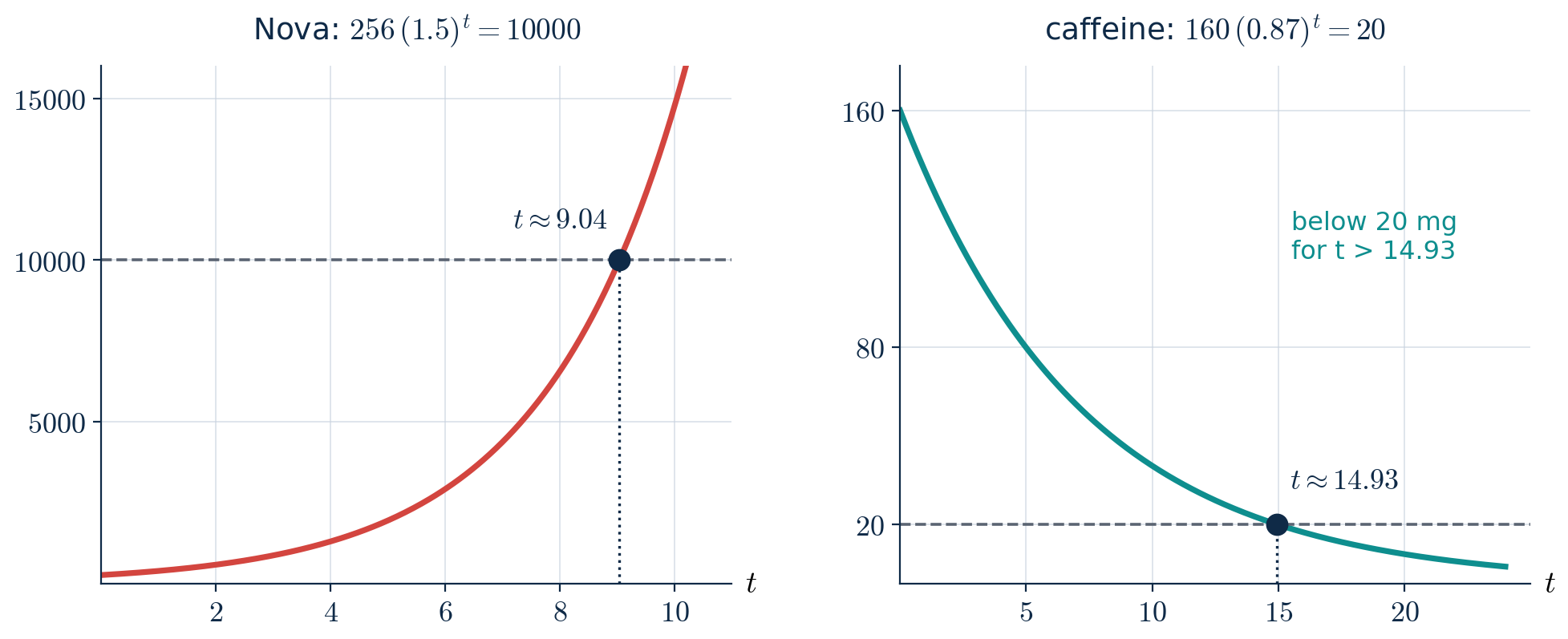
Example 2. When does Nova reach 10,000 subscribers? Solve 256(1.5)t=10000256(1.5)^{t} = 10000.

  1. 01

    Isolate the exponential first: divide both sides by 256 to get 1.5t=39.06251.5^{t} = 39.0625.

  2. 02

    Take ln of both sides: ln⁡(1.5t)=ln⁡39.0625\ln(1.5^{t}) = \ln 39.0625.

  3. 03

    Power rule: the exponent tt comes down in front: t⋅ln⁡1.5=ln⁡39.0625t \cdot \ln 1.5 = \ln 39.0625.

  4. 04

    ln⁡1.5\ln 1.5 is just a number (about 0.4055), so divide by it:

    1.5t=39.0625  ⇒  ln⁡(1.5t)=ln⁡39.0625  ⇒  tln⁡1.5=ln⁡39.0625  ⇒  t=ln⁡39.0625ln⁡1.5≈9.041.5^{t} = 39.0625 \;\Rightarrow\; \ln(1.5^{t}) = \ln 39.0625 \;\Rightarrow\; t\ln 1.5 = \ln 39.0625 \;\Rightarrow\; t = \frac{\ln 39.0625}{\ln 1.5} \approx 9.04
  5. 05

    Nova reaches 10,000 subscribers about 9.04 months after launch. Check: 256(1.5)9.04≈10,000256(1.5)^{9.04} \approx 10,000 ✓. The question from 2.1 is finally answered exactly.

    Using log instead of ln gives the same answer: log⁡39.0625/log⁡1.5≈9.04\log 39.0625 / \log 1.5 \approx 9.04. Any base works, as long as you use it on both sides.

Worked example

Example 3. Solve 3⋅5x−4=713 \cdot 5^{x} - 4 = 71 and 4e0.3x=504 e^{0.3x} = 50.

  1. 01

    3⋅5x−4=713 \cdot 5^{x} - 4 = 71: add 4 to get 3⋅5x=753 \cdot 5^{x} = 75.

  2. 02

    Divide by 3: 5x=25=525^{x} = 25 = 5^{2}, so x=2x = 2. (Method 1 works once the exponential is alone.)

  3. 03

    4e0.3x=504 e^{0.3x} = 50: divide by 4, then take ln. Since ln undoes ee, ln⁡(e0.3x)=0.3x\ln(e^{0.3x}) = 0.3x:

    4e0.3x=50  ⇒  e0.3x=12.5  ⇒  0.3x=ln⁡12.5  ⇒  x=ln⁡12.50.3≈8.4194e^{0.3x} = 50 \;\Rightarrow\; e^{0.3x} = 12.5 \;\Rightarrow\; 0.3x = \ln 12.5 \;\Rightarrow\; x = \frac{\ln 12.5}{0.3} \approx 8.419

COMMON MISTAKE

“3⋅5x=753 \cdot 5^{x} = 75, so ln⁡(3⋅5x)=xln⁡15\ln(3 \cdot 5^{x}) = x \ln 15.”

The 3 is not part of the base, so you can't combine it with 5. Isolate the exponential FIRST (5x=255^{x} = 25), then take logs. At x=2x = 2, ln⁡75≈4.3175\ln 75 \approx 4.3175 but 2ln⁡15≈5.41612 \ln 15 \approx 5.4161, so the shortcut is simply wrong.

REAL-LIFE EXAMPLE

Two “When” Questions

Caffeine: when does 160(0.87)t160(0.87)^{t} drop to 20 mg? Divide by 160: 0.87t=0.1250.87^{t} = 0.125. Take ln: t=ln⁡0.125/ln⁡0.87≈14.93t = \ln 0.125 / \ln 0.87 \approx 14.93 hours. Check with the half-life form from 2.5A: 160 → 80 → 40 → 20 is 3 half-lives of 5 hours, about 15 hours ✓.

Coffee (2.5B): when is 20+64(0.75)t/5=4020 + 64(0.75)^{t/5} = 40? Subtract 20 and divide by 64: 0.75t/5=0.31250.75^{t/5} = 0.3125. Take ln: (t/5)ln⁡0.75=ln⁡0.3125(t/5) \ln 0.75 = \ln 0.3125, so t=5ln⁡0.3125/ln⁡0.75≈20.22t = 5 \ln 0.3125 / \ln 0.75 \approx 20.22 minutes.

03

Different Bases on Both Sides

When the unknown appears in two exponents with different bases, take ln of both sides, bring both exponents down, and collect the xx terms like a linear equation:

Worked example

Example 4. Solve 2x=3x−12^{x} = 3^{x - 1}.

  1. 01

    Take ln of both sides and use the power rule: xln⁡2=(x−1)ln⁡3x \ln 2 = (x - 1) \ln 3.

  2. 02

    Distribute: xln⁡2=xln⁡3−ln⁡3x \ln 2 = x \ln 3 - \ln 3. Move the xx terms together: ln⁡3=xln⁡3−xln⁡2=x(ln⁡3−ln⁡2)\ln 3 = x \ln 3 - x \ln 2 = x(\ln 3 - \ln 2).

  3. 03

    Divide:

    2x=3x−1  ⇒  xln⁡2=(x−1)ln⁡3  ⇒  x(ln⁡3−ln⁡2)=ln⁡3  ⇒  x=ln⁡3ln⁡3−ln⁡2≈2.70952^{x} = 3^{x-1} \;\Rightarrow\; x\ln 2 = (x - 1)\ln 3 \;\Rightarrow\; x(\ln 3 - \ln 2) = \ln 3 \;\Rightarrow\; x = \frac{\ln 3}{\ln 3 - \ln 2} \approx 2.7095
  4. 04

    Check: 22.7095≈6.542^{2.7095} \approx 6.54 and 31.7095≈6.543^{1.7095} \approx 6.54 ✓.

04

Equations That Hide a Quadratic

Remember from 2.4: 4x=(22)x=(2x)24^{x} = (2^{2})^{x} = (2^{x})^{2}. So 4x−6⋅2x+8=04^{x} - 6 \cdot 2^{x} + 8 = 0 is really a quadratic in the quantity u=2xu = 2^{x}.

Worked example

Example 5. Solve 4x−6⋅2x+8=04^{x} - 6 \cdot 2^{x} + 8 = 0, and e2x−ex−6=0e^{2x} - e^{x} - 6 = 0.

  1. 01

    Let u=2xu = 2^{x}. The equation becomes u2−6u+8=0u^{2} - 6u + 8 = 0, which factors as (u−2)(u−4)=0(u - 2)(u - 4) = 0: u=2u = 2 or u=4u = 4.

  2. 02

    Undo the substitution: 2x=22^{x} = 2 gives x=1x = 1, and 2x=42^{x} = 4 gives x=2x = 2. Both work.

  3. 03

    Let u=exu = e^{x} in the second equation: u2−u−6=(u−3)(u+2)=0u^{2} - u - 6 = (u - 3)(u + 2) = 0, so u=3u = 3 or u=−2u = -2.

  4. 04

    ex=3e^{x} = 3 gives x=ln⁡3≈1.0986x = \ln 3 \approx 1.0986. But ex=−2e^{x} = -2 has NO solution: remember from 2.3 that an exponential is always positive. Reject it. The only solution is x=ln⁡3x = \ln 3.

COMMON MISTAKE

“u=−2u = -2, so x=ln⁡(−2)x = \ln(-2).”

ln⁡(−2)\ln(-2) is undefined (2.9). Before undoing the substitution, ask whether bxb^{x} can equal that value. A negative or zero value of uu is always rejected.

05

Exponential Inequalities

Solve the matching equation, then decide which side is the answer. With logs there is one extra danger: ln⁡b\ln b is NEGATIVE when 0<b<10 < b < 1 (for example ln⁡0.87≈−0.1393\ln 0.87 \approx -0.1393), and dividing by a negative number flips the inequality.

Worked example

Example 6. When is Nova above 10,000? When is the caffeine below 20 mg?

  1. 01

    256(1.5)t>10000256(1.5)^{t} > 10000 → 1.5t>39.06251.5^{t} > 39.0625 → tln⁡1.5>ln⁡39.0625t \ln 1.5 > \ln 39.0625.

  2. 02

    ln⁡1.5>0\ln 1.5 > 0, so dividing keeps the sign: t>9.04t > 9.04 months. (Growth: above the level AFTER the crossing.)

  3. 03

    160(0.87)t<20160(0.87)^{t} < 20 → 0.87t<0.1250.87^{t} < 0.125 → tln⁡0.87<ln⁡0.125t \ln 0.87 < \ln 0.125.

  4. 04

    ln⁡0.87<0\ln 0.87 < 0, so dividing FLIPS the sign:

    0.87t<0.125  ⇒  tln⁡0.87<ln⁡0.125  ⇒  t>ln⁡0.125ln⁡0.87≈14.930.87^{t} < 0.125 \;\Rightarrow\; t\ln 0.87 < \ln 0.125 \;\Rightarrow\; t > \frac{\ln 0.125}{\ln 0.87} \approx 14.93
  5. 05

    Check with test values: at t=16t = 16, 160(0.87)16<20160(0.87)^{16} < 20 ✓, and at t=14t = 14 it is still above 20. Decay: below the level AFTER the crossing, so t>14.93t > 14.93 makes sense.

    Figure

    Each solution is the t-value where the curve crosses the horizontal line. The inequality tells you which side of the crossing you want.

COMMON MISTAKE

“tln⁡0.87<ln⁡0.125t \ln 0.87 < \ln 0.125, so t<14.93t < 14.93.”

ln⁡0.87≈−0.139\ln 0.87 \approx -0.139 is negative, so the inequality must flip. Always sanity-check with the graph: a decaying amount gets SMALLER as time goes on, so “below 20” must mean LATER times.

Worked example

Try it yourself. (a) 52x−1=1255^{2x - 1} = 125 (b) 1.06t=41.06^{t} = 4 (c) e2x−5ex+4=0e^{2x} - 5 e^{x} + 4 = 0

Answers: (a) 2x−1=32x - 1 = 3, so x=2x = 2. (b) t=ln⁡4/ln⁡1.06≈23.79t = \ln 4 / \ln 1.06 \approx 23.79. (c) u=exu = e^{x}: (u−1)(u−4)=0(u - 1)(u - 4) = 0, so ex=1e^{x} = 1 or 4: x=0x = 0 or x=ln⁡4≈1.3863x = \ln 4 \approx 1.3863.

Quick check

Solve (12)x≥18\left(\tfrac{1}{2}\right)^x \ge \tfrac{1}{8}.

06

Practice

Worked example

P1. Solve 3x+2=81x3^{x + 2} = 81^{x}.

Answer: 81=3481 = 3^{4}, so 81x=34x81^{x} = 3^{4x}. Then x+2=4xx + 2 = 4x and x=2/3x = 2/3.

Worked example

P2. From 2.5A: a town of 2,500 grows 3.5% per year. When does it reach 3,750?

Answer: 2500(1.035)t=37502500(1.035)^{t} = 3750 → 1.035t=1.51.035^{t} = 1.5, so t=ln⁡1.5/ln⁡1.035≈11.79t = \ln 1.5 / \ln 1.035 \approx 11.79 years.

Worked example

P3. An 800 mg dose has a half-life of 12 days. When is less than 80 mg left?

Answer: 800(0.5)t/12<80800(0.5)^{t/12} < 80 → (0.5)t/12<0.1(0.5)^{t/12} < 0.1 → (t/12)ln⁡0.5<ln⁡0.1(t/12) \ln 0.5 < \ln 0.1. ln⁡0.5<0\ln 0.5 < 0, so flip: t>12ln⁡0.1/ln⁡0.5≈39.86t > 12 \ln 0.1 / \ln 0.5 \approx 39.86 days.

Worked example

P4. Solve ex=7e^{x} = 7.

Answer: Take ln: x=ln⁡7≈1.9459x = \ln 7 \approx 1.9459.

Worked example

P5. Solve 2⋅3x−1=502 \cdot 3^{x - 1} = 50.

Answer: Isolate first, then take ln:

2⋅3x−1=50  ⇒  3x−1=25  ⇒  (x−1)ln⁡3=ln⁡25  ⇒  x=1+ln⁡25ln⁡3≈3.92992 \cdot 3^{x-1} = 50 \;\Rightarrow\; 3^{x-1} = 25 \;\Rightarrow\; (x - 1)\ln 3 = \ln 25 \;\Rightarrow\; x = 1 + \frac{\ln 25}{\ln 3} \approx 3.9299

Common slips

  • “3⋅5x=753 \cdot 5^{x} = 75, so ln⁡(3⋅5x)=xln⁡15\ln(3 \cdot 5^{x}) = x \ln 15.”

    The 3 is not part of the base, so you can't combine it with 5. Isolate the exponential first (5x=255^{x} = 25), then take logs. At x=2x = 2, ln⁡75≈4.3175\ln 75 \approx 4.3175 but 2ln⁡15≈5.41612 \ln 15 \approx 5.4161, so the shortcut is simply wrong.

  • “u=−2u = -2, so x=ln⁡(−2)x = \ln(-2).”

    ln⁡(−2)\ln(-2) is undefined (2.9). Before undoing the substitution, ask whether bxb^{x} can equal that value. A negative or zero value of uu is always rejected.

  • “tln⁡0.87<ln⁡0.125t \ln 0.87 < \ln 0.125, so t<14.93t < 14.93.”

    ln⁡0.87≈−0.139\ln 0.87 \approx -0.139 is negative, so the inequality must flip. Always sanity-check with the graph: a decaying amount gets smaller as time goes on, so “below 20” must mean later times.

Lock it in

Try the flashcards

14 cards · Logarithms, Log rules and equations

Start

Recap card

6 lines to re-read the night before.

  1. 01

    Same base on both sides → set the exponents equal.

  2. 02

    Otherwise: isolate the exponential, take ln of both sides (allowed because both sides are equal positive numbers), bring the exponent down with the power rule, and solve.

  3. 03

    Different bases: take ln, distribute, and collect the xx terms.

  4. 04

    Hidden quadratics: substitute u=bxu = b^{x}; reject any u≤0u \le 0, because bx>0b^{x} > 0.

  5. 05

    Inequalities: dividing by ln⁡b\ln b flips the sign when 0<b<10 < b < 1. Check with the graph or a test value.

  6. 06

    Next, in 2.13B: equations with the unknown inside a logarithm, and why some “solutions” must be thrown away.

Premium feature

Unlock Premium

Every question, sets from your misses, mock exams and more.

Current accessFree

  • Every practice question
  • Sets from your misses
  • Mock exams

Free during early access — no card. Your progress stays exactly where it is. Compare plans