
Topic 2.13B
Exponential and Logarithmic Equations and Inequalities
2.13A solved equations with the unknown in an exponent. Now the unknown sits inside a logarithm, as in . The algebra uses the same tools, rewriting between log and exponential form (2.9) and the log rules (2.12), but there is one new danger. The log rules can turn an equation into one with EXTRA solutions that don't work in the original. Checking every answer is not optional here.
8 MIN READ6 IDEAS34 PROBLEMS14 flashcards
Remember from 2.9: is defined only for . Every logarithm in an equation comes with its own domain condition.
One Logarithm: Rewrite in Exponential Form
CONCEPT
Undo the Log
If , then stuff = . Isolate the logarithm first, then rewrite.
For ln, the base is : means stuff = .
Another: gives , so x = ( + 1)/2 ≈ 10.543. Check: ✓.
Several Logarithms: Combine, Solve, CHECK
CONCEPT
The Four-Step Routine
-
DOMAIN: write down the condition that makes every log input positive.
-
COMBINE: use the product, quotient, and power rules (2.12) to get a single log on each side (or one log equal to a number).
-
SOLVE: rewrite in exponential form (or set the inputs equal) and solve the resulting equation.
-
CHECK: test every answer against the domain from step 1. Throw away any that fail.
Worked example
Example 1. Solve .
- 01
Domain first: needs , and needs . So any solution must satisfy .
- 02
Combine with the product rule, then rewrite:
- 03
Solve the quadratic: factors as , so or .
- 04
Check in the ORIGINAL: ✓.
- 05
Check : is undefined (and fails from Step 1). Reject it. The only solution is .
is called an extraneous solution: it solves the combined equation , but not the original. It appeared because the product rule quietly allowed and to be negative together, since their product is still positive.
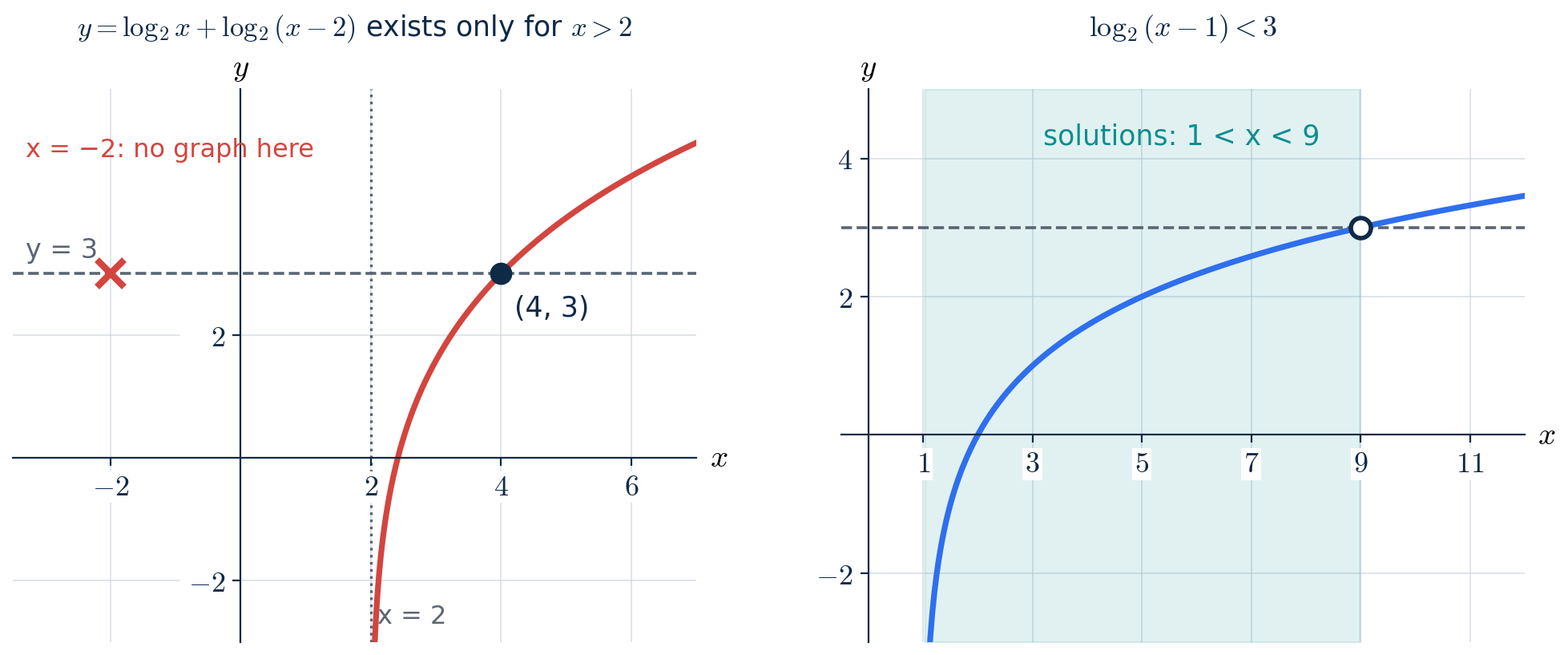
Left: the graph only exists for , so it meets once, at . Right: the solution of the inequality in Section 4.
COMMON MISTAKE
“ or . Done.”
The combined equation is not the original. Substitute each answer into the ORIGINAL equation, or check it against the domain found in Step 1. Every logarithm's input must be positive.
Worked example
Example 2. Solve .
- 01
Domain: and , so .
- 02
Quotient rule, then rewrite with base 10:
- 03
✓, so is a genuine solution: .
Worked example
Example 2b. Solve .
- 01
Domain: and , so .
- 02
Combine: , so , which is .
- 03
gives or . −5 fails : reject. works: ✓.
Quick check
Solve . Which candidate is extraneous?
Log = Log, and When Checking Saves You
If , then , because logarithms are one-to-one (2.10).
Worked example
Example 3. Solve , and then .
- 01
: , so and or . Check : and , and both sides equal ✓. BOTH solutions are valid. A negative is fine as long as every log INPUT is positive.
- 02
: the power rule gives , so and .
- 03
But the ORIGINAL has , which needs . is extraneous; the only solution is . The power rule produced , which accepted a negative that cannot.
COMMON MISTAKE
“ is negative, so it's always extraneous.”
Reject a value only when it makes some log's input zero or negative. In , makes every input 4, so it is a real solution. Check the inputs, not the sign of .
Logarithmic Inequalities
For , is increasing, so exactly when . But don't forget the domain: that gives the second half of the answer.
The left inequality comes from the domain; the right one, , comes from undoing the log. Without the domain you'd wrongly include , where is undefined.
If the base is between 0 and 1, the logarithm is DECREASING, so undoing it flips the inequality, just as dividing by a negative ln did in 2.13A:
Test: gives ✓, but gives 1, which is not > 2.
Another: means . (Here the domain is already inside the answer.)
REAL-LIFE EXAMPLE
Nova, One Year In
The inverse from 2.10 is . When does , one year? Rewrite: , so subscribers, matching from 2.4.
Worked example
Try it yourself. (a) (b)
Answers: (a) , so or ; reject −9 ( undefined). . (b) , so , which is positive ✓.
Quick check
Solve .
Practice
Worked example
P1. Solve .
Answer: , so .
Worked example
P2. Solve .
Answer: , so or . Domain : reject −4. (check: ✓).
Worked example
P3. Solve .
Answer: , so . (The domain is already included.)
Worked example
P4. Solve .
Answer: Domain . Quotient rule: , so and . Check: ✓, and ✓.
Common slips
“ or . Done.”
The combined equation is not the original. Substitute each answer into the original equation, or check it against the domain found in Step 1. Every logarithm's input must be positive.
“ is negative, so it's always extraneous.”
Reject a value only when it makes some log's input zero or negative. In , makes every input 4, so it is a real solution. Check the inputs, not the sign of .
Lock it in
Try the flashcards
14 cards · Logarithms, Log rules and equations
Recap card
3 lines to re-read the night before.
- 01
One log: isolate it and rewrite as stuff = .
- 02
Several logs: find the domain, combine with the log rules, solve, then check every answer.
- 03
Extraneous solutions come from the product, quotient, and power rules. Reject a value only if it makes some log input ≤ 0. Log inequalities: undo the log (flip if ), and add the domain condition. The answer is usually an interval with two ends. Next, in 2.14: building logarithmic models from contexts and data.