
Topic 2.8
Inverse Functions
Ridge's model answers the question “how many subscribers after months?” But the channel's owner usually asks the opposite: “how many months until we reach 3,000?” That question runs the function backwards, from output to input. A function that runs another one backwards is called its inverse.
9 MIN READ7 IDEAS33 PROBLEMS10 flashcards
Read this first
30 sec
- 01
on ⇔ on . The graph of is the reflection of across .
Remember from 2.7: the identity function changes nothing. An inverse is a function that, composed with the original, gives exactly that: it undoes everything the original did.
Undoing a Function
CONCEPT
Inverse Function
If sends input a to output , its inverse sends back to a: means = a.
Composing them in either order returns the original input.
The inputs of are the outputs of , and the outputs of are the inputs of . So the domain and range trade places.
REAL-LIFE EXAMPLE
Months Until 3,000
Solve for . The result is a new function that takes a subscriber count and returns the month:
months, and indeed . For every , : going forward and then back leaves you where you started.
COMMON MISTAKE
“ means .”
The −1 here is not an exponent. It is notation for the function that undoes . For , the inverse is , so (because ). The reciprocal is a completely different number.
From a Table: Swap the Rows
Nova's subscriber counts from 2.1:
| t (month) | 0 | 1 | 2 | 3 | 4 |
|---|---|---|---|---|---|
| N(t) | 256 | 384 | 576 | 864 | 1296 |
To get a table for , swap the rows: the subscriber counts become the inputs and the months become the outputs. For example = 3, because . We can already use from the table, even though we can't yet write its formula; that needs logarithms (2.9 and 2.10).
COMMON MISTAKE
“This table has an inverse too: : 1, 2, 3, 4, 5 and : 4, 7, 2, 7, 9.”
The output 7 comes from both and . So would have to be 2 AND 4, and a function can't give two outputs for one input. has no inverse. If an output repeats, there is no inverse.
Worked example
Example (table). is given by : 0, 1, 2, 3 and : 5, 8, 11, 14. Find , , and .
- 01
asks: which INPUT gave the output 11? , so = 2. Likewise = 3.
- 02
: , and = 2. Going forward and back returns the input 2, as it always must.
When Does an Inverse Exist?
CONCEPT
One-to-One Functions
A function is one-to-one if different inputs always give different outputs. Only one-to-one functions have inverse functions.
Horizontal line test: if some horizontal line crosses the graph more than once, the function is not one-to-one.
Functions that are always increasing or always decreasing (lines with nonzero slope, and every exponential function from 2.3) are one-to-one.
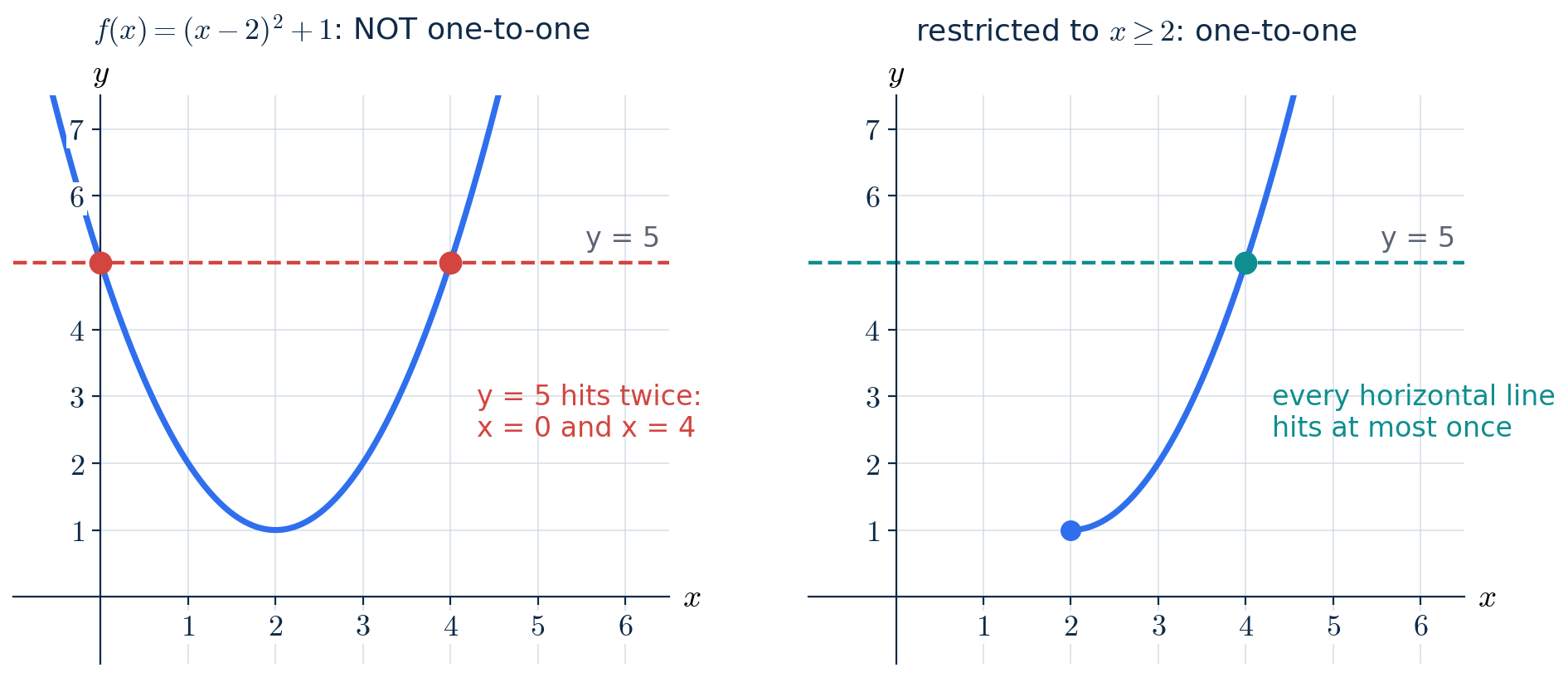
Left: crosses the parabola at and , so and has no inverse. Right: keeping only makes one-to-one.
When a function isn't one-to-one, you can often restrict its domain to a piece that is. Different restrictions give different inverses, so the restriction is part of the answer.
Quick check
A table gives at . Is invertible?
Finding an Inverse Formula
CONCEPT
Three Steps
Step 1. Write .
Step 2. Solve for in terms of .
Step 3. Rename: swap and to write . Then check with a number.
Why swap and at the end? After solving, x = (a formula in y) already IS the inverse: it takes an output and returns the input . Swapping the letters just rewrites it in the usual form, with as the input. On a graph, that swap is exactly the reflection across (Section 5).
Worked example
Example 1. Find the inverse of .
- 01
Solve for , then rename:
- 02
Check with a number: , and ✓.
- 03
Check with algebra: ✓.
Worked example
Example 2. restricted to . Find and its domain.
- 01
Solve for . Taking a square root gives TWO candidates, just as in 2.1 and 2.5A:
- 02
Now the restriction decides. We need , and is at most 2 (equal to 2 only when ), so it points to the wrong half of the parabola. Keep the + sign: .
- 03
Domain and range swap: has domain and range , so has domain and range . Check: , and ✓.
If we had restricted to instead, the other sign would win: . Same parabola, different piece, different inverse.
COMMON MISTAKE
“, so ± .”
A function must give ONE output. The ± shows two candidates; the domain restriction of picks exactly one. Without a restriction, a parabola has no inverse at all.
Worked example
Example 3. restricted to . Find .
- 01
gives , so .
- 02
The restriction keeps the + sign: , with domain (the range of f).
- 03
Check: and ✓.
Quick check
Find the inverse of .
The Graph: Reflect Across y = x
Swapping inputs and outputs turns every point on into the point on . Geometrically, that swap is a reflection across the line .
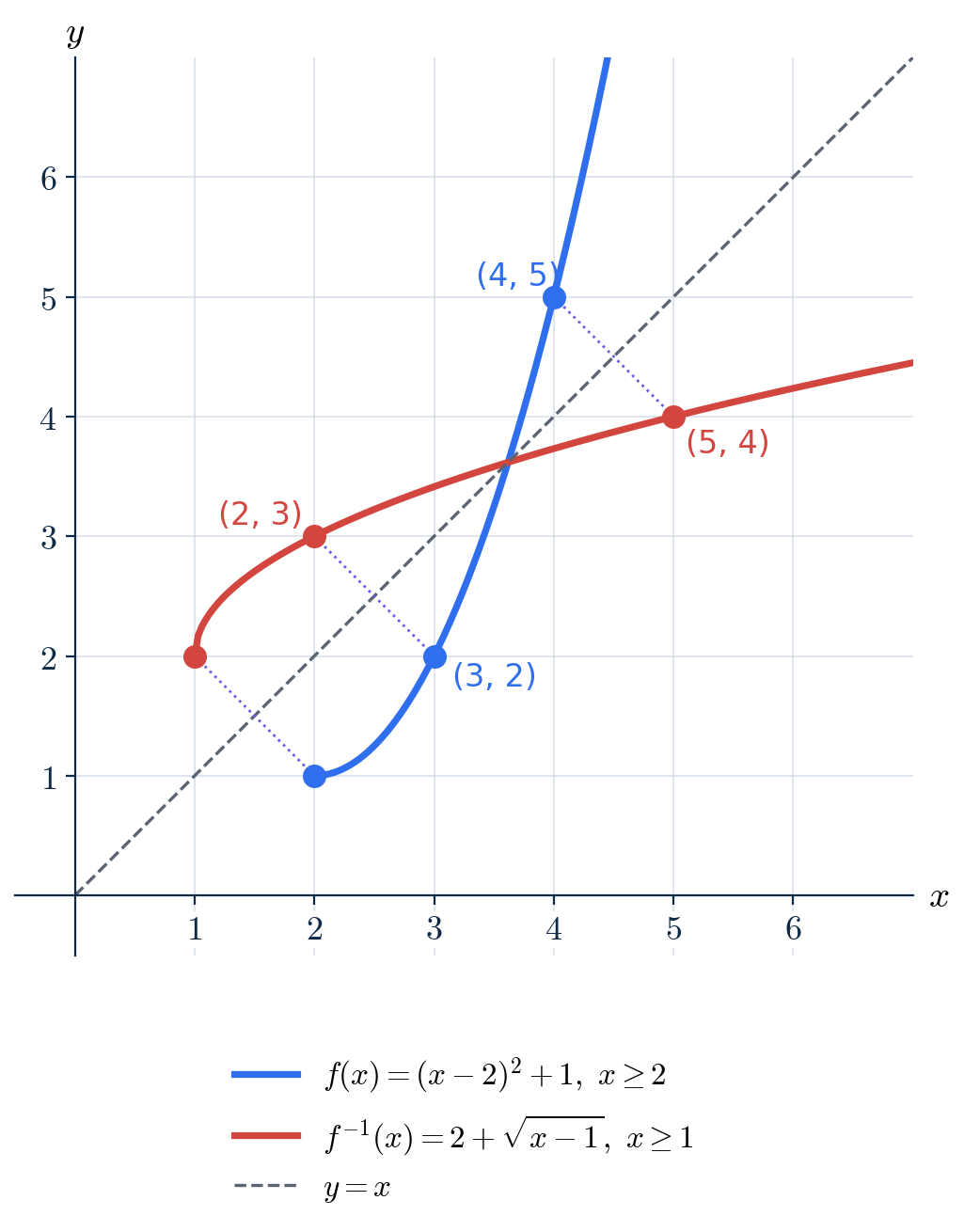
on becomes on ; becomes . The two graphs are mirror images across .
KEY RULE
on ⇔ on . The graph of is the reflection of across .
Worked example
Try it yourself. (a) Find the inverse of and check that = 3. (b) If , what is ? Which point is on the graph of ?
Answers: (a) gives , so . and ✓. (b) (9) = 2; the point .
Practice
Worked example
P1. Find the inverse of and find .
Answer: x = ∛, so = ∛. A cube root has one real value, so no restriction is needed. = ∛8 = 2.
Worked example
P2. Use to find how many months it takes Ridge to reach 4,500 subscribers.
Answer: months.
Worked example
P3. restricted to . Find , its domain, and .
Answer: ; the restriction picks the − sign: , domain . = −4, and ✓.
Worked example
P4. Find the inverse of .
Answer: . So . Check: and ✓.
Common slips
“ means .”
The −1 here is not an exponent. It is notation for the function that undoes . For , the inverse is , so (because ). The reciprocal is a completely different number.
“This table has an inverse too: : 1, 2, 3, 4, 5 and : 4, 7, 2, 7, 9.”
The output 7 comes from both and . So would have to be 2 and 4, and a function can't give two outputs for one input. has no inverse. If an output repeats, there is no inverse.
“, so ± .”
A function must give one output. The ± shows two candidates; the domain restriction of picks exactly one. Without a restriction, a parabola has no inverse at all.
Lock it in
Try the flashcards
10 cards · Composition and inverses
Recap card
5 lines to re-read the night before.
- 01
undoes : means = a, and ((x)) = . is not .
- 02
Only one-to-one functions have inverses (horizontal line test). Restrict the domain if necessary.
- 03
To find : solve for , then swap names. When a square root gives ±, the domain restriction chooses the sign.
- 04
Domain and range swap. On the graph, ↔ : a reflection across .
- 05
Next, in 2.9: the inverse of an exponential, the logarithm. It finally answers “when does Nova reach 10,000?”