
Topic 2.5A · CED: Exponential Function Context and Data Modeling
Exponential Context and Data Modeling
So far the models were handed to you: , . Real problems don't start with a formula. They start with a sentence (“the app grows 6% a week”, “caffeine has a half-life of about 5 hours”) or with a few measurements. This note is about turning that information into a model, and then reading the model back in the language of the situation.
11 MIN READ7 IDEAS34 PROBLEMS18 flashcards
Every exponential model needs the same two ingredients: a starting amount a, and a factor for some fixed length of time. Each section below is a different way those two ingredients show up. (2.5B covers models built from a whole data set.)
From a Percent Rate
CONCEPT
Growth or Decay by a Percent
If a quantity starts at a and grows by (as a decimal) each time unit, it is multiplied by each unit. If it decays by each unit, only of it remains, so it is multiplied by .
Remember from 2.3: the base is what you HAVE after one step, not what you gain or lose.
Worked example
Example 1. A study app has 3,200 users and grows 6% per week. A laptop bought for $1,450 loses 18% of its value each year. Write both models and evaluate and .
- 01
App: and , so . After 10 weeks, , so about 5,731 users.
- 02
Laptop: and , so . After 4 years, ≈ $655.58.
- 03
Sanity check: the app gained about 79% in 10 weeks (), more than % = 60%, because each week's 6% is taken of a bigger number.
COMMON MISTAKE
“6% growth means ” and “18% decay means .”
1.6 is 60% growth: with it the app would reach about 351,844 users in 10 weeks. And 0.18 would keep only 18% of the laptop's value: after one year it would be worth $261.00 instead of $1,189.00. Write the percent as a decimal first (6% = 0.06, 18% = 0.18), then add it to 1 or subtract it from 1.
From a Half-Life or a Doubling Time
Sometimes the rate isn't given per unit. Instead you're told how long it takes to halve or to double.
CONCEPT
Half-Life and Doubling Time
Half-life : the time for the amount to be cut in half. After units of time, t/h half-lives have passed, so the amount has been multiplied by a total of t/h times.
Doubling time : the time for the amount to double. After units, it has doubled t/d times.
REAL-LIFE EXAMPLE
Caffeine, Rewritten
Caffeine's half-life in the body is about 5 hours. Starting from 160 mg, : 80 mg after 5 hours, 40 after 10, 20 after 15.
Remember from 2.4: the power rule turns this into an hourly factor. , which is almost exactly the 0.87 from 2.3. The two models describe the same fading; one talks in half-lives, the other in hours.
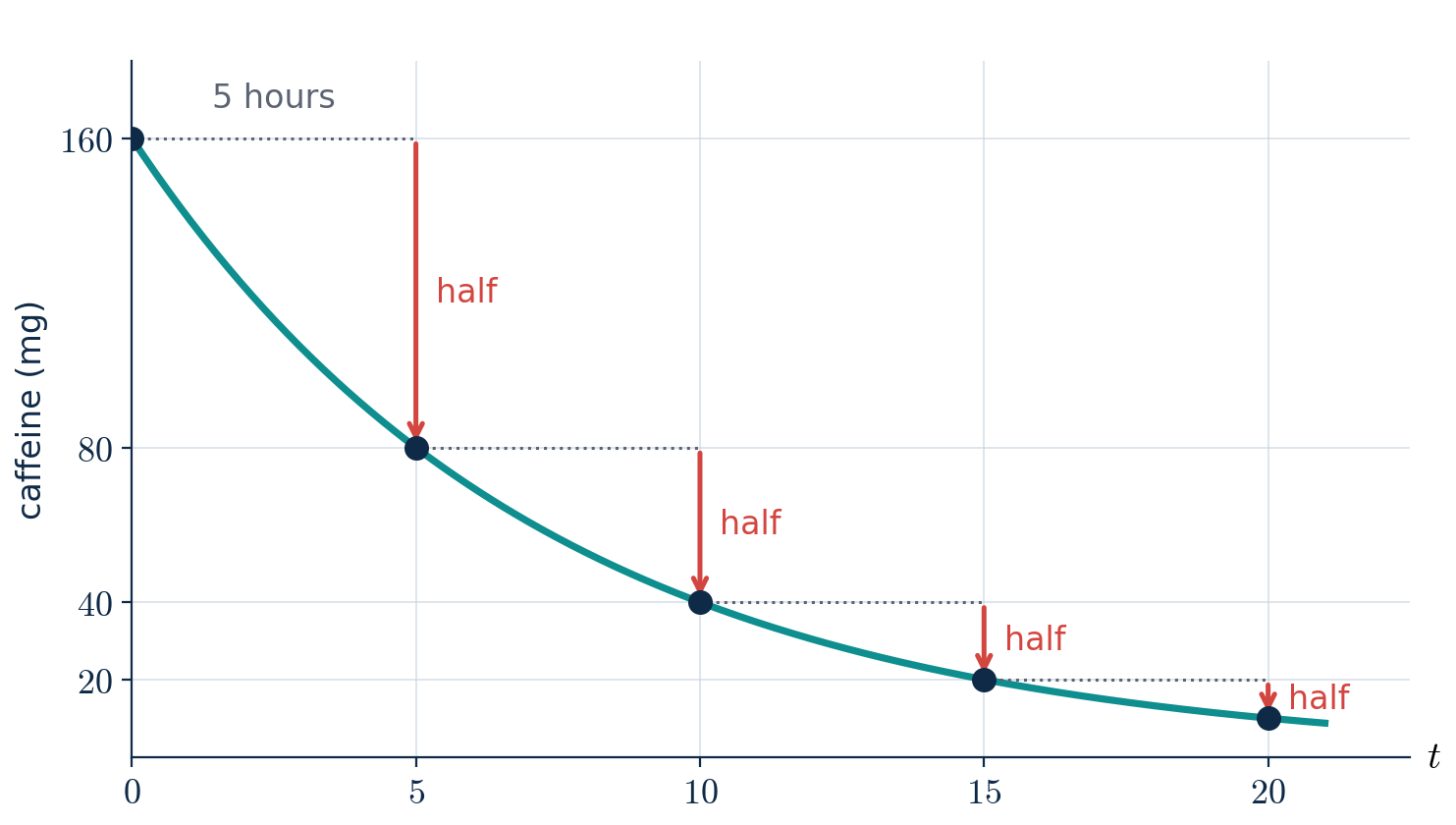
Every 5 hours the amount is cut in half, whatever the starting amount at that moment.
Why t/h? The exponent counts how many half-lives have passed. For caffeine ():
| t (hours) | 0 | 5 | 7.5 | 10 | 15 |
|---|---|---|---|---|---|
| t/5 (half-lives) | 0 | 1 | 1.5 | 2 | 3 |
| C(t) (mg) | 160 | 80 | ≈ 56.57 | 40 | 20 |
In between whole half-lives the formula still works: after 7.5 hours, 1.5 half-lives have passed, and mg.
Doubling works the same way. A mold colony covering 40 cm² that doubles every 3 days is . After 9 days (3 doublings) cm², and after 10 days cm². The daily factor is , about 26% growth per day.
For Nova, , so its doubling time is between 1 and 2 months (about 1.71). Finding it exactly needs logarithms, which you will use in 2.13.
Quick check
A 96 mg sample has a half-life of 4 hours. How much remains after 12 hours?
From Two Data Points
Given two points on , write one equation for each point, then DIVIDE them. Dividing cancels a and leaves a single power of .
Worked example
Example 2 (odd gap). A tracer in a lab sample measures 50 units on day 2 and 3.2 units on day 5. Model it as .
- 01
Two equations, then divide:
- 02
. A cube root has exactly one real answer: . The tracer keeps 40% (loses 60%) each day.
- 03
Substitute back: , so . Model: . Check: ✓.
Worked example
Example 3 (even gap). A channel, Echo, had 1,800 subscribers at month 1 and 7,200 at month 3. Model it as .
- 01
Divide the two equations:
- 02
An even power hides the sign, so there are TWO algebraic answers. Now decide. An exponential function needs (2.2, 2.3): with , the value at would need the square root of a negative number. The context agrees: forces , and then month 2 would have subscribers. So .
- 03
gives . Model: . Echo doubles every month. Check: ✓.
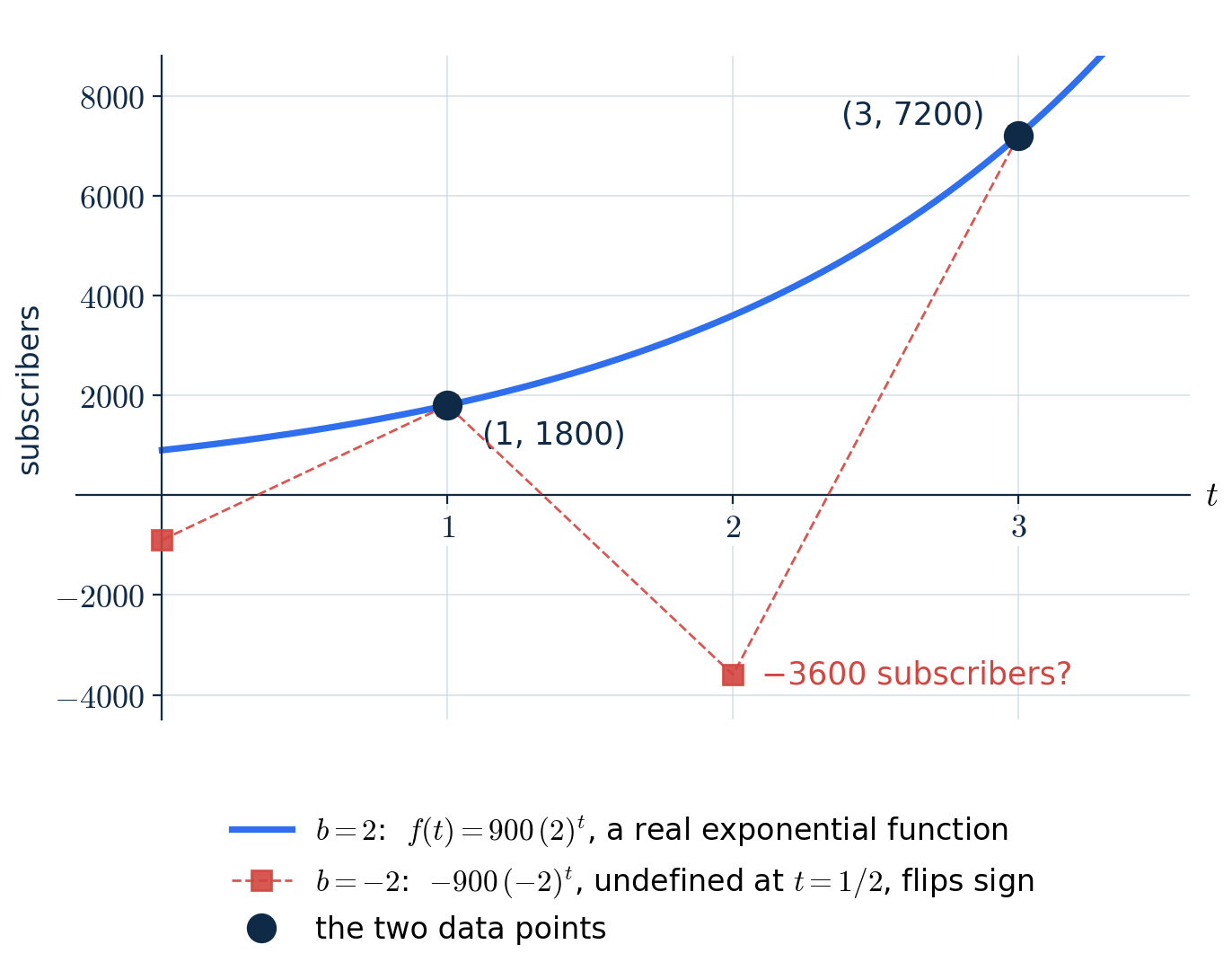
Both and pass through the two data points, but only gives a real exponential function with sensible values.
COMMON MISTAKE
“, so .” (Right answer, missing reason.)
Writing only the positive root gets the right model here, but for the wrong reason: it skips a step that sometimes matters. In 2.1 a sequence with was perfectly valid. Always write both roots, , and then state why one is rejected: an exponential function's base must be positive (and here, subscriber counts cannot be negative).
“, so .”
This happens to give 2, but only by coincidence. Try : dividing gives 4, while the correct 4th root is 2. Take the root that matches the exponent.
Worked example
Try it yourself. Each function is exponential, . (a) and . (b) and . Find and , showing the rejected root.
Answers: (a) , so or ; reject −2 (the base must be positive). , so . Check: ✓. (b) , so ; reject −2. , so , and .
Models With Base e
Many science models are written as . Remember from 2.4 that , so this is still , with . If it is growth; if it is decay.
Worked example
Example 4. The views of a video hours after posting are modeled by . Find the hourly growth factor and percent, and .
- 01
Rewrite with the power rule:
- 02
, so the views grow by about 28.4% per hour. views.
- 03
A negative means decay. For example, : the factor is about 0.8187, so the amount drops about 18.1% per unit of .
- 04
Decay works the same way: , which is caffeine's hourly factor again.
COMMON MISTAKE
“, so the views grow 25% per hour.”
is not the percent. The factor is , so the rate is about 28.4% per hour. and the percent are close only when is small.
Quick check
A model is . What is the growth factor per unit of , to four decimals?
Reading a Model in Context
A model is only useful if you can say what its numbers mean, with units.
CONCEPT
Interpreting
a: the amount at . For : 1,200 views when the video is posted.
: the factor per ONE unit of . For : each hour, the views are multiplied by about 1.284.
Average rate of change over [, ]: () ÷ (), in output units per input unit.
From hour 2 to hour 6, the video gained on average about 849.89 views per hour. Because the function is concave up, the rate is smaller than this near hour 2 and larger near hour 6, so this is an average, not a constant speed.
Practice
Worked example
P1. A town has 2,500 residents and grows 3.5% per year. Write a model and predict the population after 8 years.
Answer: . , so about 3,292 residents.
Worked example
P2. A medication has a half-life of 12 days. How much of an 800 mg dose remains after 30 days?
Answer: . 30 days is 2.5 half-lives: mg.
Worked example
P3. is exponential with and . Find and .
Answer: , so or −3/2; reject −3/2 (base must be positive). , so and .
Worked example
P4. A bacteria culture starts with 500 cells and doubles every 4 hours. Write a model, find the hourly growth factor, and find the population after 10 hours.
Answer: . Hourly factor (about 18.9% per hour). cells.
Common slips
“6% growth means ” and “18% decay means .”
1.6 is 60% growth: with it the app would reach about 351,844 users in 10 weeks. And 0.18 would keep only 18% of the laptop's value: after one year it would be worth $261.00 instead of $1,189.00. Write the percent as a decimal first (6% = 0.06, 18% = 0.18), then add it to 1 or subtract it from 1.
“, so .” (Right answer, missing reason.)
Writing only the positive root gets the right model here, but for the wrong reason: it skips a step that sometimes matters. In 2.1 a sequence with was perfectly valid. Always write both roots, , and then state why one is rejected: an exponential function's base must be positive (and here, subscriber counts cannot be negative).
“, so .”
This happens to give 2, but only by coincidence. Try : dividing gives 4, while the correct 4th root is 2. Take the root that matches the exponent.
“, so the views grow 25% per hour.”
is not the percent. The factor is , so the rate is about 28.4% per hour. and the percent are close only when is small.
Lock it in
Try the flashcards
18 cards · Linear or exponential?, Exponential models
Recap card
6 lines to re-read the night before.
- 01
Percent: growth by → ; decay by → . The base is what remains, not the change.
- 02
Half-life : . Doubling time : . The exponent t/h counts how many halvings have happened.
- 03
Two points: write at each, divide to cancel a, then take the root that matches the gap.
- 04
Even gap: write both roots ±, then reject the negative one because an exponential base must be positive (and state the reason).
- 05
, so the factor is , not .
- 06
Next, in 2.5B: building a model from a whole data set with exponential regression, and data that level off at a value other than 0.