
Topic 2.4
Exponential Function Manipulation
Nova's model counts time in months. But the channel's analytics page reports growth per week. Can we describe the same channel with a weekly factor? And what if Nova had launched 2 months earlier? Both questions have the same answer: the function stays the same, and only the way we write it changes.
10 MIN READ7 IDEAS33 PROBLEMS12 flashcards
One exponential function can be written in many equivalent forms. The tools for switching between them are the exponent rules you already know. In this note we use them to reveal what each form tells you: an initial value, a factor per week, a factor per year, or a shift in time.
The Exponent Rules
| rule | in symbols | example |
|---|---|---|
| product | · = | · = |
| power | ||
| negative exponent | = 1/ = | = 1/16 |
| rational exponent | = the kth root of b | = 2, |
Each rule is just counting factors. is two 5s times three 5s, which is five 5s. is two groups of three 2s, which is six 2s. The sections below use these rules on functions, where the exponent contains .
A fractional exponent combines a root and a power. The denominator is the root, the numerator is the power:
This is why in Section 3 means “the 4th root of 1.5”: the number that gives 1.5 when multiplied by itself 4 times.
A Horizontal Shift Is a Vertical Stretch
CONCEPT
Product Rule in Reverse
Split an exponent that is a sum: .
So shifting the graph of to the LEFT by gives the same graph as stretching it vertically by the factor . (A shift to the right, , is a vertical factor .)
For example, . The frames below show the two descriptions producing one curve.
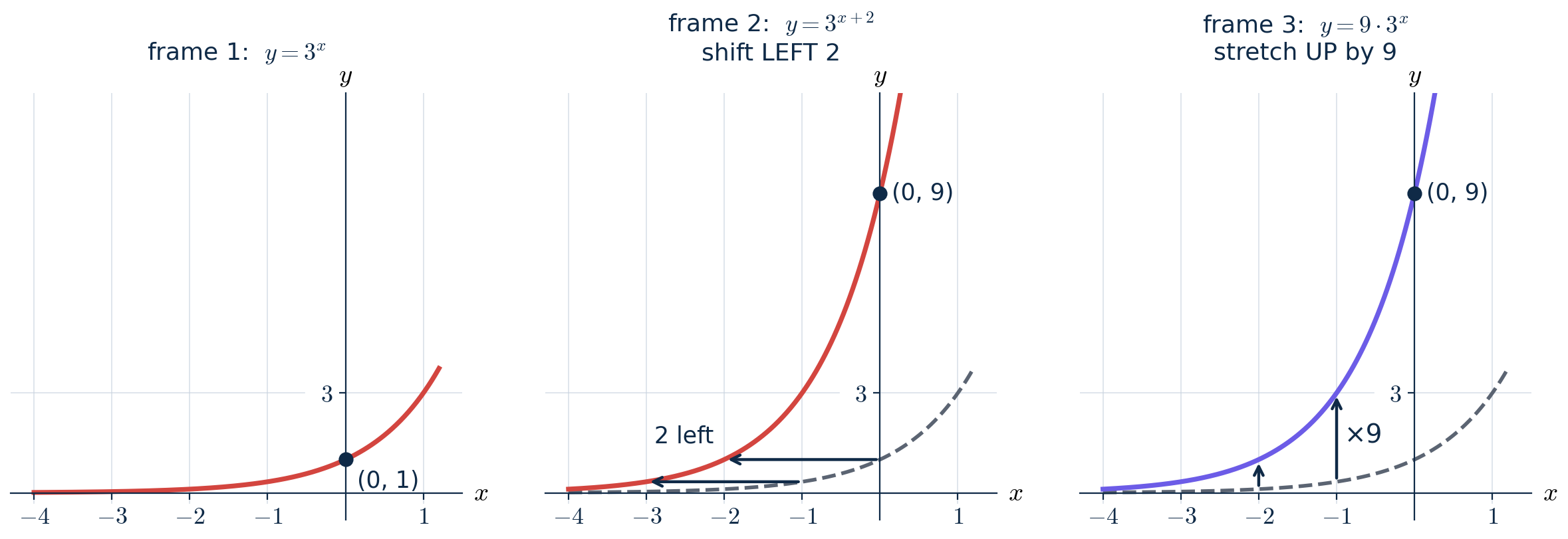
Frame 2 moves two units left. Frame 3 stretches it upward by 9. The result is the same curve, through .
Likewise : a shift RIGHT by 3 is a vertical SHRINK by .
Worked example
Example 1. Write in the form , and describe the change in two ways.
- 01
Product rule in reverse: .
- 02
Two descriptions of the same graph: shifted RIGHT 2, or shrunk vertically by the factor .
REAL-LIFE EXAMPLE
If Nova Had Launched 2 Months Earlier
Starting the clock 2 months earlier means replacing with : .
The new initial value 576 is exactly Nova's month-2 count from 2.1 (). The growth factor is unchanged; only the starting point moved.
Quick check
Rewrite in the form .
A Horizontal Stretch Is a Change of Base
CONCEPT
Power Rule in Reverse
Pull a constant out of the exponent: .
So compressing or stretching the graph horizontally gives another exponential function with a different base. Examples: and .
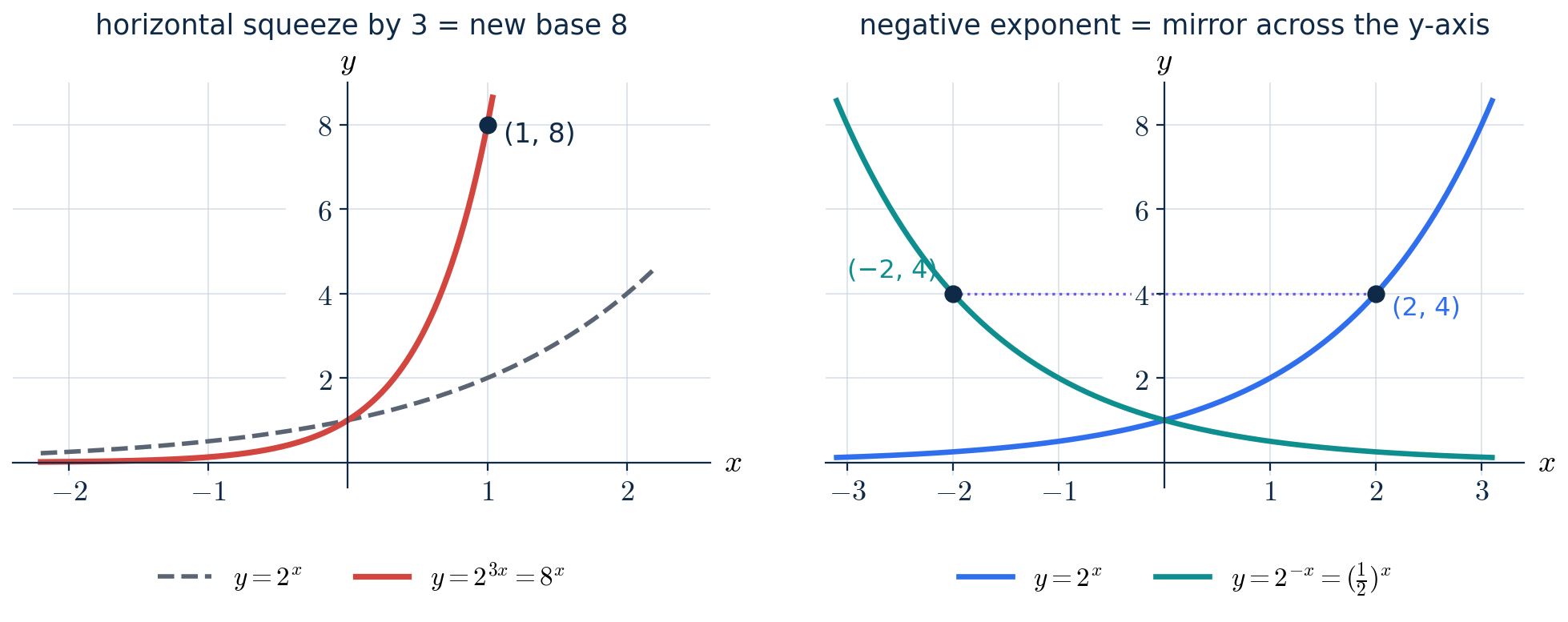
Left: climbs 3 times as fast as , and it is exactly the function . Right: a preview of Section 4, where a negative exponent mirrors the graph.
This is exactly how to change the time unit of a model.
Worked example
Example 2. Rewrite Nova's model with time measured in weeks (use 4 weeks = 1 month), and state the weekly growth rate.
- 01
Convert the unit: weeks is w/4 months, so and .
- 02
Use the power rule to move onto the base: = ()^w. The weekly factor is the 4th root of 1.5.
- 03
, so Nova grows about 10.67% per week. Check: at weeks ( months) both forms give about 705.45, matching from 2.2.
Going the other way, the yearly factor is , so with in months, and after one year .
Worked example
Example 3. The study app from 2.5A grows 6% per week: . Find the daily growth rate and the yearly growth factor (7 days = 1 week, 52 weeks = 1 year).
- 01
Daily: 1 week = 7 days, so the daily factor must satisfy . Take the 7th root: , about 0.836% per day.
- 02
Check: 1.00836 multiplied by itself 7 times gives back 1.06 (to rounding).
- 03
Yearly: 52 weeks of ×1.06 is . The app would be about 20.7 times bigger after a year if the 6% weekly growth continued.
COMMON MISTAKE
“.”
The 3 multiplies the EXPONENT, not the base. Power rule: . At : , not 6.
“1.5 per month is per week.”
Factors are multiplied, not added, so they split by roots, not division. Four weeks must multiply to one month: = 1.5. A factor of 0.375 would mean the channel loses 62.5% every week.
Also keep the exact form until the end. Rounding to 1.1067 is fine for a final answer, but , so a rounded factor slowly drifts over many weeks.
Quick check
Evaluate at by hand.
A Negative Exponent Is a Reflection
CONCEPT
Negative Exponent Rule
. Replacing with reflects a graph across the y-axis, so the graph of is the mirror image of .
This is why every decay function is a reflected growth function: , and .
COMMON MISTAKE
“.”
A negative exponent means a reciprocal, not a negative number: . That is why exponential functions stay positive even for negative inputs.
Putting the Rules Together
The standard form is the most useful form: a is the initial value and is the factor per unit. To get there, split the exponent into a constant part and an part.
Worked example
Example 4. Write each function in the form . (a) (b)
- 01
(a) Product rule: . Power rule: . So .
- 02
(b) Split: . Since , we get .
- 03
So : initial value 360, and the output is divided by 3 for each unit of . That was hard to see in the original form.
COMMON MISTAKE
“.”
The exponent applies only to the 2, not to the 3. At : , but . Combine bases only when both are raised to the same power: .
“.”
A sum in the exponent becomes a PRODUCT: . At : , but .
Worked example
Try it yourself. Write each in the form . (a) (b) (c)
Answers: (a) (a left shift of 5 is a vertical stretch by ). (b) , because . (c) , because .
Practice
Worked example
P1. Which is equivalent to ?
Answer: (). . Choice (A) comes from dividing the base by 2 instead of taking a square root.
Worked example
P2. Write in the form .
Answer: .
Worked example
P3. Caffeine: with in hours. Find the factor per half hour and the percent decrease per half hour.
Answer: hours = 2t half hours, so . The half-hour factor is , a decrease of about 6.73% per half hour (not ).
Worked example
P4. Show that and are the same function.
Answer: Power rule: .
Worked example
P5. Write in the form .
Answer: , because .
Common slips
“.”
The 3 multiplies the exponent, not the base. Power rule: . At : , not 6.
“1.5 per month is per week.”
Factors are multiplied, not added, so they split by roots, not division. Four weeks must multiply to one month: = 1.5. A factor of 0.375 would mean the channel loses 62.5% every week.
Also keep the exact form until the end. Rounding to 1.1067 is fine for a final answer, but , so a rounded factor slowly drifts over many weeks.
“.”
A negative exponent means a reciprocal, not a negative number: . That is why exponential functions stay positive even for negative inputs.
“.”
The exponent applies only to the 2, not to the 3. At : , but . Combine bases only when both are raised to the same power: .
“.”
A sum in the exponent becomes a product: . At : , but .
Lock it in
Try the flashcards
12 cards · Exponent rules, Exponential models
Recap card
4 lines to re-read the night before.
- 01
Equivalent forms describe the same function. Product rule: . A horizontal shift is the same as a vertical stretch or shrink.
- 02
Power rule: . A horizontal stretch or compression is the same as a change of base. This is how you change time units (monthly → weekly: take the 4th root).
- 03
Negative exponent: . Decay is growth reflected across the y-axis. Watch out: , and is a product, not a sum.
- 04
Next, in 2.5: exponential models built from real situations and data, including the half-life of caffeine.