
Topic 2.2
Change in Linear and Exponential Functions
In 2.1 we only checked Ridge and Nova at the end of each month. But subscribers don't wait for the end of the month. Halfway through month 2, Nova already has some number of subscribers, and a sequence has no way to talk about it.
13 MIN READ8 IDEAS33 PROBLEMS13 flashcards
Read this first
30 sec
- 01
Linear: equal intervals → equal differences. Exponential: equal intervals → equal ratios.
- 02
An increasing exponential function eventually exceeds any linear function.
In this note we let time be any real number . Ridge becomes a linear function and Nova becomes an exponential function:
Remember from 2.1: Ridge added 300 every step (arithmetic) and Nova multiplied by 1.5 every step (geometric). The same two behaviors, adding versus multiplying, are what separate linear functions from exponential functions.
From Sequences to Functions
A sequence and a function can share the same rule and still be different objects, because they accept different inputs.
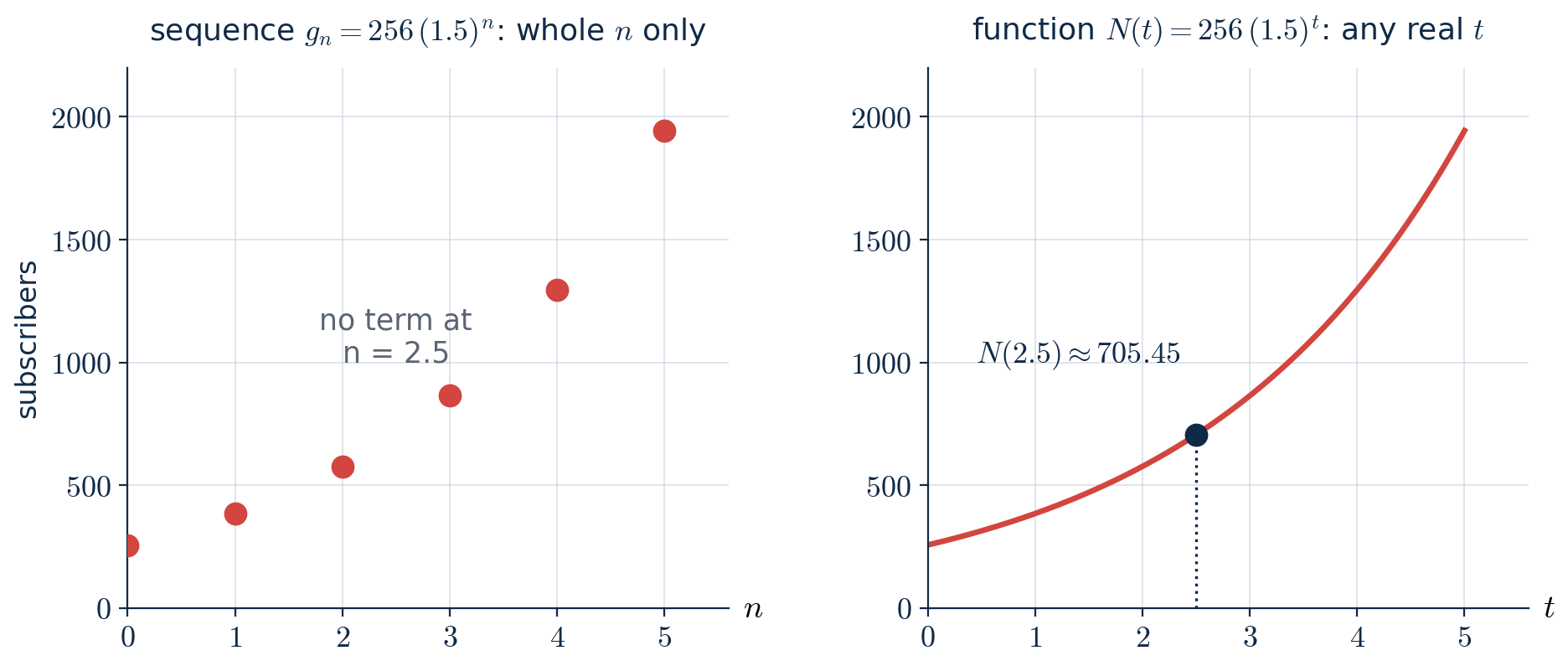
Same rule, different domains. The sequence has no term at ; the function has the value .
CONCEPT
The Two Pairings
Arithmetic sequence → linear function. Both change by ADDING a constant.
Geometric sequence → exponential function. Both change by MULTIPLYING by a constant.
The difference is the domain: a sequence takes whole numbers; a function takes every real number in its domain, so its graph is a connected curve.
The formulas line up exactly. Each one has a version that starts at the initial value (input 0) and a version that starts at any known point:
| start at input 0 | start at a known point | |
|---|---|---|
| arithmetic sequence | ||
| linear function | f(x) = b + mx | f(x) = + m(x − ) |
| geometric sequence | = · | = · |
| exponential function | f(x) = a · | f(x) = · |
For linear functions you know these as slope-intercept form and point-slope form. The exponential versions work the same way, with multiplication in place of addition: is multiplied in once for every 1 unit of .
Linear Functions: Equal Intervals, Equal Differences
CONCEPT
Change by Addition
A linear function adds to the output for every 1 unit of input. Here is the initial value and is the constant rate of change.
So over input intervals of equal length, the outputs always change by the same AMOUNT. For Ridge, every 2-month interval adds subscribers, and every half-month interval adds 150.
Notice that the intervals don't have to be 1 unit long. What matters is that they have the same length. , and all have length 2, so changes by +600 on each one.
Exponential Functions: Equal Intervals, Equal Ratios
CONCEPT
Change by Multiplication
An exponential function multiplies the output by for every 1 unit of input. Here is the initial value and is the growth factor.
So over input intervals of equal length, the outputs always change by the same FACTOR. We say they change proportionally. For Nova, every 2-month interval multiplies by , which is a 125% increase every time.
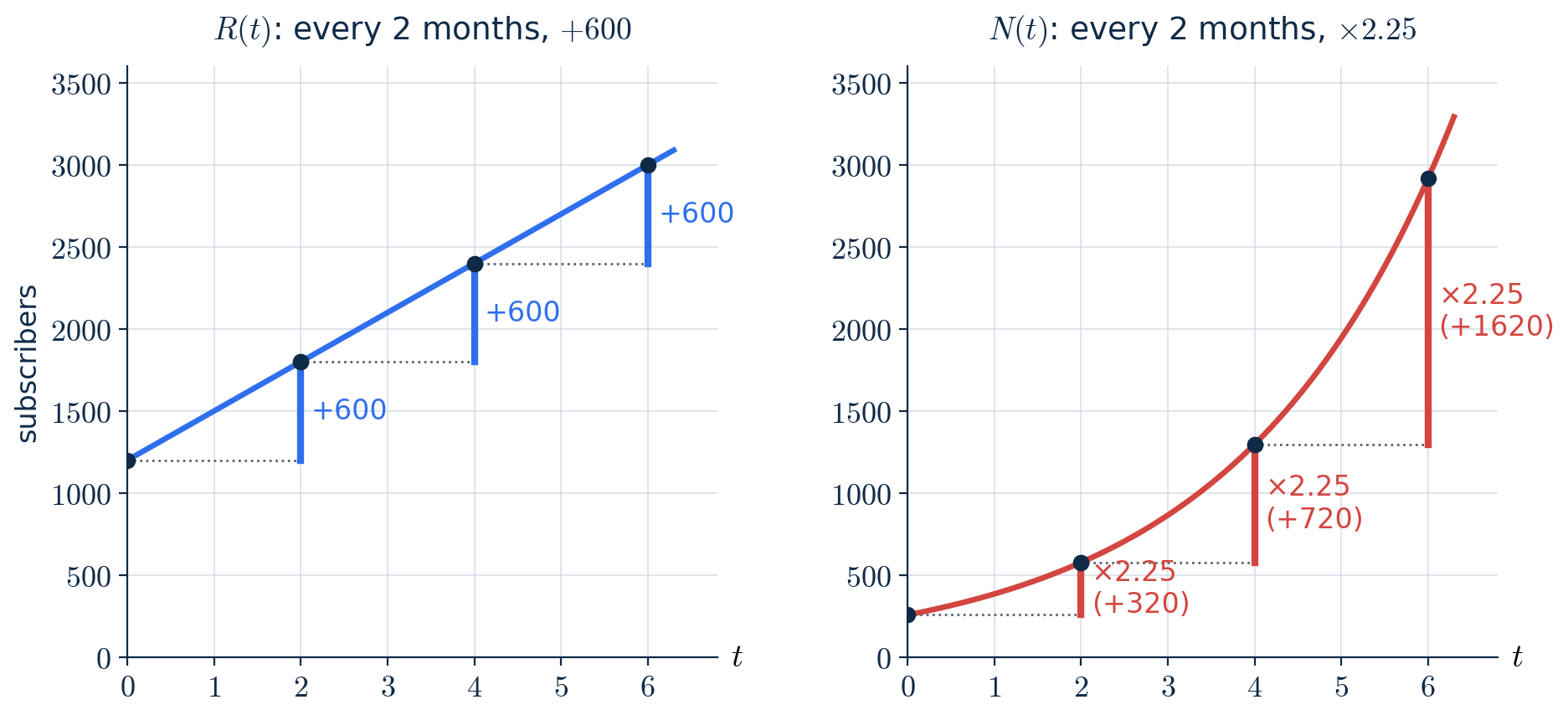
Same three 2-month intervals. Left: the change is +600 every time. Right: the change grows (+320, +720, +1620), but the factor is ×2.25 every time.
The intervals don't have to start at 0 or be next to each other. and also have length 2: and , while .
The same thing works for any interval length. Over every half month, is multiplied by , so . You will learn to rewrite factors like this in 2.4.
KEY RULE
Linear: equal intervals → equal DIFFERENCES. Exponential: equal intervals → equal RATIOS.
COMMON MISTAKE
“Nova grows 50% per month, so it grows 25% per half month.”
Percent growth doesn't split evenly, because each half month multiplies the new, larger amount. Two half-months at 25% give , which is 56.25% per month, not 50%. The correct half-month factor is : , not .
Linear, Exponential, or Neither? Reading a Table
CONCEPT
The Table Test
Step 1. Check that the x-values go up by the same amount. If they don't, the test below does not apply.
Step 2. Subtract consecutive outputs. All differences equal → the function could be linear.
Step 3. Divide consecutive outputs. All ratios equal → the function could be exponential.
If neither is constant, the function is neither linear nor exponential.
Worked example
For each table, decide whether the function could be linear, could be exponential, or is neither, and point to the differences or ratios that tell you.
| x | 2 | 6 | 10 | 14 |
|---|---|---|---|---|
| f(x) | 15 | 9 | 3 | −3 |
- 01
(a) The x-values go up by 4 each time. Differences: , , . Constant, so could be linear. The output drops 6 per 4 units of , so the slope is , and .
x 0 3 6 9 g(x) 5 10 20 40 - 02
(b) The x-values go up by 3. Differences: 5, 10, 20, not constant. Ratios: , , . Constant, so could be exponential. The factor 2 covers 3 units of , so .
x 1 2 3 4 h(x) 3 6 11 18 - 03
(c) The x-values go up by 1. Differences: 3, 5, 7. Ratios: 2, , . Neither is constant, so is neither linear nor exponential. (Remember from 1.3: the differences themselves go up by 2 each time, which is the signature of a quadratic. In fact .)
COMMON MISTAKE
“In table (b) the ratio is 2, so .”
The ratio 2 belongs to a 3-unit interval, not to 1 unit of . With base 2, would be , not 10. The per-unit factor is . The same idea holds for linear tables: in (a) the slope is −1.5, not −6.
“The outputs 4, 12, 36 at , 1, 3 triple each time, so the function is exponential.”
The x-steps are 1 and then 2, so the table test doesn't apply directly. An exponential through and has base 3, which would give , not 36. These points are not exponential (and not linear either: the slopes are 8 and 12).
Quick check
A table shows with outputs . Linear, exponential, or neither, and what is the per-unit base?
Writing the Rule from Two Points
If you already know the type, two points are enough, just as two terms were enough in 2.1.
Worked example
Example 1 (linear). is linear with and . Write .
- 01
Slope: .
- 02
Point-slope form at : . Simplified: .
- 03
Check the other point: . ✓
Worked example
Example 2 (exponential). is exponential with and . Write .
- 01
The inputs are 3 apart, so is multiplied in 3 times. Use at :
- 02
. To get the form, find , so .
- 03
Check: ✓ and ✓.
Worked example
Example 3 (exponential, even gap). is exponential with and . Write .
- 01
The inputs are 4 apart: , so .
- 02
In 2.1 a sequence could have ratio −1/2. An exponential FUNCTION cannot: its base must be positive. With , the input would need the square root of a negative number, so the function would not exist at most inputs. (2.3 makes this rule official: and .)
- 03
So . , or with , . Check: ✓.
Worked example
Try it yourself. (a) Is this table linear, exponential, or neither? : 0, 2, 4, 6 and : 40, 10, 2.5, 0.625. Write and find . (b) is exponential with and . Find the base.
Answers: (a) Ratios are all over 2 units, so it is exponential with base : and . (b) , so . (−5 is not allowed as an exponential base.)
Quick check
is exponential with and . Write using as the anchor.
The Long Run: Exponential Always Wins
Now that time is continuous, we can ask exactly when Nova catches Ridge. In 2.1 the table only told us it happens between month 6 and month 7.
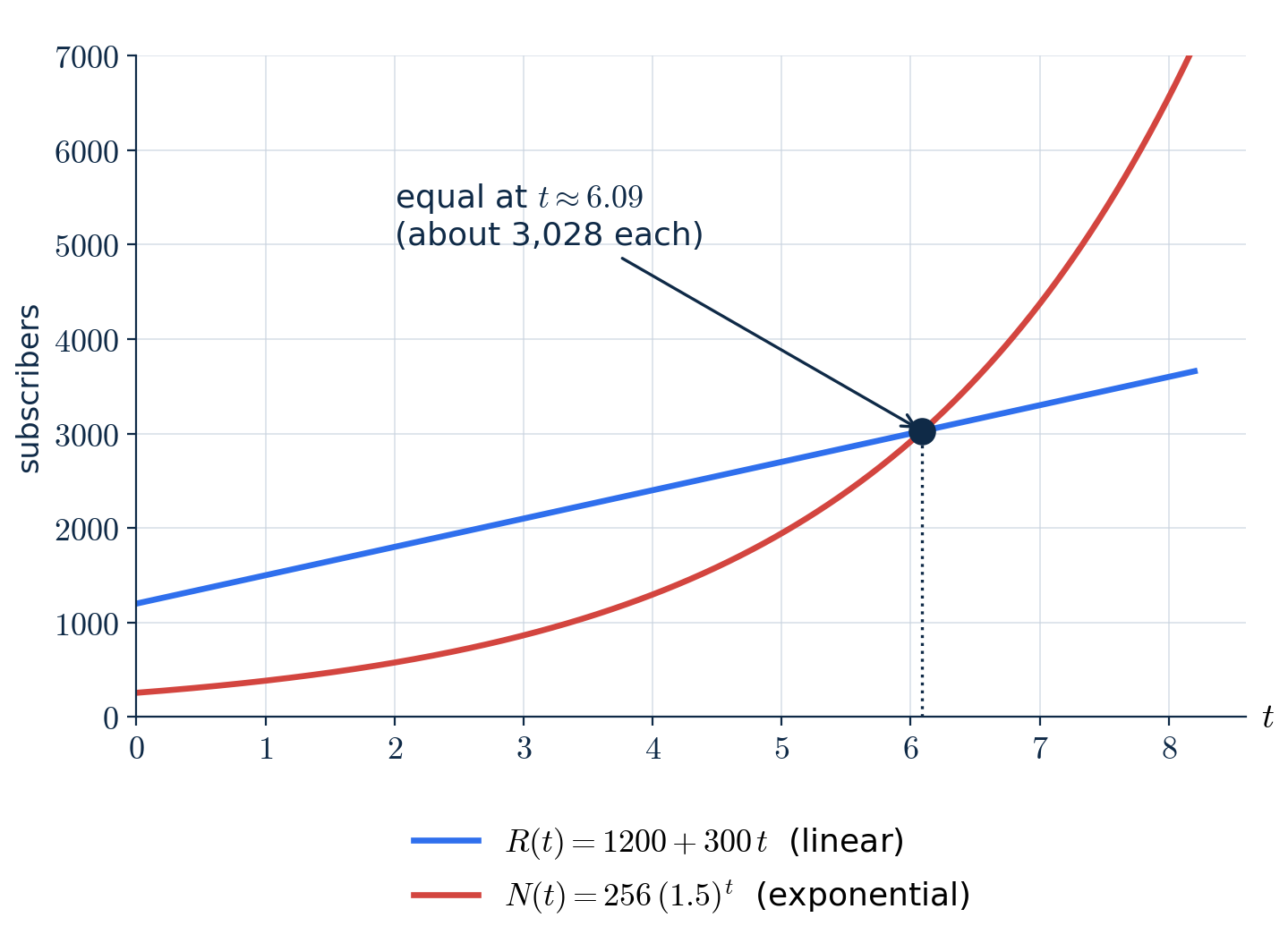
, but . The graphs cross at months.
Why can't Ridge ever get back in front? Ridge's gain per month is always 300. Nova's gain over a month is , half of whatever it has, and keeps growing, so its gain keeps growing too. Once Nova's monthly gain passes 300, Ridge falls behind a little more every month, forever.
KEY RULE
An increasing exponential function eventually exceeds any linear function.
REAL-LIFE EXAMPLE
A Bigger Rival
A new channel, Pulse, launches with 5,000 subscribers and gains 1,000 per month: . That is a much bigger head start and a much faster linear rate than Ridge. Does Nova still win?
Month 8: vs . Month 9: 9,841.5 vs 14,000. Month 10: 14,762.25 vs 15,000. Month 11: about 22,143.4 vs 16,000.
Yes. The bigger head start only delays the crossing, and Nova is ahead at the end of month 11.
Practice
Worked example
P1. : 1, 3, 5, 7 and : 7, 11, 15, 19. Linear, exponential, or neither? Write the equation.
Answer: The x-steps are all 2 and the differences are all 4, so it is linear with slope . Using : .
Worked example
P2. is exponential with and . Write in the form .
Answer: , so . Then , so . Check: ✓.
Worked example
P3. Explain in one sentence why a table with x-values 0, 1, 3, 4 cannot be tested for linear or exponential behavior just by subtracting or dividing consecutive outputs.
Answer: The x-intervals are not all the same length (1, 2, 1), and the table test compares changes over equal-length intervals only.
Worked example
P4. Two savings plans start at $200. Plan A adds $50 every month; Plan B grows 3% every month. Which is linear and which is exponential? Find each after 3 months.
Answer: A adds a constant amount, so it's linear: = $350. B multiplies by 1.03 each month, so it's exponential: ≈ $218.55. ( starts slower, but 2.2 says it eventually wins.)
Common slips
“Nova grows 50% per month, so it grows 25% per half month.”
Percent growth doesn't split evenly, because each half month multiplies the new, larger amount. Two half-months at 25% give , which is 56.25% per month, not 50%. The correct half-month factor is : , not .
“In table (b) the ratio is 2, so .”
The ratio 2 belongs to a 3-unit interval, not to 1 unit of . With base 2, would be , not 10. The per-unit factor is . The same idea holds for linear tables: in (a) the slope is −1.5, not −6.
“The outputs 4, 12, 36 at , 1, 3 triple each time, so the function is exponential.”
The x-steps are 1 and then 2, so the table test doesn't apply directly. An exponential through and has base 3, which would give , not 36. These points are not exponential (and not linear either: the slopes are 8 and 12).
Lock it in
Try the flashcards
13 cards · Sequences, Linear or exponential?
Recap card
5 lines to re-read the night before.
- 01
Arithmetic ↔ linear and geometric ↔ exponential: same structure, but a function takes every real input, so its graph is a connected curve.
- 02
Linear : over equal-length intervals the outputs change by equal differences (additive change).
- 03
Exponential : over equal-length intervals the outputs change by equal ratios (proportional change).
- 04
Table test: first check equal x-steps; then subtract (linear) and divide (exponential). A difference or ratio belongs to the whole interval, not to 1 unit of .
- 05
Two points determine the rule: or . For exponential functions, keep only the positive root. An increasing exponential function eventually passes any linear function. Next, in 2.3: a closer look at itself: growth vs decay, the asymptote, domain and range, and concavity.