
Topic 2.1
Change in Arithmetic and Geometric Sequences
Two new streaming channels launch in the same month. Ridge starts with 1,200 subscribers and gains 300 more every month. Nova starts much smaller, with only 256 subscribers, but every month its audience is 1.5 times what it was the month before. Ridge begins more than four and a half times bigger. Which channel is bigger after a year?
15 MIN READ10 IDEAS33 PROBLEMS3 flashcards
Read this first
30 sec
- 01
A sequence has inputs 0, 1, 2, 3, …, so its graph is separate dots.
- 02
Arithmetic: add every step. Geometric: multiply by every step.
Most people bet on Ridge. By the end of this note you will see why that bet loses, and why. Unit 2 is about the difference between two kinds of change: adding the same amount again and again, and multiplying by the same factor again and again. Sequences are the simplest place to see that difference, so that is where we begin.
Remember from 1.3: a linear function has a constant rate of change. In this note you will meet its step-by-step cousin (the arithmetic sequence) and a new kind of pattern whose change is not constant but proportional (the geometric sequence).
What Is a Sequence?
CONCEPT
A Sequence Is a Function on Whole Numbers
A sequence is an ordered list of numbers. Each number is a term. We name the terms , , , … (read “a sub zero”, “a sub one”, …), and the small number in (the index) tells you the position. The index is a LABEL for the position, not a multiplication: is the term in position 3, not a times 3.
Think of a sequence as a function: the input is the index , 1, 2, 3, …, and the output is the term .
Only whole-number inputs exist. There is a month 3 and a month 4, but no month 3.5. The outputs, though, can be any real number: negative, fractional, or decimal.
For example, the rule gives , , and . Asking for makes no sense, because 2.5 is not a position in the list. That is why the graph of a sequence is a set of separate dots. We never join them into a line or a curve.
KEY RULE
A sequence has inputs 0, 1, 2, 3, …, so its graph is separate dots.
This course focuses on two special kinds of sequences. Our two channels are one of each.
Arithmetic Sequences: Add the Same Amount
Here is Ridge's subscriber count at the end of each month ( is launch month):
| n (month) | 0 | 1 | 2 | 3 | 4 | 5 |
|---|---|---|---|---|---|---|
| (subscribers) | 1200 | 1500 | 1800 | 2100 | 2400 | 2700 |
| change | — | +300 | +300 | +300 | +300 | +300 |
CONCEPT
Common Difference
A sequence is arithmetic when every step adds the same number . That number is the common difference.
Because the change over every step of the same length is constant, an arithmetic sequence has a constant rate of change, exactly like a linear function. For Ridge, subscribers per month.
Why does the formula look the way it does? To get from to you take steps, and each step adds :
So the explicit rule, the rule that jumps straight to any term, is
For Ridge, and , so .
Now you can answer questions without listing every month. After one year, subscribers. After two years, .
Geometric Sequences: Multiply by the Same Factor
Now look at Nova. This time the changes are not constant; they keep getting bigger. But divide each term by the one before it, and the answer is 1.5 every time.
| n (month) | 0 | 1 | 2 | 3 | 4 | 5 |
|---|---|---|---|---|---|---|
| (subscribers) | 256 | 384 | 576 | 864 | 1296 | 1944 |
| change | — | +128 | +192 | +288 | +432 | +648 |
| ratio | — | ×1.5 | ×1.5 | ×1.5 | ×1.5 | ×1.5 |
CONCEPT
Common Ratio
A sequence is geometric when every step multiplies by the same nonzero number . That number is the common ratio.
Put another way, over every step of the same length the output changes by the same proportion. For Nova, means each month's audience is 150% of the previous month's, a 50% increase every month.
The formula comes from counting steps again. To get from to you multiply by a total of times:
So the explicit rule is
For Nova, and , so .
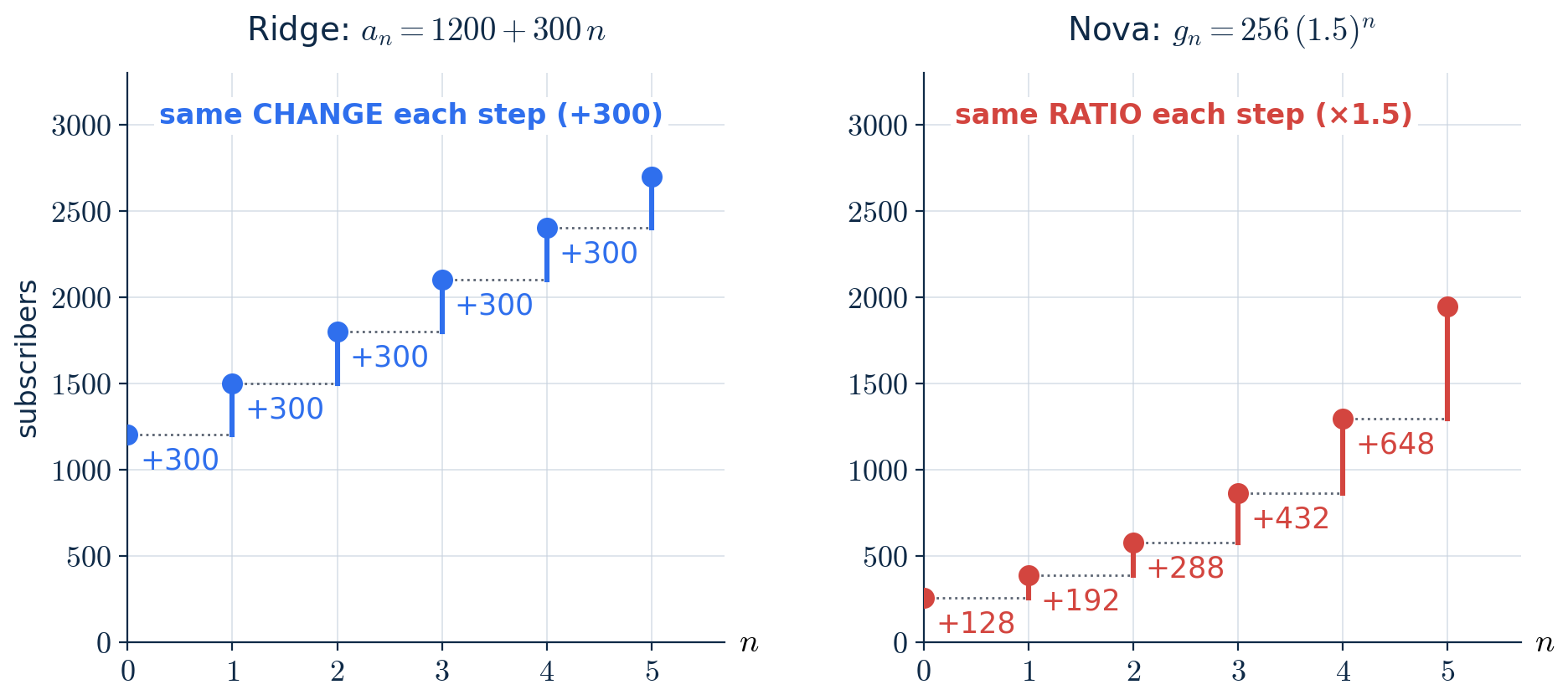
Left: every rise is +300. Right: every rise is 1.5 times the one before it, so the rises keep growing.
KEY RULE
Arithmetic: ADD every step. Geometric: MULTIPLY by every step.
Which Channel Wins?
Let's continue both tables past month 5:
| n (month) | 5 | 6 | 7 | 8 |
|---|---|---|---|---|
| Ridge | 2700 | 3000 | 3300 | 3600 |
| Nova | 1944 | 2916 | 4374 | 6561 |
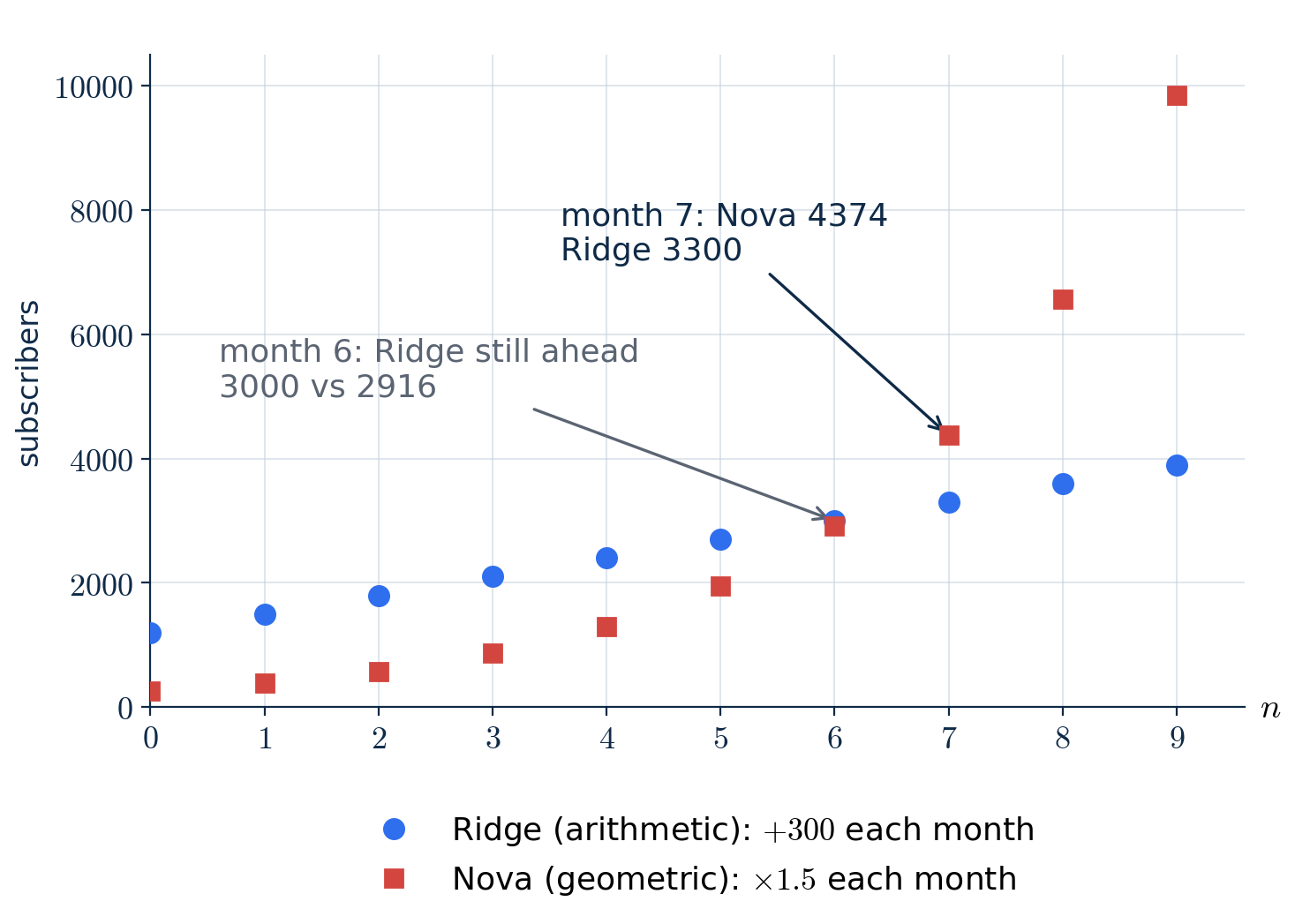
Ridge is ahead through month 6. Nova passes it in month 7 and pulls away fast.
Ridge's gain is stuck at 300 every month. Nova's gain is 1.5 times its previous gain, so it grows every month: +128, +192, +288, and then +432 from month 3 to month 4. From that step on, Nova gains more than 300 each month and closes the gap, until it passes Ridge in month 7 and pulls away.
This is the big idea of Unit 2. Repeated multiplication by a factor greater than 1 eventually beats repeated addition, no matter how big a head start the adding side gets. In 2.2 you will see the same contest between linear and exponential functions.
Arithmetic, Geometric, or Neither?
CONCEPT
The Two Tests
Subtract consecutive terms. If every difference is the same, the sequence is arithmetic.
Divide consecutive terms. If every ratio is the same, the sequence is geometric.
If neither test gives a constant, the sequence is neither.
Worked example
Classify each sequence. (a) 7, 3, −1, −5, … (b) 48, −24, 12, −6, … (c) 2, 6, 12, 20, …
- 01
(a) Differences: , , . The difference is always −4, so the sequence is arithmetic with . A decreasing arithmetic sequence simply adds a negative number.
- 02
(b) Differences: −72, 36, −18. Not constant. Ratios: , , . Geometric with . A negative ratio makes the terms switch sign every step.
- 03
(c) Differences: 4, 6, 8. Ratios: 3, 2, . Neither test gives a constant, so the sequence is neither arithmetic nor geometric.
COMMON MISTAKE
“It's going down, so it must be arithmetic.”
The direction of change tells you nothing about the type. In the example above, 7, 3, −1, −5 decreases and is arithmetic, while 48, −24, 12, −6 shrinks toward 0 and is geometric. Always run both tests.
“Nova's differences 128, 192, 288 keep changing, so there is no pattern.”
Growing differences are exactly what a geometric sequence with produces. The pattern is in the ratios, not the differences.
Start From Any Term
The rules and start counting at term 0. But you can start from any term you know. If you know the term , then getting to term takes steps:
CONCEPT
Why ?
counts steps, not terms. From to there are steps, so is added 5 times.
Check with Ridge: , so . Same rule as before.
Check with Nova: , so . Since , this is the same as .
COMMON MISTAKE
“Month 1 had 900 subscribers and the channel gains 150 per month, so .”
Here 900 is , not . With the anchor at , the rule is . Check : the correct rule gives (the list is 900, 1050, 1200, 1350), but the wrong rule gives 1,500, one step too many.
The familiar formula is just the case. Before writing any rule, check which index the first given term has, and subtract that index.
Quick check
An arithmetic sequence has and . Using as the anchor, what is ?
Given Two Terms, Find the Rule
Two terms are enough to rebuild the whole sequence, because the gap between their indices tells you how many steps separate them.
Worked example
Example 1 (arithmetic). A sequence has and . Find a rule for and find .
- 01
Steps between the terms: . Total change: . Each step adds .
- 02
Anchor at : . (The same rule anchored at 0: , so .)
- 03
.
Worked example
Example 2 (geometric, odd number of steps). A sequence has and . Find a rule for and find .
- 01
From to is 3 steps, so is multiplied in 3 times: , which gives .
- 02
Take the cube root: . An odd root of a real number has exactly one real answer, so this is the only possible ratio.
- 03
, so . (Starting from instead: . Same answer.)
Worked example
Example 3 (geometric, even number of steps). A sequence has and . Find every possible rule, and find .
- 01
From to is 4 steps: , so .
- 02
An even power hides the sign: and . Both values of work, and nothing in the problem rules one out.
- 03
So two sequences fit. gives 5, 15, 45, 135, 405, and gives 5, −15, 45, −135, 405. Therefore or .
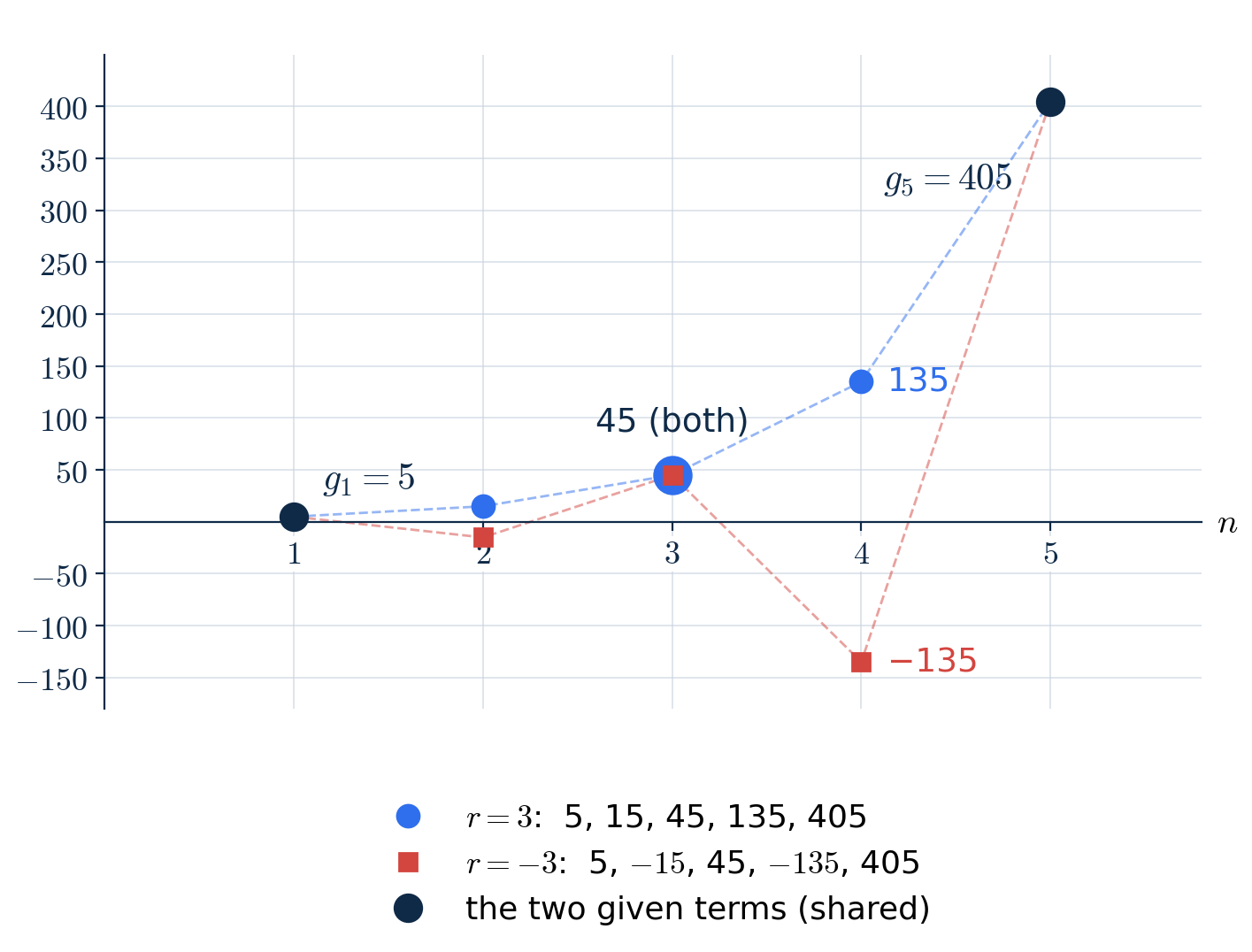
Both sequences pass through the two given terms. They agree at , 3, 5 and have opposite signs at and . (The dashed lines only guide the eye; a sequence has no values between the dots.)
Some questions still have a single answer. For example, either way, because 6 multiplications by −3 contain an even number of negative signs.
COMMON MISTAKE
“, so .”
Keeping only the positive root throws away a whole valid sequence. An even root (square root, 4th root, …) of a positive number always has two real answers, + and −. Write both, then reject one only when the problem gives a reason (see Section 8).
“, so .”
The exponent 4 means multiplying by itself four times, not multiplying by 4. Check: , not 405.
Worked example
Try it yourself. (a) An arithmetic sequence has and . Find . (b) A geometric sequence has and . Find every possible value of .
Answers: (a) , so . (b) , so or . Then or −2.
Quick check
A geometric sequence has and . What is the common ratio ?
Back to Nova: Context Decides
REAL-LIFE EXAMPLE
Nova's Missing Records
Suppose the only surviving records say Nova had 576 subscribers at the end of month 2 and 2,916 at the end of month 6, and that the growth is geometric. What is the monthly ratio, and in which month does Nova first pass 10,000 subscribers?
- 01
Month 2 to month 6 is 4 steps, an even number, so expect two candidates:
- 02
Both values satisfy the equation, but the context rules one out. With , month 3 would have subscribers. A subscriber count can't be negative, so .
- 03
Continue from : month 9 gives and month 10 gives . Nova first passes 10,000 in month 10.
(A model can give decimals like 9,841.5; the real channel would have about 9,842.) In 2.13 you will solve directly with logarithms instead of building a table.
Practice
Worked example
P1. The terms 9, 14, 19, 24, … are labeled starting with . Write an explicit rule and find .
Answer: and the anchor is , so . Then .
Worked example
P2. The sequence 1000, 800, 640, … starts at . Is it arithmetic or geometric? Find .
Answer: The differences −200 and −160 are not equal, but the ratios are both 0.8. Geometric: , so .
Worked example
P3. A geometric sequence has and . Find and .
Answer: 3 steps, so and . A cube root has only one real answer, and it can be negative. Then .
Common slips
“It's going down, so it must be arithmetic.”
The direction of change tells you nothing about the type. In the example above, 7, 3, −1, −5 decreases and is arithmetic, while 48, −24, 12, −6 shrinks toward 0 and is geometric. Always run both tests.
“Nova's differences 128, 192, 288 keep changing, so there is no pattern.”
Growing differences are exactly what a geometric sequence with produces. The pattern is in the ratios, not the differences.
“Month 1 had 900 subscribers and the channel gains 150 per month, so .”
Here 900 is , not . With the anchor at , the rule is . Check : the correct rule gives (the list is 900, 1050, 1200, 1350), but the wrong rule gives 1,500, one step too many.
The familiar formula is just the case. Before writing any rule, check which index the first given term has, and subtract that index.
“, so .”
Keeping only the positive root throws away a whole valid sequence. An even root (square root, 4th root, …) of a positive number always has two real answers, + and −. Write both, then reject one only when the problem gives a reason (see Section 8).
“, so .”
The exponent 4 means multiplying by itself four times, not multiplying by 4. Check: , not 405.
Lock it in
Try the flashcards
3 cards · Sequences
Recap card
6 lines to re-read the night before.
- 01
A sequence is a function whose inputs are whole numbers, so its graph is separate dots.
- 02
Arithmetic: constant difference . , or . Constant rate of change, like a linear function.
- 03
Geometric: constant ratio . , or . Constant proportional change.
- 04
To classify, subtract consecutive terms (arithmetic test) and divide them (geometric test). Whether the terms go up or down does not decide the type.
- 05
counts steps. From two terms: change ÷ steps gives ; for , take the root that matches the number of steps. An even number of steps gives two candidates, and : keep both unless the context rules one out.
- 06
Next, in 2.2: Ridge and Nova become functions of any real time , and we compare linear and exponential change directly.