
Topic 3.15
Rates of Change in Polar Functions
For the bicycle pedal, no matter what is: the pedal's distance from the crank center never changes, so its polar graph is a circle. Most polar curves are not like that. As increases, changes, and the point moves toward or away from the pole. This last note of Unit 3 asks two questions: which way is the point moving, and how fast is changing?
14 MIN READ4 IDEAS45 PROBLEMS6 flashcards
Read this first
30 sec
- 01
Distance from the pole is increasing when and its change have the same sign.
Toward or Away from the Pole?
Picture a dog on a leash tied to a post at the pole. The distance from the post is the length of leash that is out — that is , never negative. The sign of only tells you which SIDE of the post the dog is on (3.13A). So to know whether the dog is getting farther away, you have to look at , not just .
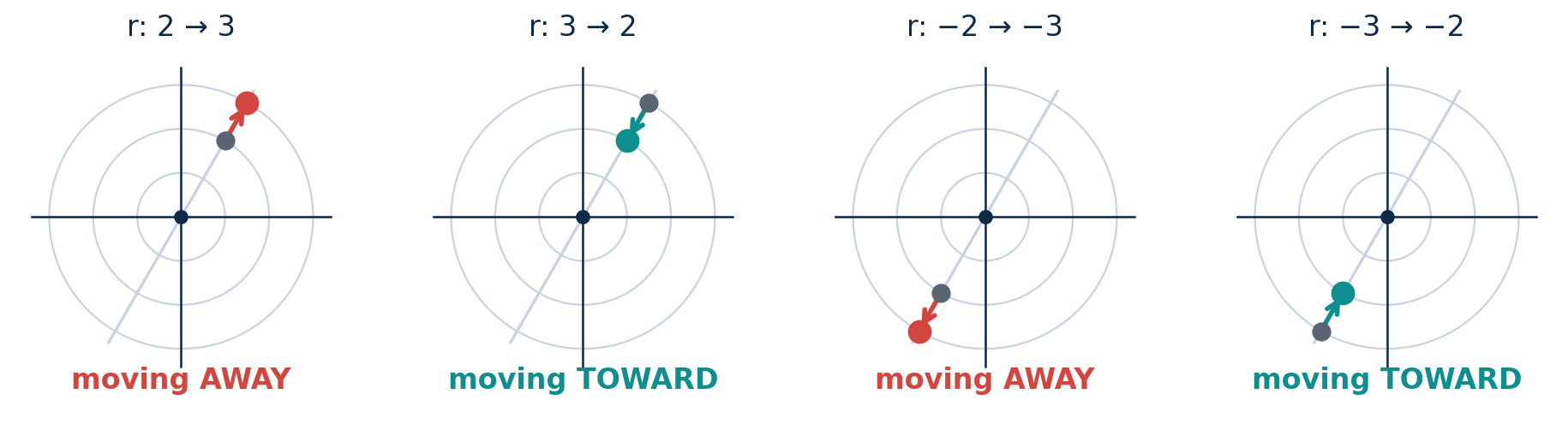
Four cases. Gray dot: before. Colored dot: after. Only the distance to the pole (the dark center dot) matters.
| r is increasing | r is decreasing | |
|---|---|---|
| r > 0 | |r| grows: moving AWAY | |r| shrinks: moving TOWARD |
| r < 0 | |r| shrinks: moving TOWARD | |r| grows: moving AWAY |
KEY RULE
Distance from the pole is increasing when and its change have the SAME sign.
Another way to see it: draw the DISTANCE as its own graph. Whenever that graph rises, the point is moving away from the pole; whenever it falls, the point is coming back. Compare the two pictures below — they carry exactly the same information.
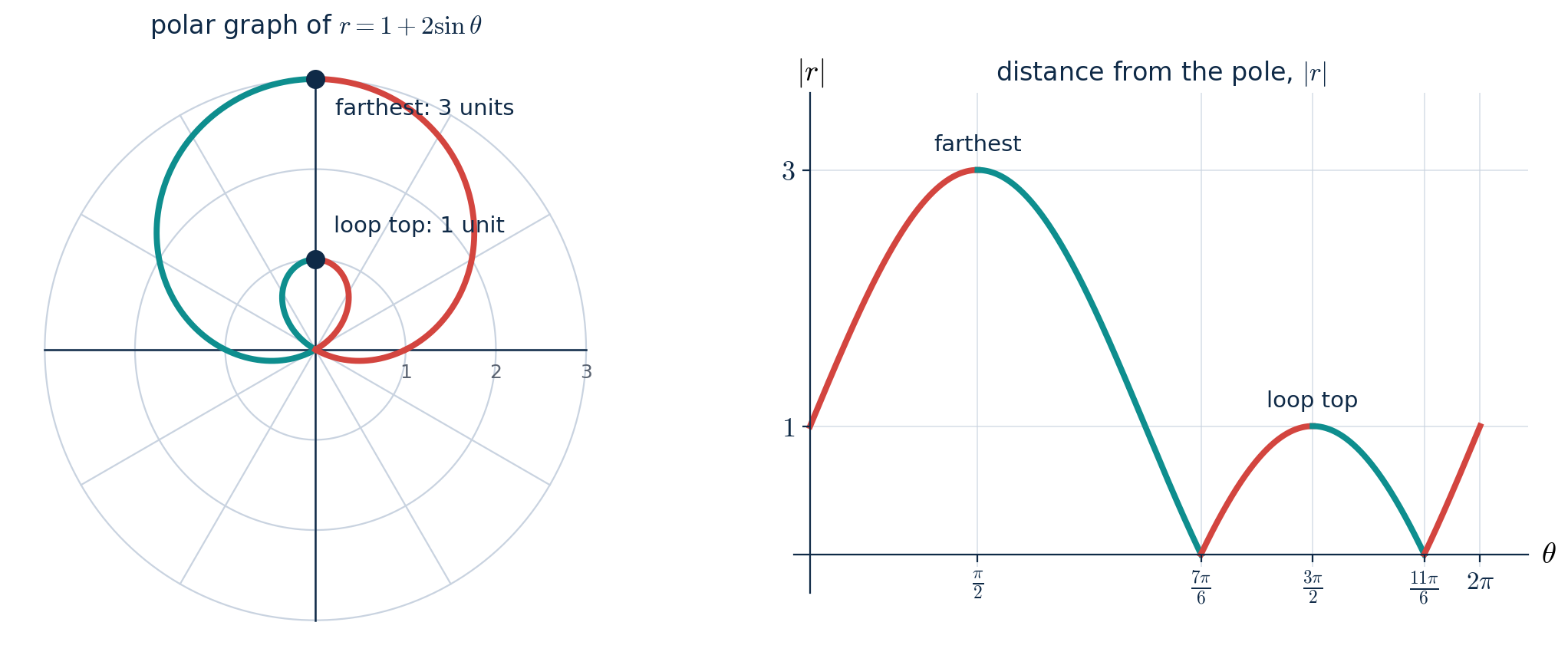
Left: the polar curve. Right: the distance from the pole. Red means the distance is growing; teal means it is shrinking.
Two details worth noticing in the right-hand graph. It touches 0 at and — those are the moments the curve passes through the pole. And it has TWO humps: a big one of height 3 (the outer curve) and a small one of height 1 (the inner loop). The inner loop never gets farther than 1 unit from the pole, even though it is drawn while is as low as −1.
CONCEPT
Three questions to ask every time
-
Is positive or negative on the interval?
-
Is increasing or decreasing on the interval?
-
Same signs (positive & increasing, or negative & decreasing) → moving AWAY. Different signs → moving TOWARD.
If changes sign inside the interval, split the interval at and answer each piece separately.
Worked example
Example 1. (Warm-up) For , when is the point moving toward the pole and when is it moving away, for ?
- 01
Question 1: the smallest is , so for every . The sign never changes — this makes the problem easy.
- 02
Question 2: decreases on and increases on , so does the same.
- 03
Question 3: on , positive and decreasing → moving TOWARD the pole. On , positive and increasing → moving AWAY.
- 04
Justification sentence (the way AP wants it): "On , and is decreasing, so the distance between the point and the pole is decreasing."
CONCEPT
Try it yourself
Decide: moving toward or away?
- goes from 5 to 2. 2. goes from −1 to −4. 3. goes from −6 to −3. 4. goes from 0.5 to 3.
Answers: 1. Toward (distance 5 → 2). 2. Away (distance 1 → 4). 3. Toward (distance 6 → 3). 4. Away (distance 0.5 → 3).
Worked example
Example 2. For (3.14B), find where the point moves away from the pole and where it moves toward it, for .
- 01
Key angles from the rectangular graph: maximum at , zeros at and , minimum at .
- 02
0 to : and increasing → away. to : and decreasing → toward, reaching the pole.
- 03
to : and decreasing (from 0 to −1) → AWAY. This is the first half of the inner loop.
- 04
to : and increasing (from −1 to 0) → toward. to : and increasing → away.
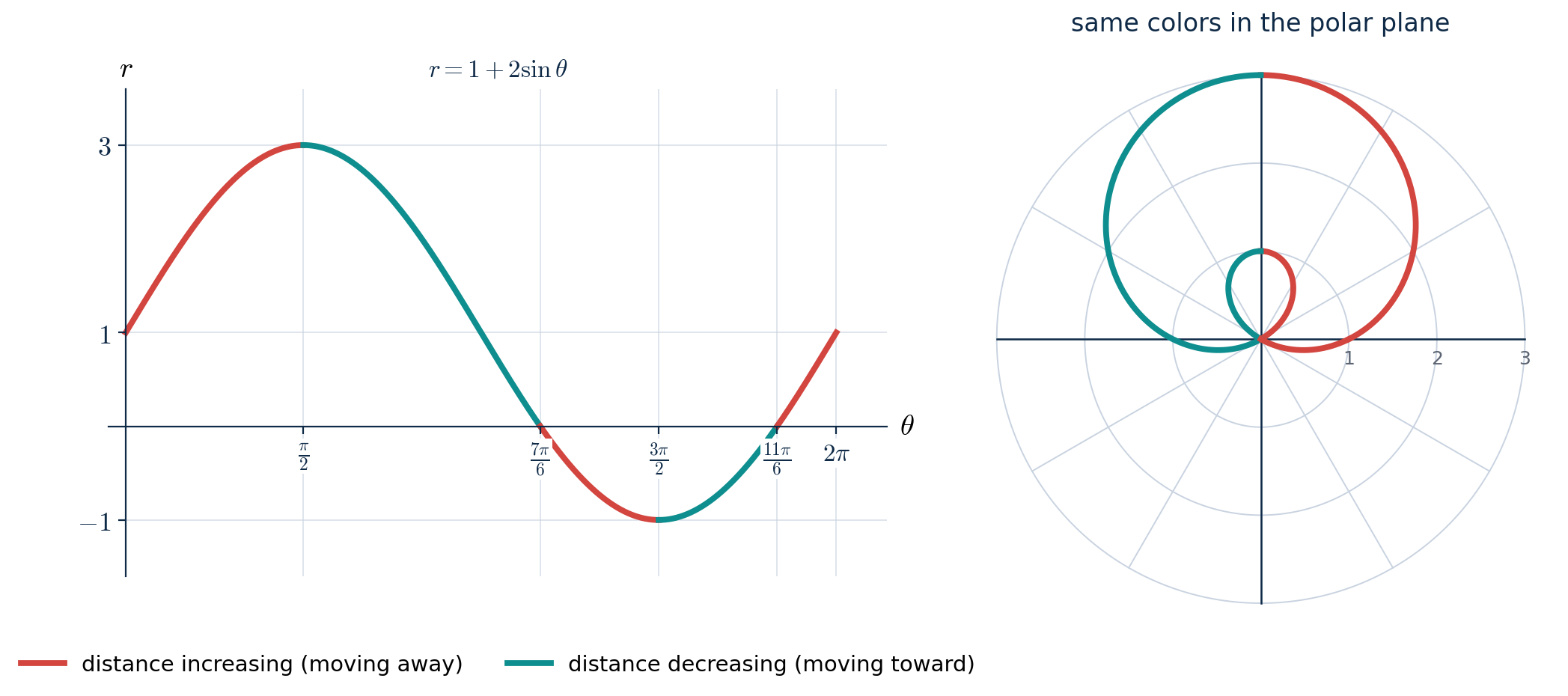
Red: moving away from the pole. Teal: moving toward it. The colors match in both graphs.
COMMON MISTAKE
"On , is decreasing, so the point is moving toward the pole."
That rule only works when . Here : it goes from 0 to −1, so goes from 0 to 1 and the point moves AWAY. In the polar graph this is the part of the inner loop leaving the pole. Always check the sign of first.
Worked example
Example 3. The table gives values of . Is the point moving toward or away from the pole on ? On ?
| θ | 0 | π/4 | π/2 | 3π/4 | π |
|---|---|---|---|---|---|
| r | 4 | 3.121 | 1 | −1.121 | −2 |
- 01
On , goes from 1 to −1.121: it CHANGES SIGN, so it passes through 0 somewhere in between (at ). Split the interval there.
- 02
Before the zero: and decreasing → moving toward the pole, all the way to the pole itself. After the zero: and still decreasing → moving away again. So the answer is "toward, then away".
- 03
On , goes from −1.121 to −2: negative AND decreasing → same signs → moving AWAY. The distance grows from 1.121 to 2.
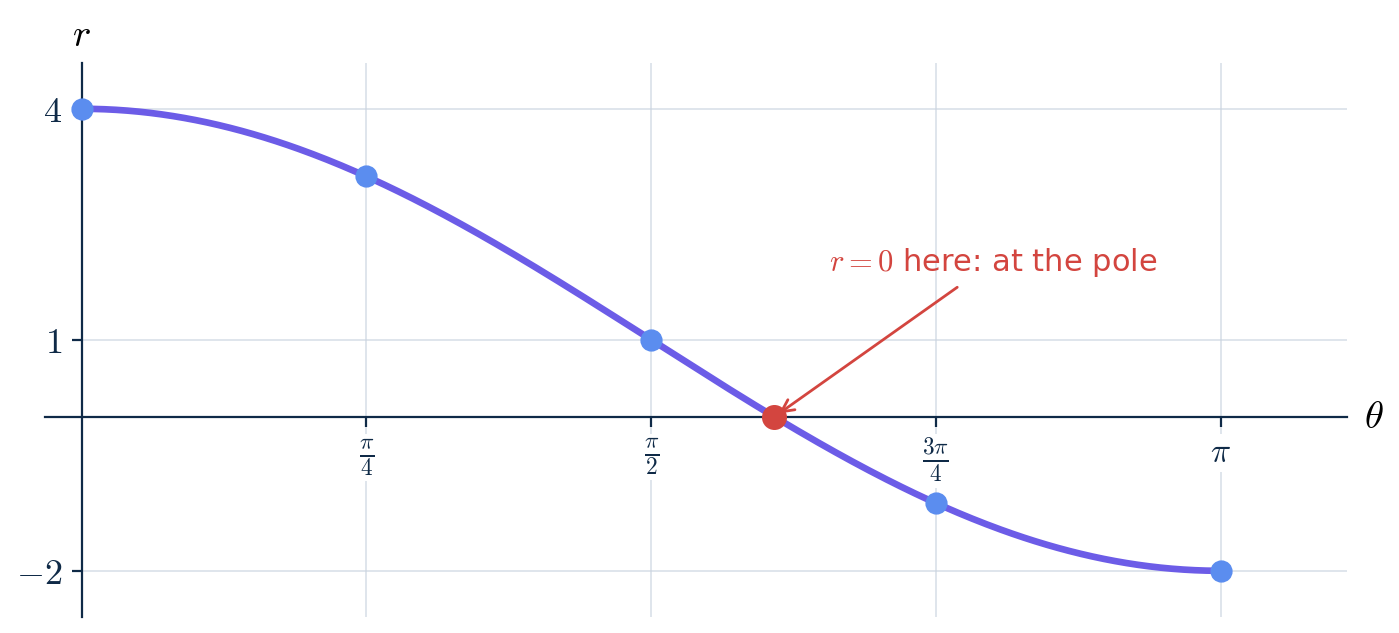
crosses 0 between and : the point touches the pole there.
Quick check
On an interval, is negative and decreasing. Is the point moving toward or away from the pole?
Average Rate of Change of r
Remember from Unit 1: the average rate of change of a function over an interval is the change in output divided by the change in input. For a polar function, the input is and the output is .
Its units are units of per radian. It tells you how fast, on average, changes as increases. Its sign tells you whether increased or decreased — but, as in Section 1, not by itself whether the point moved toward or away from the pole.
CONCEPT
Saying it in words
An average rate of change of −3.308 on means: "On average, decreases by about 3.308 units for each radian that increases, from to ."
Always include the direction (increases/decreases), the amount, the units (per radian), and the interval.
Worked example
Example 4. The table gives values of . (a) Where is increasing or decreasing on ? (b) Is the point moving toward or away from the pole on ? (c) Find the average rate of change of on . (d) Use an average rate of change to estimate .
| θ | 0 | π/6 | π/3 | π/2 | 2π/3 | 5π/6 | π |
|---|---|---|---|---|---|---|---|
| r | 2 | 0 | −1.464 | −2 | −1.464 | 0 | 2 |
- 01
(a) The values fall from 2 to −2 on and rise back to 2 on . So is decreasing on and increasing on .
- 02
(b) On , is negative AND decreasing (0 → −2). Same signs, so grows: the point moves away from the pole.
- 03
units per radian. (Exactly, .)
- 04
(d) Use the interval around from the table, : the rate is . Start at and move : .
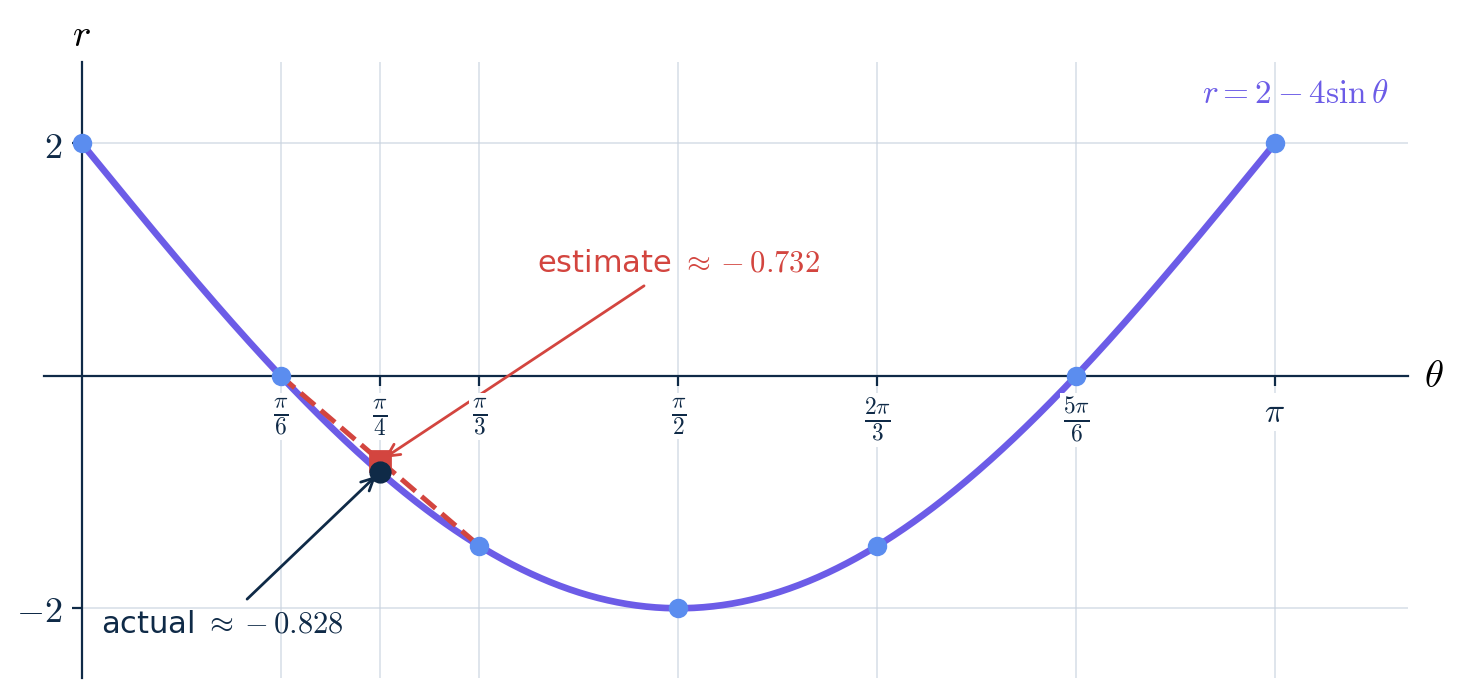
The secant line on gives the estimate. The actual value is .
Why is the estimate too high? On the graph of is concave up (its rate of change is increasing, Unit 1), so the curve bends BELOW the straight secant line. Any estimate read off that line is therefore too high. If the graph had been concave down, the curve would bend above the line and the estimate would be too low.
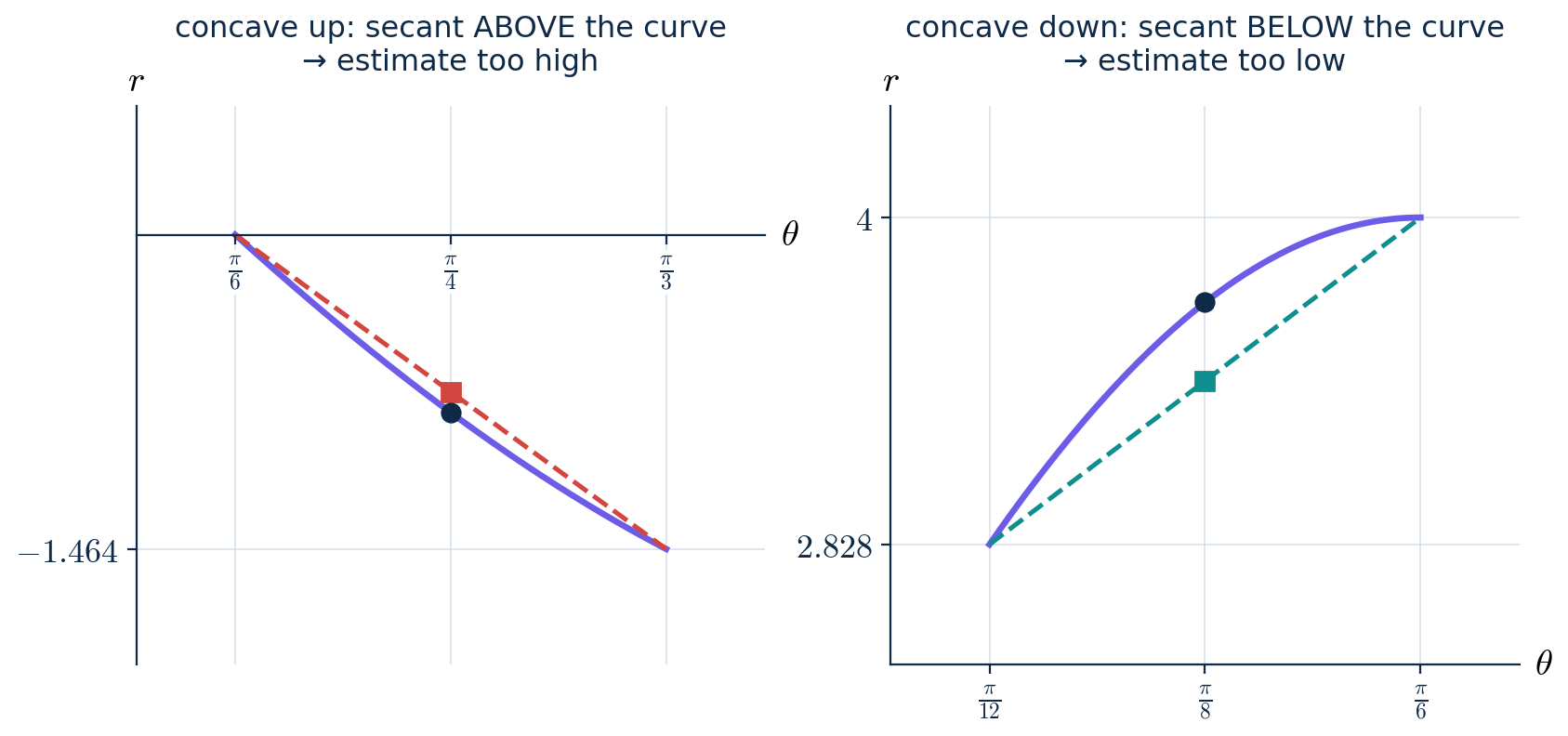
The straight dashed line is the secant; the square is the estimate and the dark dot is the true value.
Shape of r on the interval Secant line sits… Your estimate is… concave up above the curve too high (overestimate) concave down below the curve too low (underestimate) Two more habits that keep the error small: use the SHORTEST interval in the table that contains the value you want, and keep the interval centered on that value when you can.
Quick check
For with and , what is the average rate of change of on ?
Comparing Rates and Finding the Farthest Point
Worked example
Example 5. One petal of is drawn for . Compare how fast changes on and , and find the point of the petal farthest from the pole.
- 01
Values: , , .
- 02
Average rates: on , ; on , units per radian. is still increasing, but more slowly.
- 03
and increasing on , so the point moves away from the pole; and decreasing on , so it moves back. changes from increasing to decreasing at , a relative maximum of .
- 04
The farthest point is , the tip of the petal. By symmetry, the average rates on and are −4.48 and −10.80.
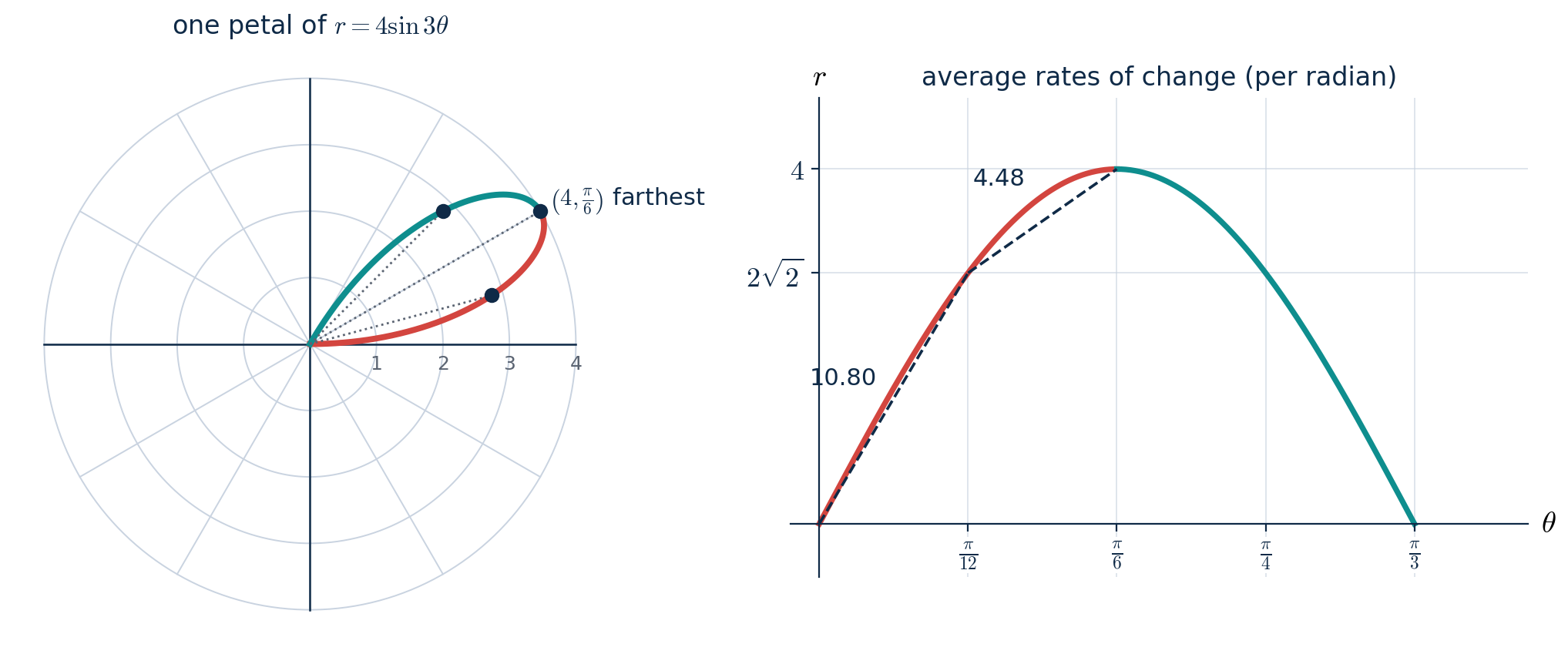
Left: the petal, red while moving away, teal while returning. Right: the secant slopes shrink as nears its maximum.
CONCEPT
Justification sentences AP asks for
Moving away: "On this interval and is decreasing, so is increasing and the point moves away from the pole."
Moving toward: "On this interval and is decreasing, so is decreasing and the point moves toward the pole."
Comparing two points: "Because , the point at θ₁ is farther from the pole."
Always name the sign of AND the direction is changing. One of them alone is not a complete reason.
CONCEPT
Extreme distances
Where changes from increasing to decreasing (or back), has a relative maximum (or minimum).
The point is farthest from the pole where is largest. That can happen at a maximum of OR at a minimum of , if the minimum is negative.
Near an extreme value of , the average rates of change get close to 0: levels off, just like a sinusoid at its peak (3.4).
COMMON MISTAKE
"The point of farthest from the pole on is where is largest, ."
The minimum at is just as far from the pole: . Distance uses , so a large negative counts. On the farthest distance, 2, is reached three times: at , , and .
Worked example
Example 6. For on , find the point farthest from the pole, and the farthest point ON THE INNER LOOP.
- 01
Distance is , so list the candidates: the largest and the most negative . Here runs from a maximum of 3 (at ) down to a minimum of −1 (at ).
- 02
Compare distances: and . The farthest point is at , distance 3, which is the point .
- 03
The inner loop is drawn while , where . On that interval the most negative value is at , so the loop reaches only 1 unit from the pole — at the point , directly above it.
- 04
Both answers are the two humps of the graph in Section 1 ✓.
CONCEPT
Try it yourself
For :
-
What is the largest value of , and at which ?
-
What is the most negative value of , and at which ?
-
Which of those two points is farther from the pole?
Answers: 1. at . 2. at . 3. The point, because .
Common slips
"On , is decreasing, so the point is moving toward the pole."
That rule only works when . Here : it goes from 0 to −1, so goes from 0 to 1 and the point moves away. In the polar graph this is the part of the inner loop leaving the pole. Always check the sign of first.
"The point of farthest from the pole on is where is largest, ."
The minimum at is just as far from the pole: . Distance uses , so a large negative counts. On the farthest distance, 2, is reached three times: at , , and .
Lock it in
Try the flashcards
6 cards · Polar rates of change
Recap card
5 lines to re-read the night before.
- 01
The distance from the pole is . Ask: is positive or negative? increasing or decreasing? Same signs → away; different signs → toward. Split the interval where .
- 02
Average rate of change of on , in units of per radian.
- 03
Estimate an unknown value using the average rate of change of the smallest interval available; concavity tells you if the estimate is too high (concave up) or too low (concave down).
- 04
Relative extrema of occur where switches between increasing and decreasing; the farthest point uses the largest .
- 05
Unit 3 complete: from periodic phenomena and the unit circle, through sinusoids, inverses, equations, and identities, to polar coordinates and polar functions.