
Topic 2.7A
Composition of Functions
Nova earns $0.02 per subscriber per day from ads. Its owner wants to know: how much does the channel earn per day, 8 weeks after launch? No single function answers that. You need three: one to turn weeks into months, one to turn months into subscribers, and one to turn subscribers into dollars. Feeding the output of one function into the next is called composition.
8 MIN READ7 IDEAS33 PROBLEMS10 flashcards
Remember from 2.4: we rewrote with time in weeks as . That was already a composition: first convert to months, then apply .
Output In, Output Out
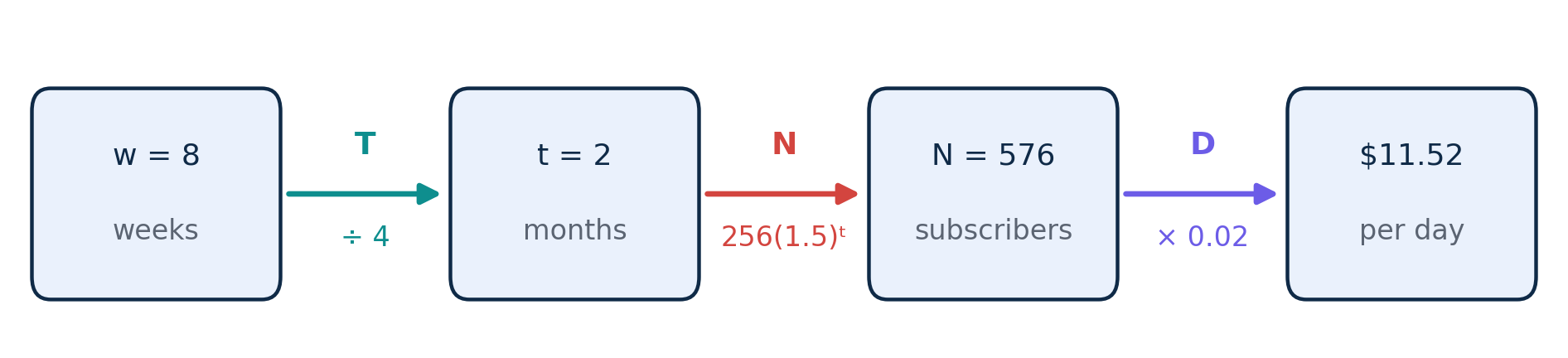
Each function's output becomes the next function's input.
With (weeks → months), (months → subscribers) and (subscribers → dollars per day):
- 01
. Eight weeks is 2 months.
- 02
subscribers.
- 03
= $11.52 per day. In one expression: = 11.52.
CONCEPT
Composition
The composition means: put into , then put the result into . It is also written ( ∘ ), read “f of of x”.
Work from the INSIDE out: the function written closest to acts first, even though it is written second.
For to exist, must be in the domain of , and must be in the domain of .
The small circle ∘ is read “composed with”, so ∘ is “f composed with g”. It is NOT a multiplication dot. ( ∘ g)(x) and mean exactly the same thing; the second form shows the order more clearly, so we'll mostly use it.
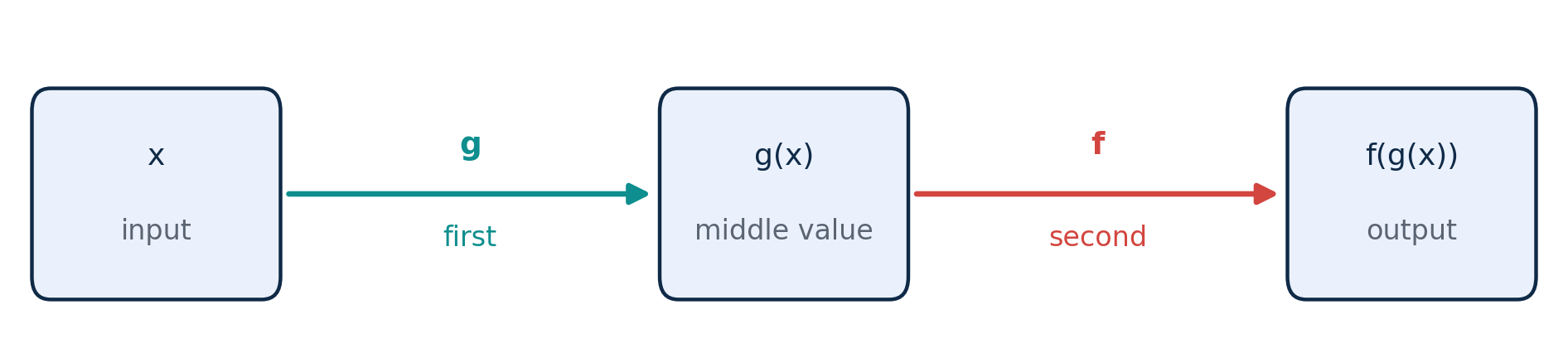
In , is applied first and second.
From Formulas
Worked example
Let and . Find , , and .
- 01
: inside first, . Then .
- 02
: inside first, . Then .
- 03
: , then . A function can be composed with itself.
but . Swapping the order changed the answer completely.
KEY RULE
Order matters: in general .
COMMON MISTAKE
“ means times .”
Composition is not multiplication. , but . In , the value goes INTO .
“: do first, because is written first.”
Read from the inside out. The function next to the input acts first. Doing first gives , a different answer.
Quick check
Let and . Find and .
From a Table
| x | −1 | 0 | 1 | 2 | 3 | 4 |
|---|---|---|---|---|---|---|
| f(x) | 3 | 5 | 2 | 0 | 4 | 1 |
| g(x) | 2 | 4 | 3 | −1 | 1 | 0 |
Worked example
Use the table to find , , , and .
- 01
: , then . : , then .
- 02
: , then .
- 03
: , then we need . The table has no , so can't be found from this information.
COMMON MISTAKE
“: , and I'll just use the last g-value in the table.”
You may only use values that are actually given. If the middle value isn't an input in the table, the composition can't be evaluated from the table. Say so; don't guess.
Quick check
A table gives , , , and . What is ?
From a Graph
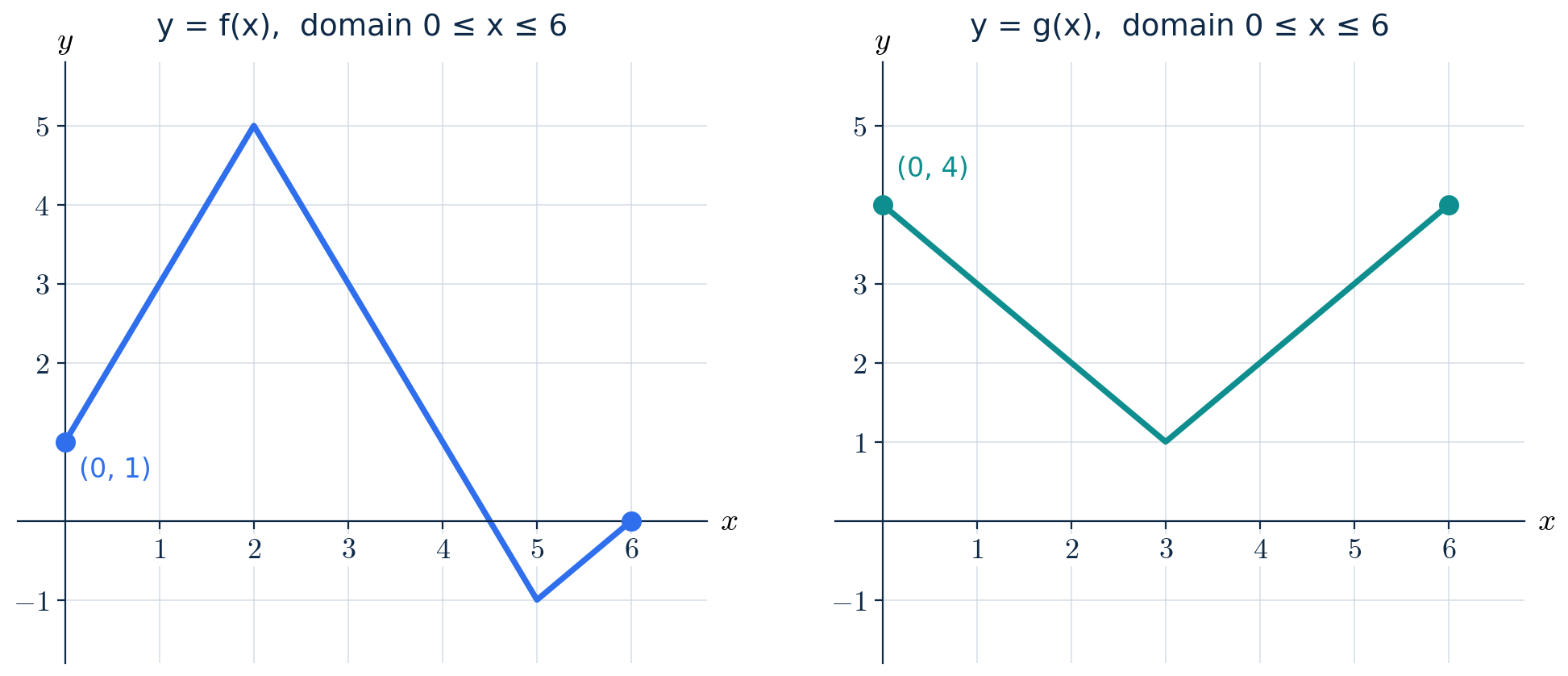
Two piecewise-linear functions, each defined only for .
Worked example
Use the graphs to find , , , and .
- 01
: on the graph of , . On the graph of , . So .
- 02
: , then . And : , then .
- 03
: , but is only defined for . Since −1 is not in the domain of , is undefined.
REAL-LIFE EXAMPLE
Nova's Daily Earnings
gives Nova's daily ad earnings weeks after launch. At weeks: months, subscribers, = $38.88 per day.
Notice that each function answers one question, with its own units, and the composition chains the answers together.
Worked example
Try it yourself. (a) With and , find and . (b) From the table, find and . (c) From the graphs, find .
Answers: (a) and ; and . (b) and ; and . (c) and .
Mixing Formulas, Tables, and Graphs
The inside and outside functions don't have to come in the same form. Just evaluate each one in whatever form it is given.
Worked example
Example. , and is given by the table in Section 3. Find , , and .
- 01
: from the table, . Then use the formula: .
- 02
: formula first, . Then the table: .
- 03
: , and the table gives .
A function can also be composed with itself on a graph. Using the graphs in Section 4: , and .
And with Nova's chain of formulas: 4 weeks after launch, month, subscribers, = $7.68 per day.
COMMON MISTAKE
“To find on the graph, I look for where equals 1.”
That's running backwards. starts at the INPUT on the graph of : go to , read the height , then use 3 as the input of .
Practice
Worked example
P1. and . Find and .
Answer: , . , . Different, because order matters.
Worked example
P2. Use the table in Section 3 to find .
Answer: , then .
Worked example
P3. Find Nova's daily earnings 12 weeks after launch, .
Answer: months, subscribers, = $17.28 per day.
Worked example
P4. With and the table in Section 3, find and .
Answer: , so . , so .
Common slips
“ means times .”
Composition is not multiplication. , but . In , the value Goes into .
“: do first, because is written first.”
Read from the inside out. The function next to the input acts first. Doing first gives , a different answer.
“: , and I'll just use the last g-value in the table.”
You may only use values that are actually given. If the middle value isn't an input in the table, the composition can't be evaluated from the table. Say so; don't guess.
“To find on the graph, I look for where equals 1.”
That's running backwards. starts at the input on the graph of : go to , read the height , then use 3 as the input of .
Lock it in
Try the flashcards
10 cards · Composition and inverses
Recap card
5 lines to re-read the night before.
- 01
= ( ∘ ): apply first, then . Work from the inside out.
- 02
Order matters: and are usually different. Composition is not multiplication.
- 03
From a table or a graph, find the inside value first, then use it as the input of the outside function.
- 04
If the middle value is not in the domain of the outside function (or not given), the composition is undefined or can't be found.
- 05
The pieces can come from any mix of formulas, tables, and graphs. Next, in 2.7B: composing formulas to get a new formula, the domain of a composition, and breaking a function apart into simpler pieces.