
Topic 3.9
Inverse Trigonometric Functions
So far we have gone forward: give sine an angle and it returns a number. Many questions go the other way. In 3.7 we asked when the bicycle pedal reaches 40 cm, and we needed a calculator's intersect feature to answer. This note builds functions that run sine, cosine, and tangent backward: give them a number, and they return an angle.
9 MIN READ6 IDEAS34 PROBLEMS10 flashcards
Read this first
30 sec
- 01
An inverse trig function returns one angle: the one in its restricted range.
Why the Domain Must Be Restricted
Remember from Unit 2: a function has an inverse function only if it is one-to-one, meaning no output comes from two different inputs. Sine fails this badly. The horizontal line crosses the sine graph infinitely many times.
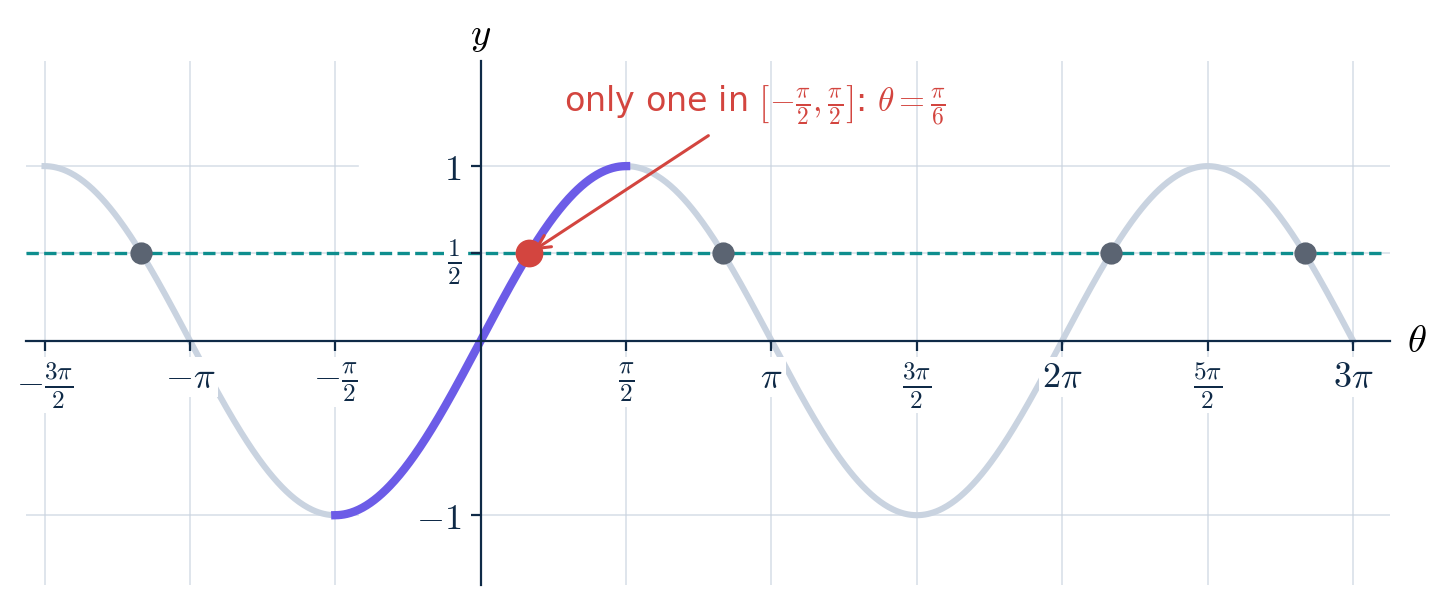
at , , , … — but only once on .
If we asked "which angle has sine ?" there would be infinitely many answers, and a function must give exactly one. The fix is to keep only one piece of the graph: a piece that is one-to-one and still produces every possible output from −1 to 1 exactly once.
| Function | Restricted domain | Why this piece |
|---|---|---|
| sin θ | −π/2 ≤ θ ≤ π/2 | increasing from −1 to 1, each output once |
| cos θ | 0 ≤ θ ≤ π | decreasing from 1 to −1, each output once |
| tan θ | −π/2 < θ < π/2 | one full branch, all real outputs once |
Cosine cannot use like sine does: and are both , so that piece is not one-to-one. Its piece runs from its maximum to its minimum instead. All three pieces include the Quadrant I angles 0 to , which keeps the answers as simple as possible.
The Inverse Functions and Their Graphs
CONCEPT
Definitions
is the angle in whose sine is .
is the angle in whose cosine is .
is the angle in whose tangent is .
The input of an inverse trig function is a value (a ratio); the output is an angle.
These functions are also written , , and . The two notations mean exactly the same thing.
COMMON MISTAKE
" means ."
Here the −1 means inverse function, like , not a reciprocal. They give completely different results: is an angle, while is a number. (The reciprocal of sine has its own name, cosecant, coming in 3.11.)
Remember from Unit 2 that the graph of an inverse is the reflection of the original graph over the line : every point becomes . Reflecting the restricted sine piece gives the graph of .
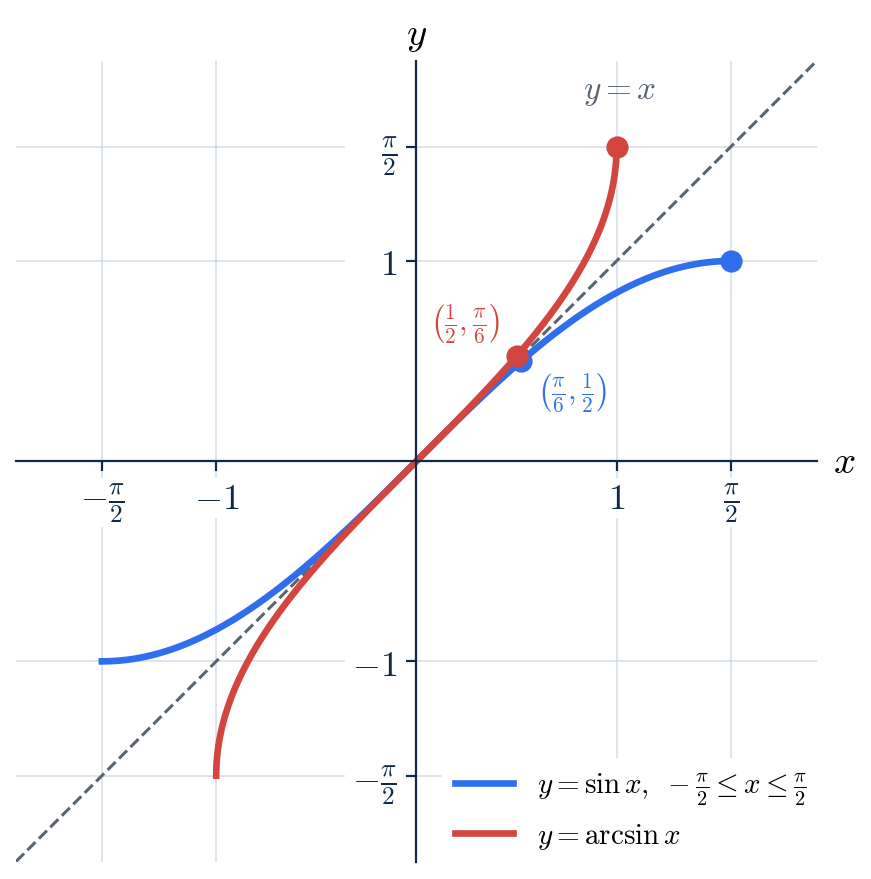
(, ) on the sine piece becomes (, ) on .
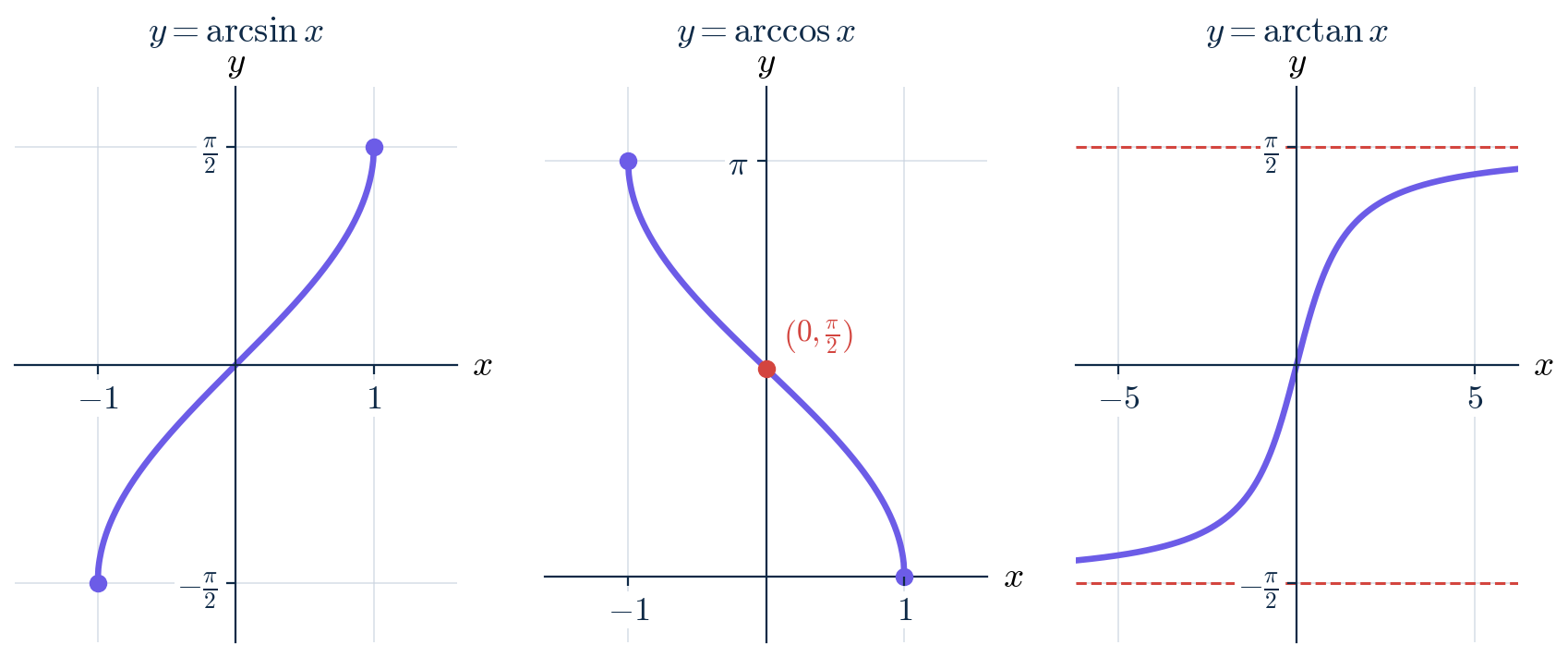
The domain and range of each inverse are the range and restricted domain of the original, swapped.
| Function | Domain (inputs) | Range (output angles) |
|---|---|---|
| arcsin x | −1 ≤ x ≤ 1 | −π/2 ≤ y ≤ π/2 |
| arccos x | −1 ≤ x ≤ 1 | 0 ≤ y ≤ π |
| arctan x | all real numbers | −π/2 < y < π/2 |
Two features to notice. and are increasing, but is decreasing, just like the cosine piece it came from. And has horizontal asymptotes : they are the vertical asymptotes of tangent (3.8), reflected over .
Evaluating Inverse Trig Functions
To evaluate an inverse trig function, ask: "Which angle in the allowed range gives this value?" On the unit circle, the allowed ranges are arcs:
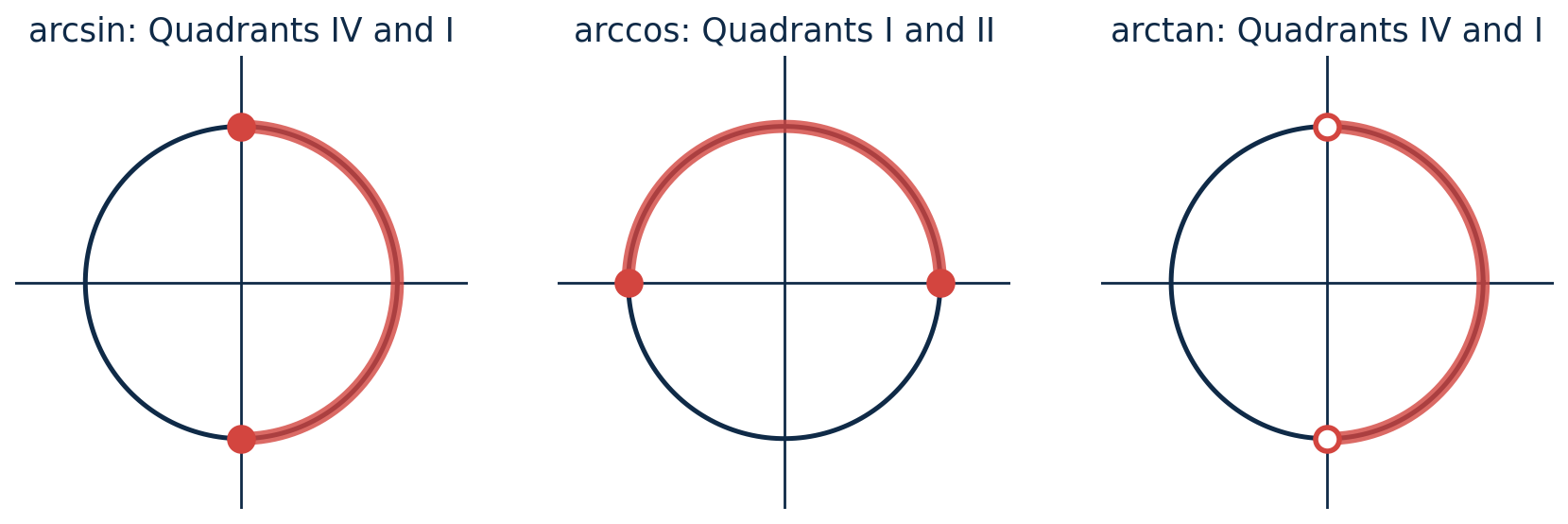
and answer on the right half of the circle; answers on the top half.
Worked example
Example 1. Evaluate without a calculator: , , , and .
- 01
: sine is negative, and answers on the right half, so the angle is in Quadrant IV. The reference angle for is , so the answer is .
- 02
: cosine is negative, and answers on the top half, so the angle is in Quadrant II. The reference angle for is , so the answer is .
- 03
: positive, so Quadrant I. , so the answer is .
- 04
: the point on the top half with is , so the answer is .
COMMON MISTAKE
"" or "."
Neither answer is correct. does have sine , but so do , , and infinitely many others; must return the one in , which is . And is not even a correct angle for : . The answer must lie in .
Always finish by checking both conditions: the value is right AND the angle is in the range.
Quick check
What is ?
Inverse and Original Together
Because undoes sine, it is tempting to think that is always . It is only when is already in the restricted domain.
CONCEPT
Composition rules
for every in . The same holds for , and holds for every real .
only when . Outside that interval, the answer is the angle in the range with the same sine.
Worked example
Example 2. Evaluate and .
- 01
Work from the inside out. , so , not , because is outside .
- 02
, so , not , because is outside .
Worked example
Example 3. Find the exact value of .
- 01
Name the angle: let . Then , and is in . Since , is in Quadrant I.
- 02
Draw a right triangle with angle , adjacent side 5, and hypotenuse 13. By the Pythagorean theorem, the opposite side is .
- 03
= opposite ÷ hypotenuse = . The sign is positive, which is correct: every angle in has a nonnegative sine.
Quick check
Is equal to ?
Inverting a Transformed Function
Worked example
Example 4. for . Find , and state its domain and range.
- 01
On , cosine is one-to-one, so is too, and exists. Write and solve for .
- 02
Add 2 and divide by 3: . Because is in , this is exactly the range, so .
- 03
Domain of = range of . goes from down to , so the domain is . Range of = domain of : .
Check with one point: , and ✓.
REAL-LIFE EXAMPLE
Back to the bicycle
Remember from 3.7: , and we used a calculator's intersect to find when the pedal first reaches 40 cm. Now we can solve it directly.
Set : , so . Take of both sides and solve for :
This matches the 0.45 s from 3.7. Notice that gave only ONE answer, the first time on the way up, because its output is limited to . The pedal reaches 40 cm again on the way down and in every rotation after that. Finding all of those solutions is the job of 3.10.
KEY RULE
An inverse trig function returns ONE angle: the one in its restricted range.
Common slips
" means ."
Here the −1 means inverse function, like , not a reciprocal. They give completely different results: is an angle, while is a number. (The reciprocal of sine has its own name, cosecant, coming in 3.11.)
"" or "."
Neither answer is correct. does have sine , but so do , , and infinitely many others; must return the one in , which is . And is not even a correct angle for : . The answer must lie in .
Always finish by checking both conditions: the value is right and the angle is in the range.
Lock it in
Try the flashcards
10 cards · Inverse trig and equations
Recap card
6 lines to re-read the night before.
- 01
Sine, cosine, and tangent are not one-to-one, so their domains are restricted before inverting: for sine, for cosine, for tangent.
- 02
, , and take a value and return an angle. means , not .
- 03
Their graphs are the restricted pieces reflected over ; domain and range swap.
- 04
To evaluate, find the angle with the right value and in the right range: right half of the unit circle for and , top half for .
- 05
always (for in ), but only when is in .
- 06
Coming up in 3.10: using inverse trig functions to find every solution of a trig equation.